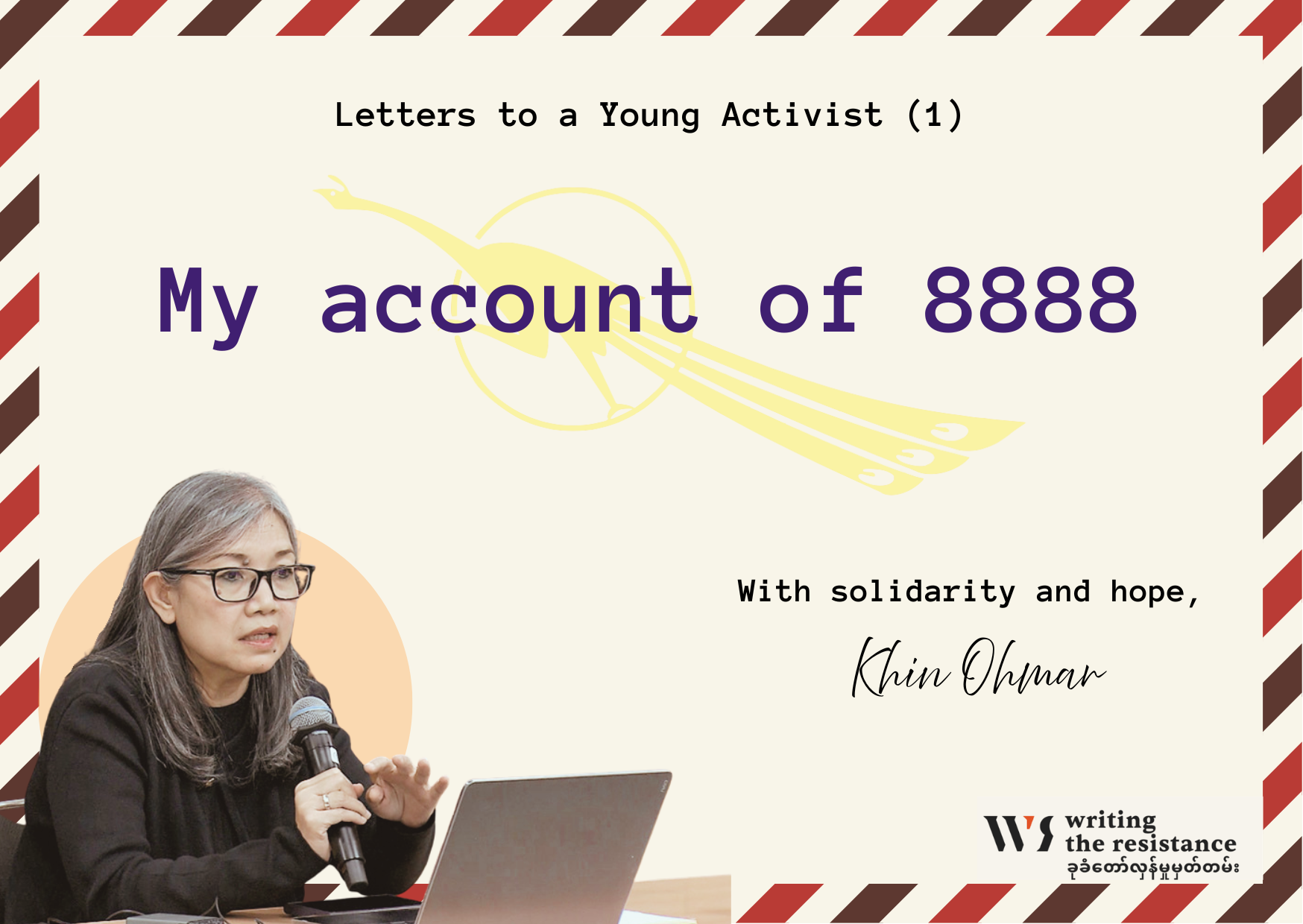
Letters to a young activist: My account of 8888
Guest contributor Khin Ohmar Dear young activist, Every activist my age has our ‘8888’ story. It was a time of intense energy, as we deeply believed the country could rise up and break free. The All Burma Students Democratic Movement,or Ma-Ka-Da, was among the initiators of the 8888 Uprising, and my involvement in this organization has determined the path of my life’s activism. My movement activism began around March 16, known as Red Bridge Day, as our student protests and the subsequent crackdowns began early in the year of 1988. We knew Ne Win dictatorship had to go and for that we had to mobilize the public to join us. We worked hard to connect with other student groups, workers, monks, and anyone in our communities who would stand with us. Then we called for a nationwide general strike on August 8. You have to remember there were no mobile phones, social media, or the internet. So we organized person to person, often in crowded teashops, monasteries and homes. On August 6, we were able to send our message about the August 8 general strike through BBC journalist Christopher Gunness; via the BBC, we reached the world and also reached back to Burmese people across the country. In those days, that was the fastest and broadest reach. On August 7, we held our final preparation meeting. I went home full of anticipation and focus, but my family had other plans for me. Concerned for my safety, a male friend had warned my family of my involvement, and out of fear they locked me inside my brother’s family apartment in downtown Rangoon. Throughout the night I plotted escapes and on the morning of August 8 I woke my brother’s family crying and pleading to be let out. They refused, and I stood by the balcony, angry and helpless. From the apartment, I could see the road towards City Hall and the Sule Pagoda, our main gathering points, but I felt a world away. The morning was deathly quiet. No one was on the street. People began to appear shortly after 9 am – first individuals, then in small clusters, and then in waves. Peoples’ expressions were a mix of hope, courage, agony, and the stressful knowledge of the immense risk they were taking. This was the first time in 26 years of Ne Win’s regime that people had dared to gather openly and voice their dissent and opposition to his one-party dictatorship. Everyone knew the danger, and everyone was firm in their determination. I felt guilty as I stood by the balcony watching and listening to the crowds chanting. My friends were out there, and I wasn’t beside them. I felt ashamed to be in a safe place while they were enacting the plans that I had been part of developing, mobilizing and preparing. The whole day I argued, schemed, and tried to find a way out, but I couldn’t. By late afternoon, my anxiety deepened. Would the crowd hold? Would they be dispersed?
This article requires PRO
This article is outside the free access window or is a special report. PRO unlocks it and the full archive.
Related articles
- Mae Tao Clinic highlights Thai-Myanmar border crisis after winning Okinawa Peace Prize
In an exclusive interview with DVB following the announcement of the 13th Okinawa Peace Prize, Dr. Cynthia Maung, founder and director of the Mae Tao Clinic, reflected on the clinic’s recognition as the first non-Japanes
- MAA calls for a one-day work stoppage to protest the visit of the interim president Min Aung Hlaing to Malaysia
Ayeyarwaddy Times October 5 Myanmar Affairs Alliance (MAA) has urged Myanmar nationals residing in Malaysia to participate in a "work stoppage strike" by refraining from going to work entirely on the upcoming October 7th
- Skeletons of 12 Civilians Discovered in Mass Graves in Myanmar’s Myaing Township
The human remains of 12 civilians abducted by Myanmar military forces in June 2023 have been discovered in two mass graves near Wetpoke Village in Magway Region’s Myaing Township, according to local resistance fighters a
- Myanmar workers in Malaysia call for strike ahead of Min Aung Hlaing visit to Kuala Lumpur
The Myanmar Affairs Alliance, an advocacy coalition representing Myanmar migrant workers across Malaysia, issued an urgent appeal on Monday, calling for a nationwide “Work Stoppage Strike” on Wednesday. The strike is org