General articles are free for 24 hours after publish.
Central Vietnam Grapples with Severe Flood Damage: Focus on Infrastructure Restoration and Resident Support
Central Vietnam's Thanh Hoa province has experienced widespread flooding due to heavy rainfall in mid-September, inundating numerous homes and agricultural land. Authorities are now prioritizing infrastructure restoration and support for affected residents.
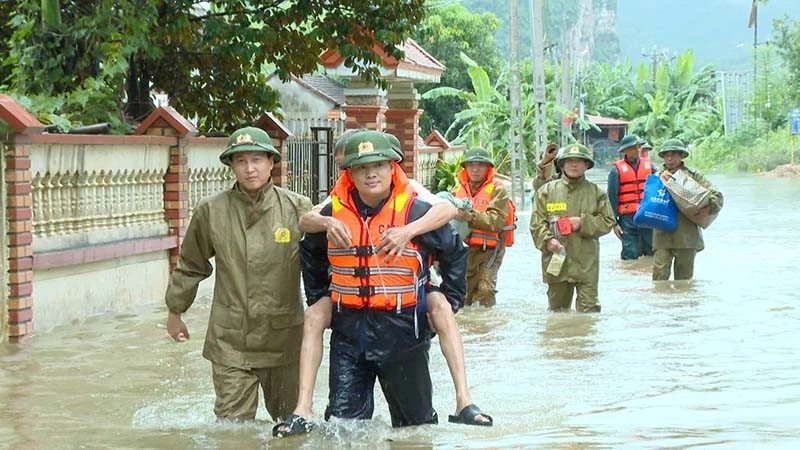
Thanh Hoa province in central Vietnam has been severely affected by record rainfall observed from September 13 to 17. During this period, the province recorded rainfall of 300-500mm, leading to floods that significantly exceeded alert levels on major rivers such as the Ma, Yen, Len, Buoi, and Cau Chay. The impact of the flooding has been extensive, with 8,419 households' homes, 6,700 hectares of agricultural land, 1,134 hectares of aquaculture farms, and 32 hectares of salt fields submerged. Furthermore, access roads to residential areas in 18 communes and wards were cut off, temporarily isolating 2,679 households, comprising 10,061 people. However, authorities promptly initiated evacuation efforts, relocating 1,016 households (3,892 people) to safe locations and ensuring the supply of food and essential goods. The isolated residents maintained communication and had sufficient reserves, thus avoiding major distress. Infrastructure damage is also significant. Four locations on national highways experienced landslides, causing road closures. Particularly on National Highways 16 and 15C, repair work is underway, but some sections require long-term restoration due to road surface subsidence and collapse. Additionally, numerous other national highways, including 45, 47B, 47C, and 217B, along with several provincial roads, are blocked by flooding. Road management departments are implementing safety measures such as installing warning signs, directing traffic, and clearing debris. In terms of water infrastructure, 60 pumping stations, 265 pumps, and 20 sluice gates are operational to enhance drainage capacity. The Thanh Hoa provincial authorities are mobilizing all resources to ensure the safety of residents, support their recovery, and expedite infrastructure restoration. Under Vietnam's one-party system, rapid information dissemination and mobilization capabilities are evident during disasters. However, delays in infrastructure development can exacerbate damage. The current flood damage highlights the urgent need for climate change adaptation measures and the construction of more resilient infrastructure. Source: Nhan Dan
Original source
Nhan Dan