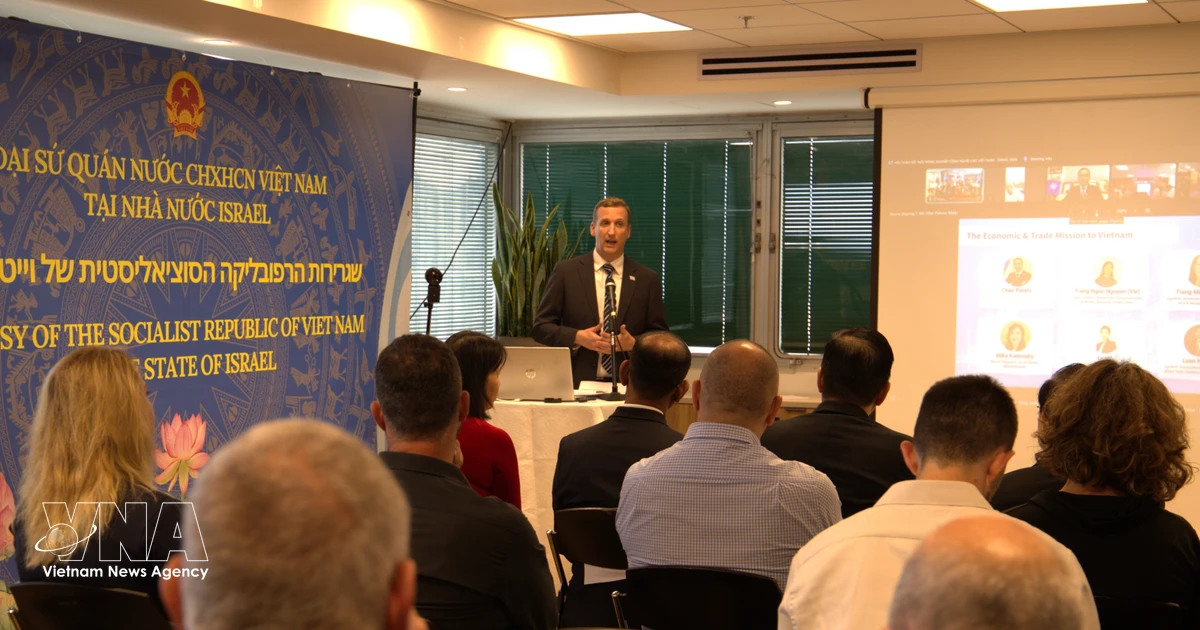
Vietnam, Israel Strengthen High-Tech Agriculture Connectivity
Vietnam and Israel are expanding cooperation in areas like AI, cybersecurity, agricultural technology, and healthcare, with a particular focus on strengthening ties in high-tech agriculture. Bilateral trade is on an upward trend, and a free trade agreement is paving the way for further collaboration.
Israel views Vietnam as a highly promising market of more than 100 million people and an increasingly important global manufacturing hub. Both countries identified artificial intelligence (AI), cybersecurity, agricultural technology, health care and innovation as key areas for future collaboration. During January-May, Vietnam-Israel trade neared 1.6 billion USD. Vietnam's exports to Israel jumped 30.6% year-on-year to 462 million USD. If the current growth momentum holds, full-year trade is on track to reach around 3.9 billion USD, with Vietnam's exports set to surpass 1 billion USD for the first time. As Israel’s first free trade agreement with a Southeast Asian country, Vietnam–Israel Free Trade Agreement has unlocked new avenues for cooperation and offers considerable potential for further growth in two-way trade. National flag carrier Vietnam Airlines will increase frequencies on several routes to Japan, the Republic of Korea (RoK) and Taiwan (China) to meet rising demand for tourism, business and family visits between Vietnam and Northeast Asia. The maximum retail price of E5RON92 was set at 19,191 VND (0.73 USD) per litre, down 539 VND from the previous ceiling and 812 VND lower than E10RON95-III. The latter was capped at 20,003 VND per litre, a decrease of 412 VND. The recognition marks a significant milestone for Vietnam’s maritime industry as it advances the development of smart, green ports and sustainable logistics. Singapore-based United Overseas Bank (UOB) has sharply raised its forecast for Vietnam's 2026 GDP growth to 8.5%, more than reversing the previous downgrade to 7%, citing stronger-than-expected first-half economic performance driven by manufacturing, investment and foreign direct investment (FDI). PM Le Minh Hung said the fulfilment of the capital disbursement target should become a key criterion in evaluating the performance of ministries, sectors and local authorities. Da Nang is pursuing a next-generation IFC focused on innovation, fintech and sustainable finance, concentrating on high-value segments rather than a traditional fully integrated financial-centre model. Instead of concentrating mainly on attracting foreign capital, Resolution No. 10-NQ/TW emphasises building a foreign-invested sector that is closely integrated with the domestic sector to create new growth drivers for the country. Vietnam is projected to remain the fastest-growing economy in Southeast Asia, with the Asian Development Bank (ADB) maintaining its growth forecasts of 7.2% for 2026 and 7.0% for 2027 in its Asian Development Outlook (ADO) July 2026 released on July 8. Vietnam currently has about 17,400 OCOP products rated three stars or above. The figure is set to increase to around 25,000 by 2030, with greater emphasis on improving quality, adding value and enhancing competitiveness rather than simply expanding the number of products. Vietnam currently has 130,571 rental housing units under construction. A review of national rental housing demand will be completed before the construction ministry assigns specific targets to provincial governments. India remained the largest supplier, with the value reaching 63.2 million USD, representing around 52% of Vietnam's total diamond imports. Speaking at the opening ceremony at Staybridge Suites London-Vauxhall in Lambeth, Vietnamese Ambassador to the UK Do Minh Hung said bilateral ties have developed strongly in recent years, culminating in the establishment of a Comprehensive Strategic Partnership during Party General Secretary To Lam’s official visit to the UK in October last year. The meetings with AFD and EDF were seen as an important step in deepening ties between Quang Ngai and French partners as the province enters a new phase of development. Through broader international cooperation, Quang Ngai aims to attract more capital, technology, management expertise and training resources to advance green industry, clean energy and sustainable infrastructure, strengthen competitiveness and move toward becoming a major industrial, energy and logistics hub in central Vietnam and the country. Deputy Minister of Agriculture and Environment Dang Ngoc Diep said the sector achieved encouraging results thanks to close monitoring of market developments, proactive production management and timely measures to remove institutional and policy bottlenecks. According to the National Statistics Office, cultural industries contributed about 3.54% of Ho Chi Minh City's gross regional domestic product (GRDP) in 2020. The figure rose to around 5.7% in 2025 and is expected to continue growing. The State Bank of Vietnam set the daily reference exchange rate at 25,211 VND/USD on July 9, up 5 VND from the previous day. By 2030, Vietnam aims for its airport network to handle about 249 million passengers and 4.4 million tonnes of cargo annually, while ensuring more than 95% of the population lives within 100km of an airport. Experts say Resolution No. 10-NQ/TW could become a strategic lever for Vietnam’s sustainable development, but pose major challenges related to infrastructure capacity and environmental standards. At the conference, 11 pairs of businesses from Guangxi and Quang Ninh signed cooperation agreements in areas including smart border gate development, logistics infrastructure, trade in agricultural, forestry and fishery products, cross-border cultural tourism, and testing and inspection services, to enhance connectivity between Guangxi's industrial and supply chains and those of Vietnam. The positive FDI performance in the first half of 2026 provides a favourable foundation for Vietnam to realise Resolution No. 10-NQ/TW’s goals. However, to maintain advantages and improve the quality of capital inflows, Vietnam needs not only to improve the investment environment but also develop infrastructure, strengthen domestic enterprises, expand capital markets and promote substantive links between the FDI and domestic sectors.
多角的分析
ベトナムとイスラエルの貿易額が急増している背景には、両国間のFTA発効による関税障壁の低下と、ベトナムの製造業ハブとしての魅力向上があります。特に、イスラエルが持つ先端農業技術は、ベトナムの食料生産性向上と輸出競争力強化に直結し、経済成長の新たな牽引役となる可能性があります。AIやサイバーセキュリティ分野での協力は、ベトナムの産業高度化とデジタル経済への移行を加速させるでしょう。これは、ベトナムが単なる低コスト製造拠点から、技術集約型経済へと脱皮しようとする戦略と合致しています。
ベトナムとイスラエルのハイテク分野、特に農業技術における連携強化は、投資家にとって新たな機会をもたらします。イスラエルの先進技術とベトナムの広大な市場および生産能力の組み合わせは、農業関連スタートアップや既存企業にとって魅力的な投資先となり得ます。また、両国間のFTAは、貿易コストの削減と市場アクセスの改善を通じて、投資リスクを低減させる効果も期待できます。ベトナム経済全体の堅調な成長予測と、 FDIの増加傾向も、投資環境の良好さを示唆しています。
ハイテク農業の推進は、ベトナムの農村部における雇用創ちや所得向上に貢献する可能性があります。イスラエルの技術導入により、より効率的で持続可能な農業が実現すれば、農産物の品質向上や安定供給につながり、国民の食生活の質の向上にも寄与するでしょう。一方で、技術導入に伴う労働力のスキルアップや、小規模農家への技術普及といった課題も存在し、社会的な包摂性を確保するための政策が求められます。また、都市部ではAIやサイバーセキュリティ分野での人材育成が急務となり、教育システムへの影響も考えられます。
イスラエルとのハイテク農業分野における連携強化は、ベトナム国民、特に農村部の生活に直接的な影響を与える可能性があります。先進技術の導入により、農作物の収穫量が増加し、品質が向上することで、食料価格の安定や農家の所得向上につながることが期待されます。例えば、イスラエルの灌漑技術や病害虫管理システムが導入されれば、これまで気候変動に左右されやすかった農業生産が安定し、農家の経済的基盤が強化されるでしょう。しかし、これらの新技術への適応や、それに伴う労働形態の変化に対応できるかどうかが、国民生活の質向上を左右する鍵となります。また、AIやサイバーセキュリティ分野での協力は、将来の雇用機会の創出に繋がる一方で、新たなスキル習得の必要性も生じさせます。
背景・歴史的文脈
ベトナムは、1986年のドイモイ政策以降、市場経済化と国際社会への開放を進めてきました。特に、中国との経済的な結びつきが強い一方で、地政学的なバランスを取るため、米国、日本、欧州諸国、そしてイスラエルのような国々との関係強化も図っています。イスラエルとのFTAは、2023年7月に発効し、両国間の貿易・投資関係を飛躍的に発展させる契機となりました。ベトナムは、農業分野におけるイスラエルの世界的な先進技術に注目しており、食料安全保障の強化と輸出競争力の向上を目指しています。これは、ベトナムが製造業だけでなく、高付加価値産業への転換を目指す国家戦略の一環です。
原文ソース
VietnamPlus English