16 Nations and EU Reaffirm 2016 Ruling Invalidating China's South China Sea Claims
The US, UK, and 14 other nations, along with the EU, reaffirmed on Sunday that China's expansive maritime claims in the South China Sea lack legal basis following a 2016 arbitration ruling. They rejected actions that destabilize regional stability, while China reiterated its stance that the ruling is void and unacceptable.
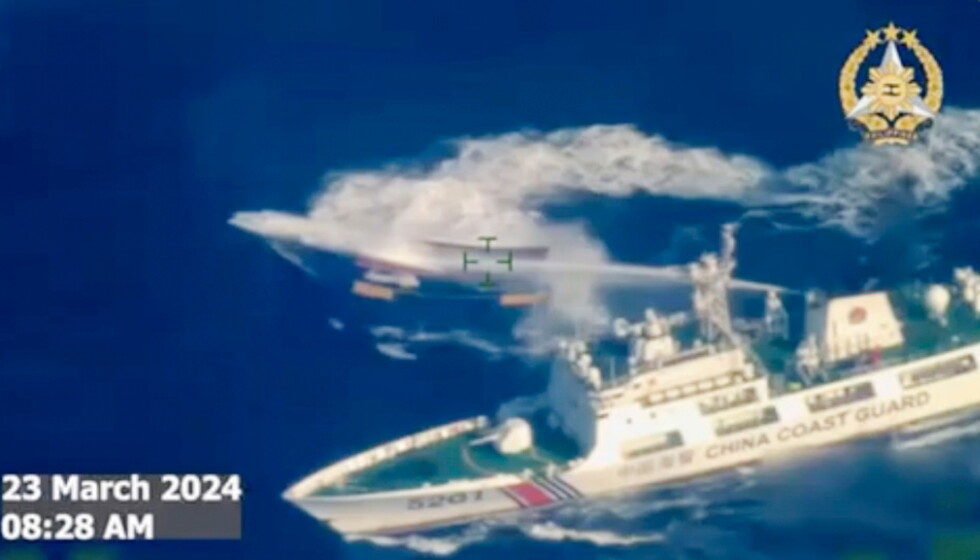
In this image made from video provided by the Armed Forces of the Philippines, a Chinese coast guard ship uses water cannon on a Philippine resupply vessel Unaizah May 4 as it approaches Second Thomas Shoal, locally called Ayungin shoal, at the disputed South China Sea on March 23, 2024. (Armed Forces of the Philippines via AP, File) MANILA, Philippines (AP) — The United States, the United Kingdom and a dozen other Western and Asian countries reasserted on Sunday that China’s expansive claims in the South China Sea are illegal based on a 2016 arbitration ruling. A joint statement issued by the 14 nations said they rejected “destabilizing” actions in the disputed waters that threaten regional stability. The 27-nation European Union released a separate statement, reaffirming the ruling as a “landmark decision in the peaceful settlement of disputes.” The statements commemorated a July 12, 2016, arbitration ruling by a tribunal established in The Hague under the United Nations Convention on the Law of the Sea, saying the landmark decision is “is final and legally binding.” China reiterated Sunday that the ruling was “null and void and has no binding force” and Beijing “neither accepts nor recognizes it.” China refused to join the arbitration initiated by the Philippines in 2013 after a tense standoff in the contested waters a year earlier that ended with Beijing effectively seizing a disputed shoal. Beijing rejected the 2016 ruling and continues to defend its claims to virtually the entire sea passage, a key global trade route that has long been feared as one of Asia’s most active flashpoints. The areas has been the scene of repeated territorial standoffs involving China and the Philippines, Vietnam, Malaysia, Brunei and Taiwan. “We reaffirm the Arbitral Tribunal’s decision that there is no legal basis for China’s expansive maritime claims in the South China Sea, including those based on `historic rights,’” the U.S.-led statement said. The arbitration tribunal largely decided in favor of the Philippines, ruling then that under the U.N. Convention on the Law of the Sea, “there was no legal basis for China to claim historic rights to resources” in the South China Sea outside of its regular territorial areas recognized under the convention. The convention, largely regarded as the treaty governing the world’s oceans and seas, took effect in 1994 and has been ratified by more than 170 countries and parties, including China and the Philippines. In addition to the U.S. and Britain, the other countries listed in Sunday’s statement were the Philippines, Japan, Australia, New Zealand, Canada, Germany, Italy, Estonia, Latvia, Lithuania, Romania and Slovenia. “We reiterate our strong opposition to any destabilizing or unilateral actions including by force or coercion that threaten peace and stability in the region,” they said. The nations stressed “our strong opposition to the use of coast guard, military and maritime militia forces to harass, obstruct, intimidate lawful operations by other states at sea or in the air and in so doing endanger the safety of personnel and fishermen and seriously degrade regional peace and security.” “Freedom of navigation and overflight as well as other internationally lawful uses of the sea as reflected in UNCLOS” must be upheld, the countries said, adding that the territorial disputes should be resolved peacefully based on the 1982 U.N. convention. In Beijing, China’s Ministry of Foreign Affairs said the arbitration tribunal and its ruling “seriously contravene the general practice of international arbitration” and “gravely infringe upon China’s legitimate rights as a sovereign state and state party to UNCLOS and are unjust and unlawful.” “China opposes and will never accept any claim or action based on those awards,” the Chinese foreign ministry said, adding that Beijing “does not accept any means of third-party dispute settlement or any solution imposed on China.” Territorial confrontations in the disputed waters have become more prevalent in recent years, particularly between Chinese and Philippine and Vietnamese forces and fishing fleets. Chinese coast guard ships and support vessels have used powerful water cannons, military-grade lasers and dangerous blocking maneuvers against Philippine forces and fishermen from rival claimant countries that have led to collisions in the high seas and high-risk encounters in the air. The United States has repeatedly called on China to comply with the arbitration ruling. The former Biden and current Trump administrations both warned that Washington is obligated to defend the Philippines, its oldest treaty ally in Asia, if Filipino forces, vessels or aircraft come under armed attack in the disputed waters.
多角的分析
南シナ海は世界の主要な海上貿易ルートであり、その安定はグローバル経済に不可欠です。中国の海洋権益主張の拡大とそれに対する国際社会の懸念は、この地域の航行の自由と貿易の安全に直接影響を与え、サプライチェーンの混乱や海運コストの上昇につながる可能性があります。ベトナム経済は輸出に大きく依存しており、南シナ海での緊張は、ベトナムの貿易活動や経済成長の見通しに間接的ながらも悪影響を及ぼす可能性があります。
南シナ海における中国の海洋権益主張を巡る緊張の高まりは、地域への投資リスクを増大させます。特に、紛争地域に近いベトナムなどの国々への投資は、地政学的リスクの観点から慎重な評価が必要となります。投資家は、航行の自由の確保、紛争解決メカニズムの透明性、そして地域における軍事的な緊張緩和の兆候を注視する必要があります。これらの要因は、外国直接投資(FDI)の流入や、既存の投資プロジェクトの継続性に影響を与える可能性があります。
南シナ海における領有権問題は、ベトナムの漁業コミュニティに直接的な影響を与えています。中国海警局による漁船への妨害行為や放水は、漁師たちの生計を脅かし、漁業活動の安全を危うくしています。また、この問題はベトナム国民の愛国心やナショナリズムを刺激する側面もあり、社会的な結束や対外的な感情に影響を与える可能性があります。政府は、国民の安全確保と、国際法に基づく権利主張のバランスを取る必要があります。
南シナ海を巡る国際的なやり取りは、ベトナム市民の日常生活に直接的な影響を与えることは少ないものの、国家の主権や領土保全に対する国民の関心を高めています。特に、中国の海洋進出に対する警戒感は根強く、政府の外交・安全保障政策への注目度も高まっています。ベトナムの一党体制下では、こうした国民の世論が政策決定にどの程度影響を与えるかは限定的ですが、国民の支持を得る上で重要な要素となり得ます。
背景・歴史的文脈
南シナ海を巡る問題は、中国が2013年にフィリピンが提起した仲裁手続きを拒否し、2016年の仲裁裁判所の判決を「無効」と主張したことに端を発する。この判決は、中国の広範な海洋権益主張の法的根拠を否定するものであった。ベトナムも南シナ海で中国と領有権を争っており、過去には中国海警局による放水や妨害行為が発生している。ベトナムは、国連海洋法条約に基づき、平和的な紛争解決を求めているが、中国の強硬姿勢に直面している。今回の声明は、こうした状況下で、国際社会が中国の海洋進出に対して改めて懸念を表明したものである。
原文ソース
AP News Vietnam