Marcos leads P3.4B project distribution in BARMM, remains silent on peace process
Politics
2026年7月24日
5
MindaNews Philippines (GN)

General articles are free for 24 hours after publish.

Marcos leads P3.4B project distribution in BARMM, remains silent on peace process

Share
AI Summary

President Ferdinand Marcos Jr. led the distribution of P3.4 billion worth of projects and assistance to the Bangsamoro Autonomous Region in Muslim Mindanao (BARMM). However, he remained silent on the peace process and the appointment of a new peace adviser, drawing criticism. The move is seen as an emphasis on development initiatives ahead of the region's first parliamentary elections on September 14.

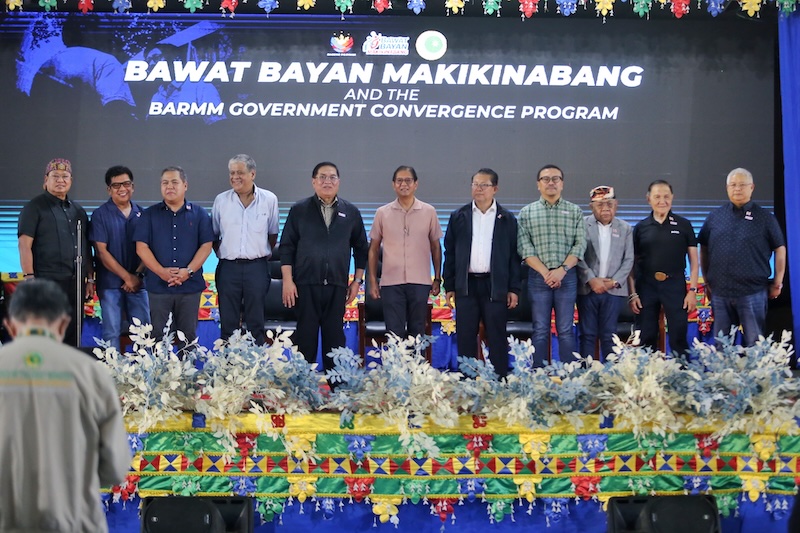
President Ferdinand Marcos Jr. entered the 6ID Gym at Camp Siongco here in Datu Odin Sinsuat, Maguindanao del Norte at 9:30 a.m. on Wednesday, graced the ceremonial distribution of P3.4 billion worth of projects and assistance to local governments and beneficiaries, and delivered a seven-minute speech on the "shared task" of building a "peaceful, stable, and prosperous Bangsamoro." Several attendees had expected the President to address the Bangsamoro peace process, particularly after the naming of Presidential Peace Adviser Mel Senen Sarmiento as concurrent chair of the government’s Peace Implementing Panel just a week earlier. However, Marcos Jr. did not mention the Comprehensive Agreement on the Bangsamoro (CAB) or Sarmiento's appointment in his speech. Of the P3.4 billion worth of projects and assistance, P2.9 billion is from the Bangsamoro Government and P433 million from the National Government, according to briefing materials. Marcos acknowledged the "significant progress achieved through the partnership between the National Government and the Bangsamoro Government" but emphasized that the "shared task" of building a peaceful, stable, and prosperous Bangsamoro continues. He spoke of the determination to push through with the 1st Bangsamoro Parliamentary Elections on September 14, aiming to achieve the goal of having a "duly elected parliament." Through the "Bawat Barangay Makikinabang" (BBM) Program, each barangay in BARMM will receive P200,000. Half, or P100,000, is allocated for educational assistance to five Presidential scholars at P20,000 each, while the remaining half will be for "key priorities identified by local communities." The BBM is a nationwide program, and according to Marcos, nearly P7 billion has been distributed to 34,800 barangays from April 8 to July 17. The BBM for all 2,595 barangays in BARMM will amount to P519 million, though the President did not specify when it would be distributed. Ceremonial checks were distributed for P433 million worth of financial assistance from the national government under the Socio-Civic Projects Fund, to support priority local development projects and essential public services in the five BARMM provinces—Basilan, Maguindanao del Norte, Maguindanao del Sur, Lanao del Sur, and Tawi-Tawi—and Cotabato City. From the BARMM’s Ministry of Interior and Local Government, the governors of the five provinces received ceremonial checks worth P20 million each for prepositioned goods to support disaster relief and recovery. They also received ceremonial checks of P30 million each from the BARMM’s Ministry of Labor and Employment for the Bangsamoro Tulong Pangkabuhayan sa Ating Disadvantaged Workers (BTUPAD) program. The seven-year-old BARMM, comprising five provinces, three cities, and one Special Geographic Area, will elect its first set of officials on September 14. Marcos also cited the Iftar Program, which ensures sociocultural and socioeconomic initiatives reach communities "in ways that are respectful of their faith and of their traditions," with at least 18,200 beneficiaries having availed of relief, burial, and medical assistance, and 26,800 Hajj registrants receiving extended assistance. Marcos described the gathering as reaffirming the "enduring partnership" between the National Government and the Bangsamoro Government, anchored on "mutual trust, shared responsibility, and a firm commitment to our people." He mistakenly referred to BARMM as its predecessor, ARMM, stating, "Together, the Autonomous Region of (sic) Muslim Mindanao and the National Government of the Republic of the Philippines we are advancing a shared vision of a more peaceful, prosperous, and inclusive Philippines." Interim Chief Minister Abdulraof Macacua welcomed the President, stating, "Together, we can work towards a better future for everyone in our region." He added, "Sa BARMM government, inuuna natin ang serbisyo publiko, at uunahin natin ang kapakakan ng bawat Bangsamoro." Originally scheduled for Monday, the Presidential visit was reset to Wednesday. The venue was also moved from the Shariff Kabunsuan Cultural Complex in Cotabato City to the 6ID Gym in Camp Siongco. Macacua told MindaNews on Monday that the postponement was recommended by the Presidential Security Command (PSC). ### Silent on the Peace Process The Philippine government signed the CAB with the MILF on March 27, 2014, paving the way for BARMM's establishment. BARMM was established after the Organic Law for the BARMM was ratified in January 2019. During the transition, BARMM is governed by an MILF-led 80-member Bangsamoro Transition Authority (BTA) appointed by the President. The transition period has been extended multiple times, most recently until October 2026. Mohagher Iqbal, MILF Peace Implementing Panel chair, had reacted positively to Sarmiento's appointment as GPH Peace Implementing Panel chair on July 15, calling it "a most welcome development."

0

Original source

MindaNews Philippines (GN)

原文を読む