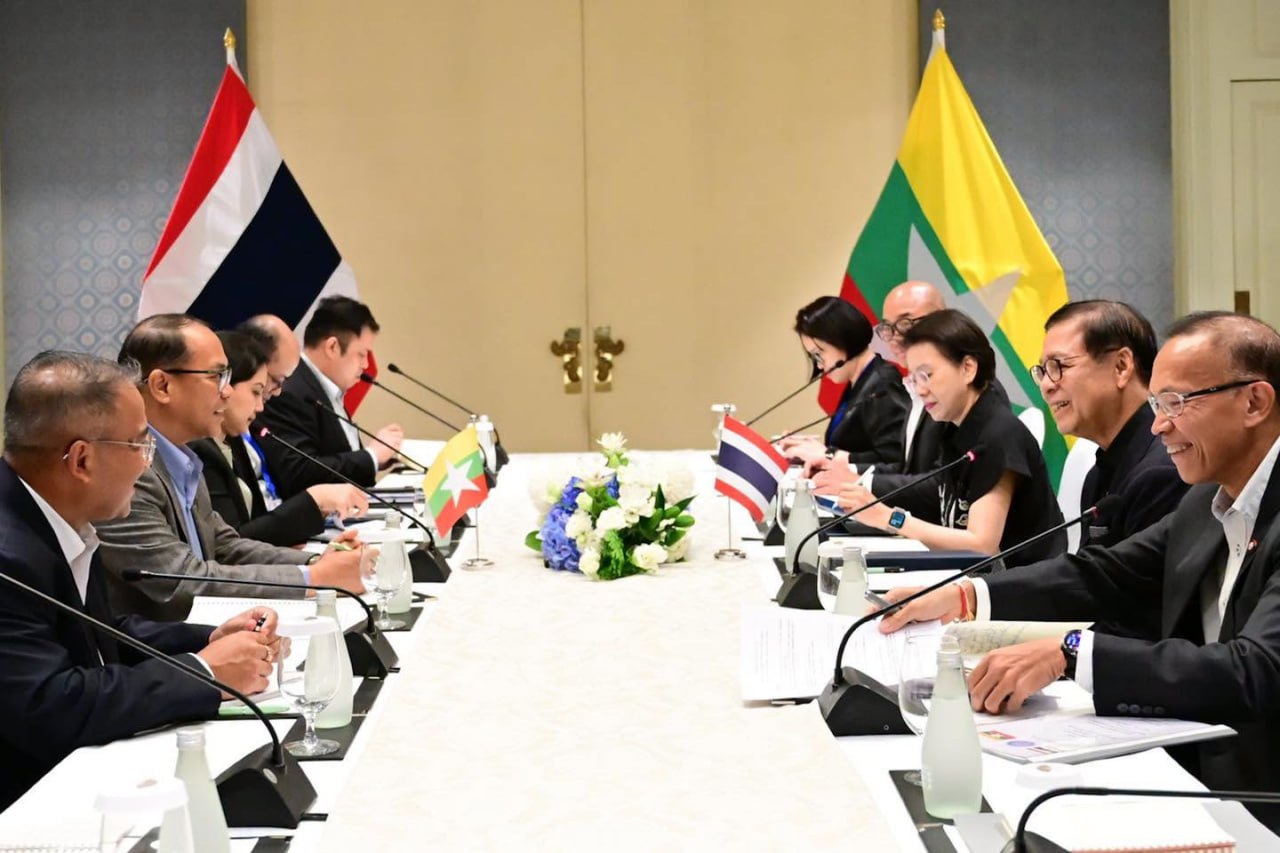
The real battle in Bangkok was not diplomacy, it was perception
Guest contributor James Shwe When Myanmar’s junta foreign minister sat down with his Association of Southeast Asian Nations (ASEAN) counterparts in Bangkok this weekend, the images that mattered were manufactured before anyone entered the room. This was not an act of diplomacy. It was an act of information warfare — and it is the front on which the generals now expect to win. Consider what the junta actually did on the way to that table. It is reported to have refused ASEAN’s request for access to Aung San Suu Kyi, offering only a verbal assurance that the “sister” would be “looked after.” Its own parliamentarians publicly dismissed the Five-Point Consensus — ASEAN’s founding framework for the crisis — as foreign “interference.” And having repudiated both the person and the process, it still obtained the first minister-level ASEAN engagement since the 2021 coup, with all the optics of a normal government. A regime sincerely trying to satisfy ASEAN would not insult the framework it needs. The contradiction only makes sense as a message. Denying access to Suu Kyi blocks independent verification while projecting absolute control: we hold your leader, we reject your framework, and none of you can make us blink. The intended audience was never in Jakarta or Manila. It was the people of Myanmar, and the engineered message is the one the junta wants us to absorb above all others: ASEAN sits with us anyway. Your resistance is pointless. You are alone. A whole apparatus, not a single stunt Bangkok was one move in a sustained campaign. The junta cannot govern what it claims, cannot recruit without kidnapping, and survives only on Beijing’s sufferance. It has one asset left that is cheap, deniable, and potentially decisive: the power to shape what people believe. So it has built the machinery to do exactly that — and by credible reporting it stood up a major-general-led task force for psychological warfare and counter-information in 2026. A government that could actually rule would not need one. You can watch the apparatus work across several registers at once: Buying the messenger. The junta’s information ministry is paying the American lobbyist Roger Stone a reported $50,000 USD a month to “rebuild” its relations with Washington — an open attempt to purchase legitimacy it cannot earn. Manufacturing the narrative. A steady stream of op-eds, “analysis,” and polished web platforms now urges the region to “move beyond Naypyidaw,” accept the post-election order, and treat junta rule as a settled fact. Some of it is sincere fatigue with a long war. Some of it is seeded. The effect is the same: it normalizes a criminal enterprise as a government-in-waiting and quietly moves the world toward premature recognition. Bending the coverage. The most instructive example came this month, and it shows how the manipulation actually works. Agence France Presse sent a team to a single People’s Defence Force camp in Sagaing and first produced an honest, sympathetic dispatch — “Jungle spirit: Myanmar fighters try to keep hope alive,” carried by France 24. It was candid about retreat and dwindling ammunition, but it took the fighters seriously and closed on their defiance: “we organize and revolt with a spirit of defiance and a refusal to accept injustice.” It made no mention of ASEAN, the election, or the “civilian” president. That version did not suit the normalization campaign. What followed was a second AFP treatment of the very same reporting from the very same camp — recast as “Myanmar’s pro-democracy revolution weakens five years on.” Same fighters, same jungle, opposite conclusion: the retreating rebels now open the story, but the frame is in decline. It leans on outside analysts, threads in Chinese-brokered truces, the military’s “sweeping gains,” the new “civilian” president, and the July 12 ASEAN meeting, and lands on the line that the opposition is “increasingly irrelevant.” The decisive part is what happened next. The junta did not need to suppress the hopeful story; it only needed the demoralizing version to be the one that travelled. And it was — the “weakening” framing is what search engines surface, what algorithms push, and what therefore lands on the desks of the policymakers and journalists who shape the next round of coverage. Identical facts on the ground; the demoralizing conclusion optimized to win the click and the citation. That is information asymmetry in the flesh, and it is the junta’s true theatre of operations. Why this is the generals’ most effective weapon The military has decades of practice at one thing above all: divide and rule. It kept power for half a century not by winning arguments but by setting Myanmar’s peoples against one another and its opponents against themselves. It is now applying that same craft to the resistance — and it has found the seam. Because here is the uncomfortable truth the junta understands better than we sometimes do: it does not need to defeat the National Unity Government or the ethnic revolutionary organizations on the battlefield. It only needs Myanmar’s people to lose faith in them. So it invests relentlessly in two ideas, repeated until they feel like common sense: the resistance has no real leadership, and the resistance is not united. Every grievance is amplified, every failure magnified, every internal disagreement dressed up as terminal rot. And crucially, the junta attacks the very habit that would inoculate us — critical thinking — because a public is trained to ask “who benefits from this framing? ” is a public it cannot manipulate. This is why perception, not territory, is the junta’s growing advantage. On the ground it is losing the ability to win. In the mind, it still has a chance — and we keep handing it openings. The common sense no one is saying out loud Somewhere in all of this, an obvious truth has gone strangely unspoken. The resistance does have an organized political leadership. The NUG and its partners are not a rumor or an aspiration; they are a functioning, if imperfect, structure that has held together under exile, bombardment, and blockade for five years. They are not flawless. No government-in-exile, with no territory of its own, no reliable revenue, no recognized army, and no seat at the U.N., could be. But the practical choice in front of us is not between this leadership and a perfect one. It is between improving what we have and dismantling it to start again from scratch — in the middle of a war, against an enemy praying for exactly that. It is far more sensible to strengthen, reform, and hold accountable the institutions we have built than to tear them down and hand the junta the collapse it cannot achieve by force. That is not blind loyalty. It is the most basic strategic realism. I notice that the loudest calls to dismantle rarely come from those with a workable alternat
This article requires PRO
This article is outside the free access window or is a special report. PRO unlocks it and the full archive.
Related articles
- YGN Region CM met with returnees from Malaysia
The Government of the Republic of the Union of Myanmar places great importance on supporting its citizens and assists Myanmar nationals residing abroad under any circumstances whenever they encounter difficulties. On the
- Inspecting Meat Production Sub-Division: YGN Mayor inspected meat production sub-division
Yangon Region Minister for Development Affairs and Chairman of Yangon City Development Committee-YCDC (Mayor), U Myo Myint Aung, accompanied by Secretary U Cho Tun Aung, committee members, heads of departments, and respo
- Malaysian Prime Minister says 10,000 Myanmar nationals repatriated since January
Malaysian Prime Minister Anwar Ibrahim told parliament in the capital Putrajaya on Tuesday that approximately 10,000 Myanmar nationals have been repatriated from Malaysia since January. Prime Minister Anwar defended Putr
- Efforts underway to form Urban Search and Rescue Special Team
Efforts are underway to select firefighters and form an Urban Search and Rescue Special Team, said Deputy Minister of Home Affairs, Major General Min Thu. Major General Min Thu made this statement in response to a starre