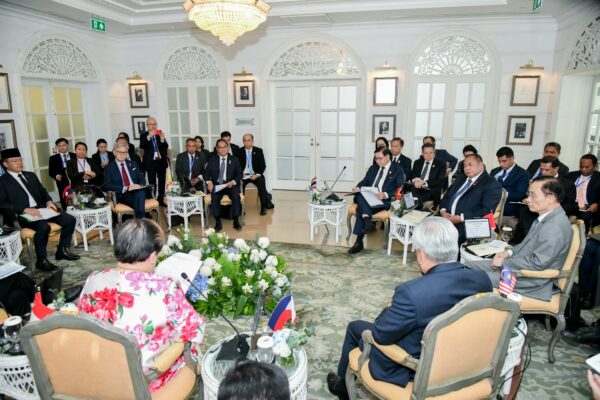
ASEAN Foreign Ministers Hold 'Icebreaker' Meeting With Myanmar Counterpart Amid Peace Accord Challenges
ASEAN foreign ministers met with Myanmar's Foreign Minister Tin Maung Swe for the first time in five years, reaffirming commitment to the Five-Point Consensus for peace. However, Myanmar's military junta has effectively rejected the accord, and substantive progress remains limited, with a request to meet Aung San Suu Kyi denied.
Foreign ministers and representatives from the Association of Southeast Asian Nations (ASEAN) met with Myanmar's Foreign Minister Tin Maung Swe for the first time in five years, aiming to revive a regional peace initiative intended to resolve the country’s civil war. The meeting, brokered by Thailand, supported an approach of “calibrated engagement” to bring Myanmar back into the “ASEAN family.” The meeting comprised both an informal discussion and a session involving only ASEAN member states. Foreign ministers or representatives from every member state, except Cambodia and Malaysia, were in attendance. According to Philippine Foreign Secretary Ma. Theresa Lazaro, Tin Maung Swe provided a comprehensive briefing covering the Myanmar military’s peace efforts, the status of ousted civilian leader Aung San Suu Kyi, and cooperation against cross-border scam operations, trafficking, and drug trafficking. However, a significant gap remains between ASEAN’s expectations for progress and the stance of Myanmar’s military junta. The Five-Point Consensus, agreed upon in April 2021, calls for an immediate cessation of violence and inclusive dialogue involving “all parties” to the conflict. Yet, Myanmar’s military has done little to implement it, focusing instead on defeating its opponents by force. Last week, Myanmar’s military-dominated parliament passed a motion rejecting the Consensus as interference by ASEAN. One of the key issues discussed was the status of Aung San Suu Kyi, the elected civilian leader ousted in the 2021 coup and held in custody ever since. Tin Maung Swe stated that she was in good health and would be looked after, but ASEAN’s special envoy on Myanmar, Lazaro, was denied a request to meet her. Thailand’s Foreign Minister noted that ASEAN member states “clearly spelled out our expectations” and called for access to Suu Kyi “so that we can be able to verify the claims” that she is in good health. Myanmar’s new government seeks to normalize relations with ASEAN while maintaining a free hand in dealing with its adversaries. Myanmar’s Foreign Ministry stated that the meeting discussed enhancing relations and “constructive cooperation for the restoration of Myanmar’s full and equal participation in ASEAN.” Human rights organizations and armed groups have criticized the meeting. ASEAN Parliamentarians for Human Rights (APHR) urged member states to reject any “steps toward legitimizing Myanmar’s military junta.” Mercy Chriesty Barends, an Indonesian MP and chair of APHR, stated, “ASEAN must not fall into the junta’s trap. Time and again, ASEAN has rewarded the junta’s non-compliance instead of holding it accountable for its crimes against the people of Myanmar.” Lazaro defended the decision to meet with Tin Maung Swe, noting progress on humanitarian access, one of the goals of the Five-Point Consensus. “It can’t be done in one stroke. It’s evolving, and I think all of these engagements are very important,” she said. Lazaro plans a second trip to Myanmar later this year, while Thailand is working to facilitate talks between Myanmar and ethnic armed groups along their border. Progress will be reviewed at the next ASEAN Summit at the end of the year.
多角的分析
ミャンマー情勢の不安定化は、ASEAN地域全体の経済的結びつきにも間接的な影響を与えうる。特に、ミャンマーがASEANのサプライチェーンや地域経済統合の恩恵を十分に受けられないことは、地域全体の成長ポテンシャルを低下させる可能性がある。また、ミャンマー国内での紛争継続は、人道支援や復興への投資を阻害し、長期的な経済回復を遅らせる要因となる。
今回の会談は、ミャンマーへの投資環境改善に向けた軍事政権の意欲を示すものだが、ASEANの「5点合意」に対する実質的な進展が見られない現状では、投資家のリスク許容度は依然として低いままだろう。特に、アウン・サン・スー・チー氏の処遇や、民主化プロセスへの透明性の欠如は、主要な懸念事項であり続ける。投資家は、軍事政権の行動とASEANの要求との乖離を注視し、状況の推移を見極める必要がある。
ミャンマー国民にとって、この会談は和平への期待を抱かせる一方で、軍事政権による抑圧が続く現状では、その効果は限定的である。特に、アウン・サン・スー・チー氏のような政治的指導者へのアクセスが制限されていることは、国民の政治参加への希望をさらに遠ざける。また、越境詐欺や人身売買といった問題への言及は、これらの犯罪が国民生活に与える直接的な影響の大きさを物語っている。
ミャンマー国民は、ASEANとの会談が和平への一歩となることを期待しているが、同時に軍事政権による弾圧が続いている現状に不安を感じている。特に、アウン・サン・スー・チー氏の健康状態や処遇に関する情報が不透明であることは、国民の政治的権利への懸念を深めている。また、越境詐欺や人身売買といった問題は、国民の生活に直接的な影響を与えており、これらの問題解決への具体的な取り組みが求められている。
背景・歴史的文脈
ミャンマーでは2021年2月の軍事クーデター以降、アウン・サン・スー・チー氏率いる文民政権が打倒され、軍事政権が実権を掌握した。これに対し、ASEANは同年4月に「5点合意」を採択し、暴力停止、包括的対話、特使派遣などを求めた。しかし、軍事政権は合意の履行を拒否し、ASEAN首脳会議への参加も禁止された。今回の会談は、タイの仲介により、ASEANがミャンマーとの対話を再開し、和平プロセスを前進させようとする試みである。
原文ソース
The Diplomat Indonesia