General articles are free for 24 hours after publish.
Cambodia Aims to Expedite Land Title Issuance with New System and Tax Incentives
Cambodian Prime Minister Hun Manet has ordered the establishment of a centralized data management system to expedite land title issuance, aiming for completion by the end of 2027. Tax incentives have also been announced. While civil society acknowledges progress, concerns remain regarding unresolved land disputes.
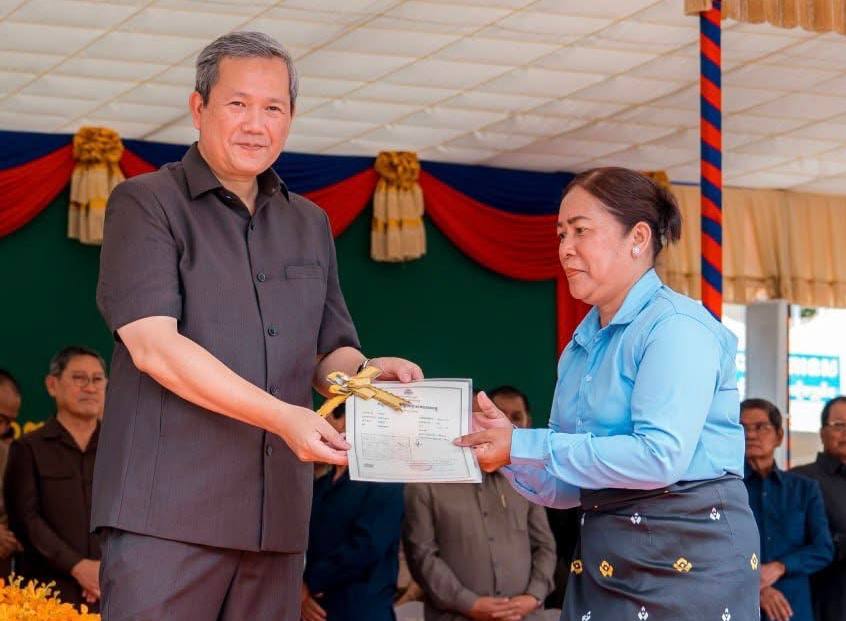
Prime Minister Hun Manet has called for the establishment of a centralized data management system to resolve the issuance of land titles and streamline document processing, linking to land records at the General Department of Taxation so that citizens receive land titles quickly. Civil society and international organizations, including Human Rights Watch have in the past criticised insecure land tenure and problems involving “soft titles”, and overlap with collective land titles. The World Bank also documented land title issuance as a “lengthy process” with a backlog of applications. As of now, Cambodia has registered nearly 14 million land plots nationwide and issued about 10 million land titles to citizens, Hun Manet said during the handing over of land titles in Kandal province on July 29. (STPM) “We will continue this work so that measurement, boundary demarcation, registration, and land title provision to citizens will be completed by the end of 2027,” he said. “Currently, land registration management at provincial levels does not have a clear management system capable of handling document flows and unified data,” Hun Manet mentioned, adding that the systems remain separate from the cadastral and land administration office at lower levels. He also outlined several tax-related reforms to address land title backlogs due to ownership documents being held by banks and microfinance institutions as collateral for loans. The Land Management Ministry is also coordinating with the National Bank of Cambodia to allow citizens to retrieve or exchange documents without affecting loan guarantees. In addition, an exemption of 100% penalty fees on delayed stamp-duty payments would be effective through the end of 2027 for documents with accompanying court orders that have exceeded three months. Hun Manet noted that some lands have been transferred multiple times at the local level without proper records, leaving owners liable to taxes on each transaction. He approved an exemption for successive land transfers made from 2017 through July 2026, requiring tax to be paid only once by the final owner. Owners of land that was later developed will be allowed to pay stamp duty and property tax on structures based on the actual construction year, provided they have a construction permit or confirmation from competent authorities, Hun Manet said. The government would also consider extending low land survey fees under the previous Inter-Ministerial Prakas No. 186 or reducing current fees to help citizens who cannot afford the high fees to complete land registration and obtain ownership titles. Mar Sophal, a program manager for Policies and Advocacy Influence at The NGO Forum, said that the issuance of 10 million land titles represents a major milestone that enhances land tenure security for citizens and resolves land disputes. He lauded the government’s decision to complete land registration by 2027, and for introducing positive reforms in land tax registration. “These measures help reduce the financial burden on the general public and smallholders farmers, including encouraging legal and transparent land transfers on a large scale,” Sophal said. However, he said, despite the accelerated pace of land registration, significant land disputes persist due to remaining lands being unregistered plots consisting mostly of areas with overlapping claims between local residents and forest covers and protected areas, and economic land concessions. “Dispute resolution mechanisms that face constraints, including out of court dispute resolution mechanisms still face resource limitations, lengthy processes, or inconsistent legal enforcement at the local level,” Sophal said. Sophal said that vulnerable groups are disproportionately affected due to specific structural challenges as “collective land registration” involves complex and time-consuming procedures across three ministries, as well as lack official documentation or risk being classified as “illegal occupiers” on state land when areas are designated for concession or protection. The Cambodian Center for Human Rights previously said the government has fallen “far below” its 2017 target of granting collective land titles to 10 Indigenous communities each year. It said only 43 out of 458 Indigenous communities have received titles between 2011 and 2024.
Original source
CamboJA News