General articles are free for 24 hours after publish.
China's 'Anti-Terror' Push in Central Asia Raises Uyghur Rights Concerns
At the Shanghai Cooperation Organization (SCO) summit, China appears to have secured Central Asian nations' de facto acceptance of its human rights suppression tactics in Xinjiang, under the guise of combating 'terrorism, separatism, and extremism.' This move is seen as an attempt by China to expand its institutional framework for surveillance, intelligence exchange, and political labeling of Uyghurs.
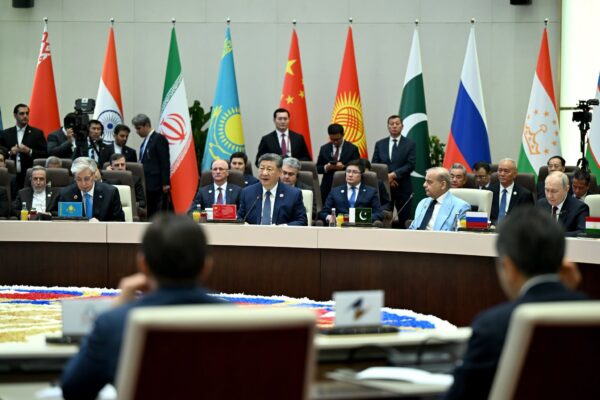
Read The Diplomat, Know The Asia-Pacific The SCO may serve legitimate Central Asian interests, but it should not become the vehicle through which Beijing’s definitions of security, political loyalty, and ethnic identity become normalized across the Turkic world. China’s growing efforts to increase control over the Turkic states of Central Asia was the dominant, if little discussed, outcome of the Shanghai Cooperation Organization (SCO) summit in Bishkek, Kyrgyzstan on September 1. Beijing wants its relationship with the Central Asian states to be one of vassals thankful for China’s “protection” and economic integration. The recent summit produced the 25th anniversary Bishkek Declaration and 27 other documents, which claimed they would strengthen mechanisms for security, countering terrorism and organized crime, and promised new transport lines and logistics. On its face, the Central Asian states are promised infrastructure, technology and diplomatic engagement. But beneath those promises is guaranteed deeper dependence on Chinese capital, standards, and security concepts. China successfully got Muslim-majority states (including Iran, Pakistan, Kazakhstan, Kyrgyzstan, Tajikistan, and Uzbekistan) to sign onto documents clearly aimed at China’s own Turkic Muslim populations. The SCO endorsement of combatting “terrorism, separatism, and extremism” was China-sponsored and indisputably about Uyghurs. Under this pretext, the institutional capacity that enables surveillance, intelligence exchange, and political labeling of Uyghurs is being expanded. Sadly, China’s economic leverage and coercion means the public support that these Muslim-majority states provide to Muslim communities globally is absent when it comes to China. The Central Asian states should ponder carefully when Beijing uses the security vocabulary noted in the Bishkek Declaration. China’s decade-long ethnic cleansing campaign in Xinjiang, also referred to as East Turkestan, demonstrates what happens when cultural difference is reclassified as a security problem. Religious behavior can be labelled extremism. Cultural autonomy can be called separatism. Overseas relationships of Uyghurs with Turkic states have tended to attract suspicion. Language, memory, and identity become objects of political management. ASPI’s Xinjiang Data Project has documented mass detention, surveillance, forced labor and political re-education. ASPI’s Cultural Erasure research estimated that around 16,000 of Xinjiang’s 24,000 mosques had been damaged or destroyed, alongside extensive damage to Islamic shrines and other sacred sites central to regional Turkic history. Arguments that Beijing is only concerned about its “ internal affairs” are blind to China’s foreign policy. Beijing’s formula of combating the “three evils” – terrorism, separatism, and extremism – was incorporated into the SCO establishment document signed in June 2001, and that vocabulary has been institutionalized across Eurasia. That should matter in the Muslim-majority Turkic states of Kyrgyzstan, Kazakhstan, Uzbekistan, and Turkiye. During Xi’s visit to Kyrgyzstan, Bishkek explicitly reaffirmed support for China on Xinjiang-related issues while agreeing to deepen law-enforcement, counterterrorism, and information-security cooperation. China and Uzbekistan have made similar commitments. Uyghur, Kazakh, Kyrgyz, Uzbek, and other Turkic identities do not end at borders. Families, languages, religious traditions, and diaspora communities extend across the region. When governments repeat Beijing’s anti-separatist language without qualification, they risk allowing legitimate concern for fellow Turkic communities to be recast as interference or subversion. China’s July 2026 Law on the Promotion of Ethnic Unity and Progress contains a provision on extraterritoriality (Article 63) that authorizes Chinese authorities to pursue organizations and individuals outside of China’s borders. China’s recent technological advancements increase the risks that might have been assessed in 2001 by the SCO founding nations (Kazakhstan, Kyrgyzstan, Tajikistan, and Uzbekistan) as unlikely to cross borders. Some Chinese tech companies expanding across Central Asia have developed important capabilities within the same security ecosystem used to monitor and suppress Uyghurs and other Turkic peoples in the region. iFLYTEK worked with China’s Ministry of Public Security on voiceprint systems and supplied voice-recognition technology used by Xinjiang police. It has since established a Central Asian presence in Tashkent offering multilingual AI services. Technical documentation from Dahua policing systems described functions including “real-time Uyghur warnings” and identification of Uyghur attributes. Dahua disputes allegations that it intentionally designed systems for ethnic targeting. But its technology demonstrates how ostensibly neutral surveillance platforms can be adapted for ethnicity-based policing. Dahua systems are already present in Central Asian security environments. Genomics raises an equally serious question of sovereignty. BGI has established sequencing capabilities in Uzbekistan and Kazakhstan and has discussed combining AI with large-scale genomic data in Central Asia. Those laboratory platforms are likely to be connected and operate on Beijing’s cyber cloud, in collaboration with companies such as Huawei. But genomic information is permanent, sensitive, and strategically valuable. The Central Asian states should know where samples are processed, where data is stored, who can access it, and whether it can leave national jurisdiction. The same scrutiny should apply to natural resources. Chinese entities are expanding into geological exploration, mining, and processing across Kazakhstan, Uzbekistan, Turkmenistan, Tajikistan, and Kyrgyzstan. Joint surveys can give Chinese partners detailed knowledge of strategic mineral deposits long before extraction begins. The China-Kyrgyzstan-Uzbekistan railway will bring genuine commercial benefits, but it will also strengthen Beijing’s overland supply chains and reduce China’s dependence on vulnerable maritime routes. The answer for the Central Asian SCO members is not decoupling from China as there is a genuine need for infrastructure, capital, technology, and markets to boost living standards. But blindly accepting and complying with Beijing’s demands is also not what a sovereign state should aim for. The Russian invasion of Ukraine has heightened anxiety across the former Soviet republics and encouraged Central Asian states to diversify their external relationships, including by moving closer to Beijing. But that strategic realignment should not proceed without regard to China’s human rights in general and to Xinjiang specifically. The experience of Uyghurs and other Turkic peoples under Chinese rule offers a stark warning about the political costs that can accompany deeper dependence on Beijing. Turkic governments should d
Original source
The Diplomat Indonesia