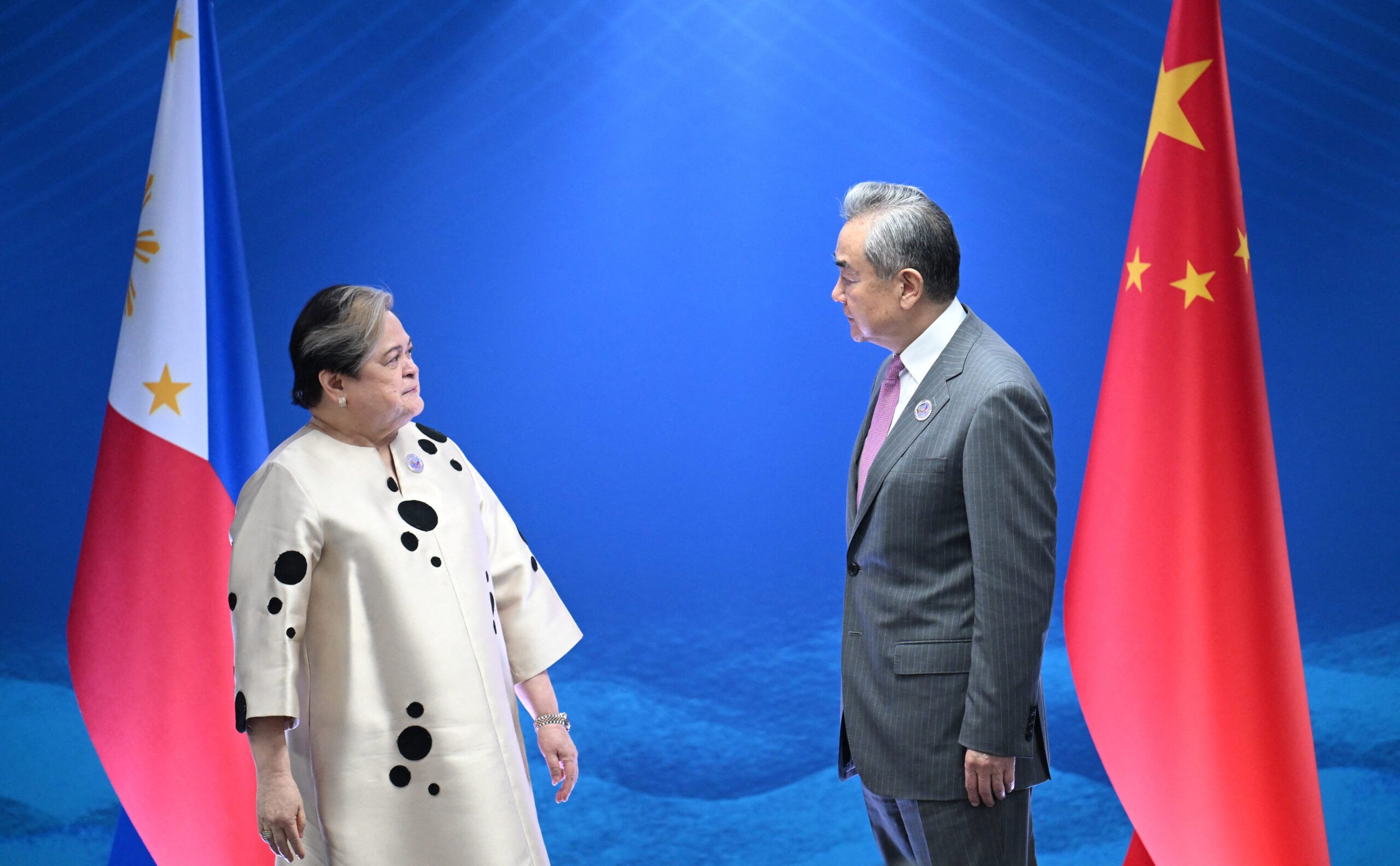
Philippines raises Ayungin incident, racist ‘monkey’ video in meeting with China’s Wang Yi
Diplomacy
2026年7月22日
5
Rappler Philippines

General articles are free for 24 hours after publish.

Philippines raises Ayungin incident, racist ‘monkey’ video in meeting with China’s Wang Yi

Share
AI Summary

Philippine Foreign Secretary Maria Theresa Lazaro raised a litany of concerns with Chinese Foreign Minister Wang Yi, including violent actions by the China Coast Guard at Ayungin Shoal and a racist AI video depicting Filipinos as monkeys. While both sides agreed on maintaining dialogue, easing tensions remains a challenge.

MANILA, Philippines – Philippine Foreign Secretary Maria Theresa Lazaro raised a long list of Manila’s grievances and concerns against China during the first foreign minister-level meeting between Manila and Beijing in two years. In a release to the media, the Department of Foreign Affairs (DFA) said Lazaro raised the following in her meeting with Chinese Foreign Minister Wang Yi: the Philippines’ strong protest over the violent actions committed by China Coast Guard personnel against Filipino navy personnel at Ayungin Shoal on July 20 concerns over actions that have infringed on maritime rights and entitlements, including incidents affecting the safety of Filipino personnel and fishermen the removal of remaining structures in Bajo de Masinloc Lazaro, according to the DFA, also said during the meeting that “disagreements over legal and political issues do not justify resorting to disturbing imagery.” The DFA had earlier protested the depiction of the Philippines and Filipinos as monkeys in a July 10 “deeply offensive, distressing, and unacceptable” AI-generated video by Chinese state-run China Daily. Two things serve as backdrop to the Lazaro-Wang meeting: Manila’s desire to “reset” ties with its northern neighbor and successive incidents, at sea and in the political and information sphere, that have caused tensions between the Philippines and China to rise. The bilateral meeting is the first foreign minister-level meeting between Beijing and Manila. It happened on the sidelines of the Association of Southeast Asian Nations Foreign Ministers Meetings and the Post-Ministerial Conferences, where ASEAN officials met with their counterparts from the bloc’s dialogue partners, including China. The DFA, in its release, described the meeting as a “candid, comprehensive, and constructive” discussion covering “political and security matters, maritime and law enforcement issues, regional and international developments, and mutually beneficial cooperation in trade and investment, agriculture, tourism, connectivity, and people-to-people exchanges.” The two countries, said Manila, “underscored the importance of maintaining open channels of communication, enhancing mutual understanding, and strengthening confidence-building measures.” Philippine-China ties The two countries’ bilateral ties have turned tense since 2023, when Philippine policy under President Ferdinand Marcos Jr. evolved to become more assertive in its entitlements and claims in the South China Sea, which Beijing claims in almost its entirety. At sea, confrontations between the two countries are almost always dangerous and have, in several instances, turned physical or mortal. In June 2024, the China Coast Guard harassed Philippine soldiers already moored alongside the BRP Sierra Madre in Ayungin Shoal. Over two years later, on July 20, 2026, CCG personnel sailed close to the makeshift outpost, leading to a confrontation that left a Filipino soldier with a head wound. For China, maritime confrontations have harmed their own, too. A CCG and Chinese navy warship collided with each other in August 2025 as both were trying to chase down a Philippine Coast Guard vessel. It’s been reported that at least two CCG personnel may have died from the collision, but Beijing had not even acknowledged the clash. At the beginning of 2026, or upon Manila’s assumption of the ASEAN chairmanship, the Philippines also worked to revive bilateral ties. On the sidelines of the Code of Conduct negotiations in Cebu City last January, senior diplomats from both sides met. This meeting was followed by a series of consultations in China at the end of March. ASEAN hopes to finish its talks on a Code of Conduct (COC) on the South China Sea with China before the Philippines’ chairmanship ends. Experts have not been optimistic about the ASEAN-set 2026 deadline, although both Lazaro and Wang “highlighted the progress of the negotiations” in their meeting, said the DFA. “Both sides underscored the importance of maintaining open channels of communication, enhancing mutual understanding, and strengthening confidence-building measures. They highlighted the progress of the negotiations on the ASEAN-China Code of Conduct and the continued willingness to work together to conclude the negotiations of the COC this year,” said the DFA. “The two sides underscored the importance of maintaining peace, security, and stability in the region, reducing the risk of miscalculation, and sustaining dialogue on matters of mutual concern.” – Rappler.com

0

Original source

Rappler Philippines

原文を読む