Child Learning Theories of Primary Importance
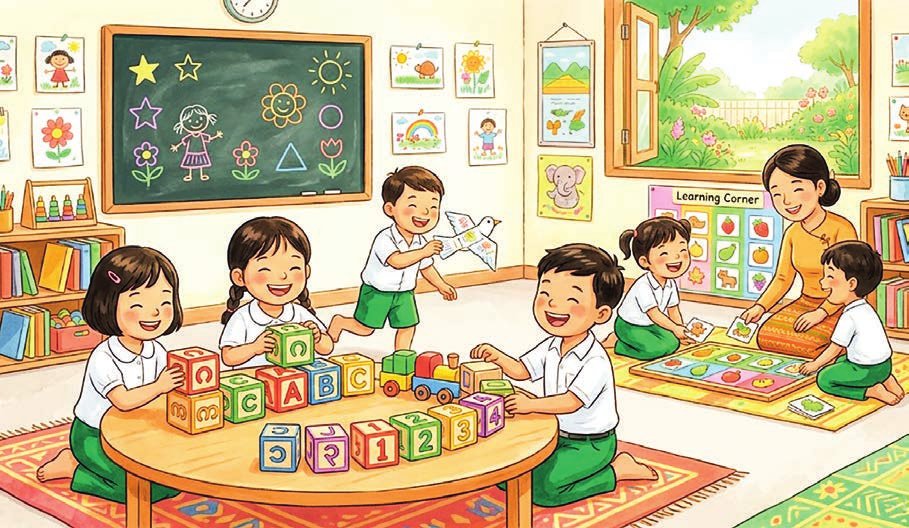
NATURALLY, children like to learn something that they have not yet known, just out of curiosity. To think of it simply, before children come to the world, they have lived in their mother’s womb for nine months or so, roughly knowing only to live there. That is to say, they know nothing while living in the womb. On the other hand, some educational theorists believe that children are born empty-handed, which means that their inherited brain looks like an empty cup, whereas others strongly think that children have been full of growth energy, intrinsic motiva- tion, sensory feelings and multiple intelligences to some extent since before their birth. After all, it is natural if children enjoy playing as well as learning. Of course, playing is a kind of learning for children. Thanks to their willing- ness to learn, young children tend to frequently and continuously ask lots of questions about whatever they see. Child learning starts at home and then at school, as al- ways. So, what usually influences us teachers to teach and support primary learners? The four theo- ries of learning in education will be deeply described, based on my personal opinion and teaching experience, as follows. Children should learn by do- ing. (Jean Piaget) In the world of educa- tion, there is a famous saying, `Learning by Doing ́. Our chil- dren can learn everything they can do; at least they like imitat- ing and following their elders to the letter, such as parents and teachers. At school, children often mimic their teachers; they put on some flowers on their heads, use lipsticks or make-up and even wear handkerchiefs at their waists like their teach- ers. Also, they imitate how their teachers speak, especially their foreign language pronunciation, sometimes that of their mother tongue. Thus, well-pronounced teachers will give birth to out- standing children with accuracy of language as usual. And in mathematics and science teach- ing, children can learn better by doing it themselves in calcu- lation and scientific testing. Add- itionally, learning by doing en- ables children to memorize subject content by heart more than average and find it authen- tic to study school subjects rath- er than being too unimaginative. Furthermore, learning by playing is similar to learning by doing. Subject matter may be created into play by seasoned teach- ers’ instructional methods. Chil- dren are happy to play while playing as well as study while studying in an enjoyable learn- ing environment, too. Children should use all their senses. (Maria Montessori) There are found six kinds of senses can be felt in the human body: sight, sound, smell, taste, touch and thought. A lesson can be learned by children with the help of one or more of these sens- es. According to Piaget’s Cogni- tive Theory, children are given to learning several subject matters by sight instead of other senses. The proverb `Seeing is believing ́ will be absolutely true for them. Therefore, more illustrations are prescribed in the primary text- books from every corner of the globe. However, they sometimes believe in supernatural powers like black magic, but their belief is likely to diminish when they grow older. Not only that, children enjoy music; schoolgirls with well-devel- oped throat muscles can recite poems beautifully and sing some songs very well. What is more, they know what is scented, pun- gent, rotten or odourless, particu- larly flowers, for example. Simi- larly, they can feel something sweet, bitter, salty or tasteless. Strange- ly enough, many primary children prefer a sharp flavour to being insipid, for instance, sour man- goes. In addition, children learn to touch something probably not in danger — that is, mud is wet, soft and sticky, while sand is dry, coarse and compact, for example. Despite this, thought may be the most difficult concept to handle, such feelings as envy, upset and content. Here, an experienced teacher will be able to provide his elementary students with food for thought, such as drama playing, storytelling or making them en- counter any learning experience that can lead to a concept which he would like to give. Conse- quently, multi-sensory learning should be conducted in primary stu- dent learning by respective teach- ers as much as possible and in the nature of things, children mostly enjoy getting involved in school learning activities. SEE PAGE 11 Child Learning Theories of Primary Importance By Hu Wo (Cuckoo’s Song) By Soe Khant Lin Children respond well to an authority figure. (Margaret Donaldson) Teachers should never look down their noses at children, also primary learners. By Howard Gardner, learners have diverse types of intelligence: linguistic, mathematical, spatial, musical, kinesthetic, interpersonal, intra- personal and naturalistic. Verbal learners can speak a language with fluency and accuracy nearly to the extent of an adult learner; logical learners can really work out math problems very quickly, enjoying the magic or language of mathematical numerals; visual learners can draw or paint pic- tures and diagrams in accord- ance with their educational level; musical learners can sing a song according to its melody and rhythm; bodily kinesthetic learners can dance or carry out co-curricular and extra-curricu- lar activities such as doing aero- bics; interpersonal learners can do well in social dealings with classmates, friends, teachers and even senior students; intraper- sonal learners can build self-ac- ceptance, self-awareness and self-improvement; and finally, naturalistic learners can have a sense of natural beauty and phenomena. Depending on the biased intelligence, primary learners show their distinctive manners and behaviours towards teachers. Sometimes, it is quite difficult for teachers to reply to some learners’ mathematical questions in a moment. Children should learn from each other in small groups of mixed ability. (Lev Vygotsky) As we may all know, chil- dren are potentially the easiest to mould into any shape which teachers like. In the same way, children should have a chance of meeting various learning ex- periences. In actual fact, children can learn not only from teachers but also from each other. They have a tendency to emulate their friends’ competent study skills. Despite this, everybody has both strengths and weaknesses. A person’s strengths are liked by almost everyone, including chil- dren, yet his weaknesses are usu- ally not tolerated. In this case, the expression `Unity in Dive
This article requires PRO
This article is outside the free access window or is a special report. PRO unlocks it and the full archive.
Related articles
- Five female drivers to be assigned for the first time on DEMU and RBE trains running on Yangon City Circular Line
It is known that for the first time, five female drivers will be assigned to DEMU and RBE trains running on the Yangon City Circular Line. It is known that the Myanmar Railways, Department of Transportation, is making ar
- 3 out of 23 basic education schools temporarily closed due to river water receding reopened in Tanintharyi Township
It is reported that three out of 23 basic education schools that were temporarily closed in Tanintharyi Township, Myeik District, Tanintharyi Region, due to the receding water level of the Tanintharyi River have reopened
- Schools and offices reopened in flood-affected Hlaymyetnar Township, rehabilitation work still ongoing
Schools and offices have been reopened in Hlaymyetnar Township, which was affected by floods, and rehabilitation work is still ongoing, it is known. Rehabilitation activities have begun after facing flood hazards for abo
- Female drivers start duties on Yangon circular railway line
Five female drivers have started their duties on trains running on the Yangon circular railway line, according to Myanmar Railways. It is said that this is the first time in the history of Myanmar Railways to assign duti