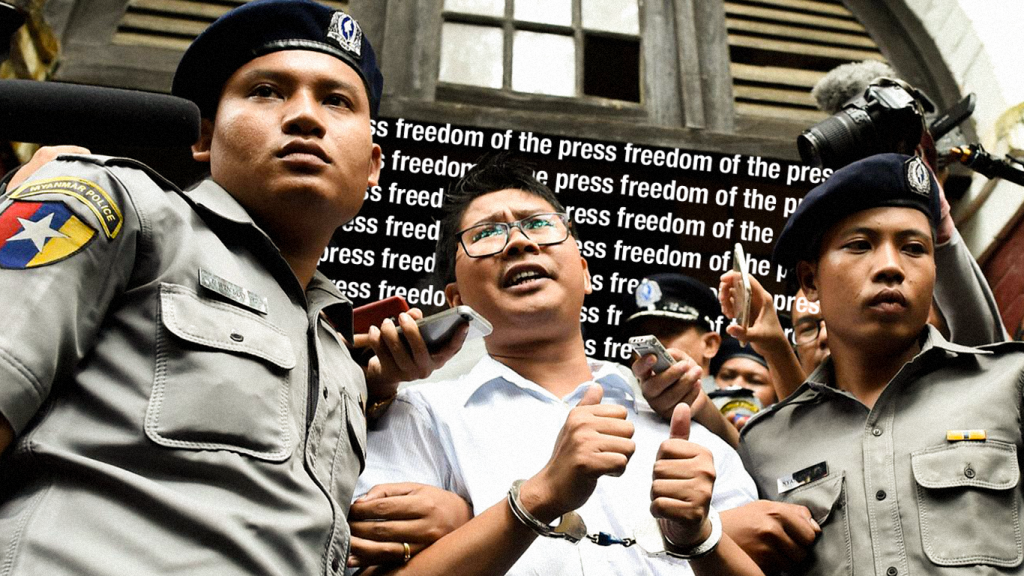
How Independent Burmese Media Is Keeping Its Citizens — And The World — Informed
Those covering Myanmar rely on citizen journalists and clandestine methods to report under threat — underscoring the importance of specialized training and the need for greater international support. After a decade of relative democracy, a coup d’etat on February 1, 2021 plunged Myanmar back into unrest. These conditions have affected every citizen, but in the face of overt threats like military raids, sophisticated surveillance, air strikes, and internet shutdowns, journalists covering the country also contend with difficult-to-reach and traumatized sources, complex regional conflicts, a highly restricted information ecosystem, and a lack of funding. The solutions these Burmese media organizations employ are as complex as the situations they report on: operating from abroad, decentralized information sharing, clandestine reporting techniques, and an army of highly trained citizen journalists. This style of reporting “has been fostered in the country for the last 20, 25 years,” says University of Toronto professor Matthew Walton, whose research centres on religion and politics in Southeast Asia, with a special emphasis on Myanmar. However, in the face of dwindling funding, this style of reporting may be endangered. As of February 2026, data from an armed conflict location and event data tracker shows nearly 93,000 fatalities since the junta took control, with the United Nations estimating over 30,000 people have been arrested on political grounds. The International Center for Not-For-Profit Law reports at least 226 journalists have been arrested since the 2021 coup, with around one quarter of them having been given extreme sentences of up to 27 years in prison. According to The Committee to Protect Journalists, seven journalists have been killed since February 2021. Sai Kham Phu, CEO of the Shan Herald Agency for News (SHAN), recalls covering the protests in Taunggyi, the capital of Shan state, when the junta first seized control. “Our journalists [were] hiding in the building, shooting videos and recording, [witnessing] the shooting of the people…our journalists had to hike to a safe place,” Phu says. While the 2010s saw a period of relative press freedom, according to Reporters Without Borders, the press in Myanmar was “set back ten years in ten days” after 2021. Since then, Phu says the government’s goal has been “to silence the people’s voice.” Surveillance mechanisms have helped the junta to stifle public dissent. According to Aung Zaw, the founder and editor in chief of Irrawaddy, an independent Burmese media outlet, the military government actively monitors outspoken journalists online. “The junta surveillance techniques are more sophisticated than ever due to assistance from Beijing and Moscow,” he says. On April 2, 2026, following what the United Nations (UN) referred to as a “sham election process” that populated Myanmar’s parliament with junta loyalists, General Min Aung Hlaing was elected president. But this false democracy, which the BBC called “more of a coronation than an election,” is something Burmese journalists are rallying against. Soe Myint, the founder of Mizzima, a Burmese multimedia news organization with millions of followers across its social media, states bluntly, “right now, the military is again consolidating its power, and they will try to hoodwink the international community…Canadian people should know very well. There’s nothing changing. This doesn’t lead to any democracy or human rights or federal union or peace.” For Myanmar’s journalists and media organizations, the fight to get information into and out of the country has never been more important. Phu says SHAN was originally affiliated with the Mong Tai Army (MTA), an ethnically Shan armed group, but after the MTA surrendered to government forces in 1996, the news agency moved its operations to Thailand. While briefly returning to Myanmar following democratic elections in 2010, after the coup in 2021, SHAN was forced to relocate once more. SHAN is not the only media organization operating in exile. Myint cofounded Mizzima while in India in 1998. Banned by the junta following the coup, the outlet now covers Myanmar from abroad, operating out of India, Thailand, and the Czech Republic. But being miles away presents a unique challenge for covering stories. “[Citizen journalists] might be connected with newsrooms [outside Myanmar],” but media organizations don’t necessarily know “many details [about their location] for the sake of their security,” says Tin Zar Aung, the co-founder of non-profit Myanmar Women in Media (MWiM). This makes fact-checking difficult too. Aung says one media organization may report on drone attacks, but the same one may also identify the wrong attack. “This is challenging for the media organization, and also this is the impact for the reader,” she says. Beyond hampering traditional newsgathering practices, this disconnect also endangers journalists and civilians. For instance, Phu says journalists who report unfavourably on the junta are often arrested, and the junta will only release them if they take down the news story. “We cannot protect them, right? So that safety is our first priority, so that we compromise, remove the story from…social media, sometimes even [our] website, just for the safety of our [citizen journalist],” he explains. “Just reporting is not a crime, but the state treats journalists as criminals; that is not fair.” Sources are treated similarly by the military government and other armed factions. “They don’t feel secure if they provide information sometimes…people would like to speak up, they would like to provide information, but later on…[a group] would come and intimidate the source,” he adds. Additionally, Aung says, “[Sources] are traumatized because of these kinds of problems…sometimes, [journalists] don’t know they are traumatized people.” In 2023, along with two other women journalists, Aung co-founded MWiM to shine a light on the specific challenges women journalists face, such as exploitation and sexual harassment. “We are concerned about [journalists’] safety, and our women journalists are facing a lot of the problem,” Aung adds. Meanwhile, reporting on regions not controlled by the junta is dangerous too. “Pieces that are critical of ethnic armed organizations or of the National Unity Government of Myanmar [the democratic government in exile] or things like that, those are not going to get you disappeared in the way that reporting in military-controlled areas might get you disappeared, but that’s going to maybe get more online backlash or that kind of backlash,” Walton says. Most recently, as many government aid agencies, such as USAID and Global Affairs Canada, scaled back their funding, Burmese media organizations are feeling the pinch. “The funding crisis is not only from the U.S., but also from others…most of the Myanmar media, independent media, rely on the funding,” explains Aung, who lost
This article requires PRO
This article is outside the free access window or is a special report. PRO unlocks it and the full archive.
Related articles
- Myanmar military deploys troops to Ywangan village, restricts male residents
The Myanmar military has deployed nearly 100 troops to Nwar Ban Gyi village in southern Shan State's Ywangan Township, restricting male residents from leaving the area and compiling detailed household rosters, according
- 87 individuals involved in online fraud and gambling arrested in Hopone
The Myanmar Police Force announced that 87 individuals involved in online fraud and gambling were arrested along with business equipment near Narlong Village, Hopone Township, Shan State South. On the morning of October
- Over 10 Billion Kyats Worth of Narcotics Seized in Leway
Over 10 billion kyats worth of methamphetamine tablets and heroin powder were seized from a 12-wheel vehicle in Leway Township, Naypyidaw, the Myanmar Police Force announced. A joint team including members of the Anti-Na
- Surrenders and internal friction reported among resistance ranks in Sagaing Region
At least 30 members of the People’s Defence Force (PDF), as well as another 30 members of unnamed resistance forces, surrendered to the military in Sagaing Region’s Shwebo, Monywa and Chaung-U townships over the past two