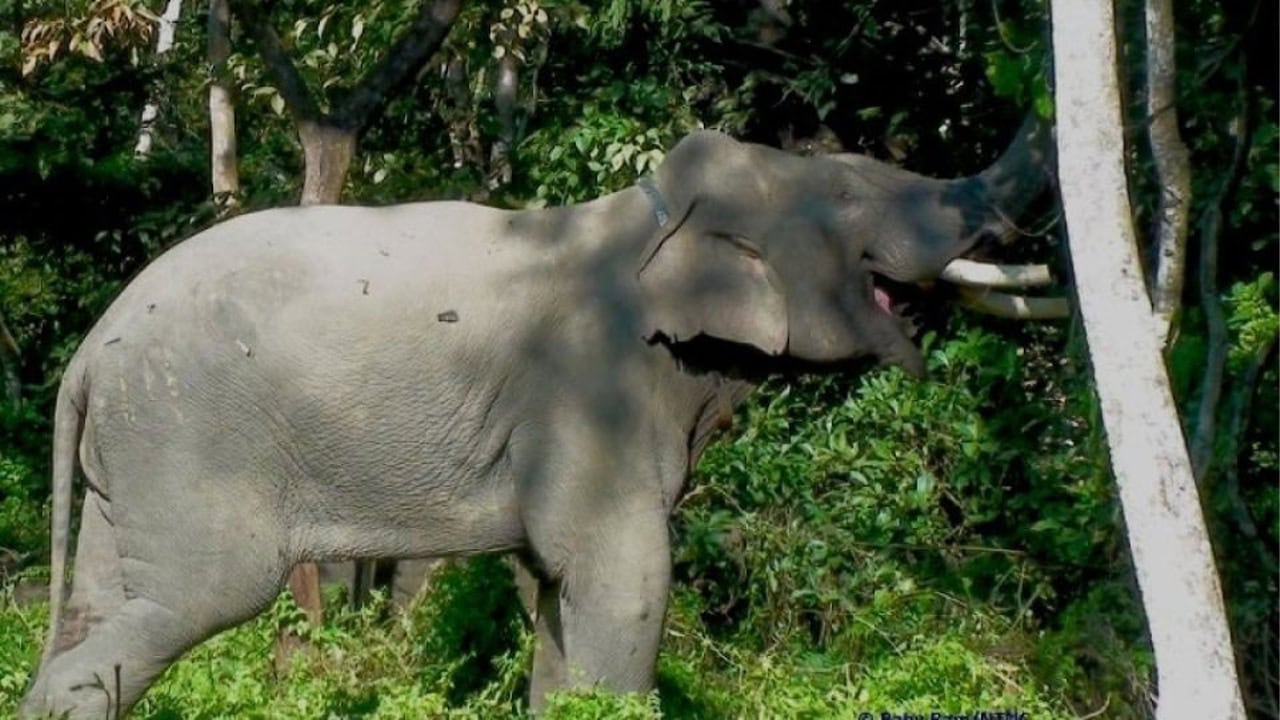
Nepal Launches All-Out Operation to Capture Killer Elephant 'Dhurbe'
Nepal has launched a full-scale operation to capture Dhurbe, a wild elephant blamed for at least 25 deaths over 15 years. Following recent fatalities, park authorities, the army, and veterinarians are collaborating, utilizing advanced technology to track the animal.
CHITWAN – Chitwan National Park has deployed round-the-clock patrols in a renewed effort to capture Dhurbe, the notorious wild male elephant blamed for killing at least 25 people over the past 15 years, after it recently claimed the lives of a 25-year-old woman and her four-year-old son in Chitwan. The joint operation, involving park officials, veterinarians, the Nepali Army and technicians from the National Trust for Nature Conservation (NTNC), has been searching for the elephant for the past week. However, officials say the animal has repeatedly evaded capture by remaining deep inside the forest during the day and venturing into nearby settlements at night. The latest operation follows the July 4 attack in Jagatpur in ward 23 of Bharatpur Metropolitan City where Dhurbe killed 25-year-old Ashika Bote and her four-year-old son Bharat Bote after breaking into their home. The incident sparked protests by local residents, who demanded that authorities immediately control the tusker and provide relief to the bereaved family. Since then, the elephant has continued to move across western Chitwan, damaging houses in Meghauli and, most recently, in Bankatta of Madi Municipality, where it destroyed the house of local Deepak Bote late on Friday night before retreating into the forest. “We have deployed patrol teams in three shifts, operating round-the-clock, from the park headquarters,” said Dill Bahadur Pun, chief conservation officer at Chitwan National Park. “The teams are monitoring the areas from Jagatpur to Meghauli Golaghat and Madi, but the elephant has remained difficult to locate because it hides in the dense core forest during the day.” According to Pun, poor visibility caused by dense vegetation and the monsoon weather has made tracking the elephant particularly challenging. Authorities plan to tranquillise Dhurbe using a dart gun as soon as it is located. Officials will then fit it with a new satellite tracking collar and trim its tusks, which park officials believe could help reduce its aggressiveness. “The new collar is far more advanced than the previous one,” Pun said. “It can transmit the elephant’s location as frequently as every 15 minutes and comes equipped with geofencing technology. If the elephant enters a designated high-risk area, the system immediately sends an alert, allowing our response teams to act quickly.” The previous collar transmitted the elephant’s location only once an hour. Officials said geofencing has already been programmed for villages stretching from Jagatpur to Meghauli Golaghat and from Bankatta to Bagai in Madi, where the elephant frequently strays into human settlements. Dhurbe has been fitted with tracking devices three times before. A radio collar was first attached in November 2012 after authorities abandoned an attempt to shoot the elephant. Satellite collars were later fitted in 2020 and again in 2023, but the latest unit has deteriorated and no longer provides reliable signals. Park information officer Abinash Thapa Magar said the upgraded collar would allow officials to monitor the elephant’s movements in real time through mobile phones and computers, enabling quicker deployment of response teams. Dhurbe’s violent history stretches back to 2010, when it began attacking people around Chitwan National Park before expanding its range into Bara and Parsa districts. According to the park, the elephant has now killed 25 people, including Ashika and Bharat Bote. Following the deaths of 15 people, the government ordered the elephant to be shot in December 2012 and spent around Rs1.6 million on a military operation to hunt it down. Despite being wounded, the elephant escaped into the dense forest and reappeared in western Chitwan in 2016. As reported by the Post last week, Dhurbe has repeatedly devastated the family of Shanichara Bote. The elephant killed Shanichara’s parents in Madi in 2012, forcing the family to relocate to Jagatpur. Fourteen years later, it found the family again, and killed Shanichara’s daughter-in-law and grandson. After Shanichara’s parents were killed, a high-level emergency security meeting chaired by the Chief District Officer issued a formal executive order to track down and kill the elephant. What followed was an intensive two-week operation involving the Nepali Army and conservation personnel in the dense forests of Chitwan. Wildlife experts say fitting the elephant with a satellite collar remains the most practical short-term measure to protect nearby communities. Hari Bhadra Acharya, senior ecologist and information officer at the Department of National Parks and Wildlife Conservation, said long-term solutions should also be explored. “Continuous monitoring through satellite collars can help protect local communities, but a permanent solution could involve establishing a sanctuary for such aggressive elephants,” Acharya said. He added that Nepal’s wildlife laws also allow authorities to destroy elephants officially declared rogue, although such a decision requires clear evidence and official approval. Chitwan is also home to other wild bull elephants, including Ronaldo and Govinde, which conservationists say play an important role in breeding with captive female elephants. However, human-elephant conflict continues to claim lives in and around the park every year, as local communities press for a lasting solution. ANN/The Kathmandu Post
多角的分析
人食い象「ドゥルベ」による被害は、単に人命に関わるだけでなく、農作物や家屋への損害を通じて地域経済にも影響を与えている。特に、象が頻繁に出没する地域では、農業活動が阻害され、住民の生計が脅かされる可能性がある。また、象の捕獲や管理には多額の費用がかかり、国立公園の予算を圧迫する要因ともなりうる。長期的な解決策として、象の生息域と人間の居住域の分離や、象が嫌う植物の植栽などが経済的負担を軽減する可能性がある。
このニュースは直接的な投資機会には結びつかないものの、カンボジアにおけるインフラ開発や観光業への投資を検討する際には、人獣衝突のリスクを考慮する必要があることを示唆している。例えば、国立公園周辺での観光施設開発においては、野生動物との共存を前提とした計画が不可欠となる。また、農業関連の投資においても、野生動物による被害リスクを評価項目に含めることが賢明である。
人食い象「ドゥルベ」による度重なる襲撃は、チトワン国立公園周辺住民の生活に深刻な恐怖と不安をもたらしている。特に、過去に被害に遭った家族が再び犠牲になった事例は、住民の無力感と怒りを増幅させている。日中のパトロール強化や最新技術の導入は、住民の安全確保に向けた当局の努力を示す一方、象が夜間に活動するという特性から、住民は依然として夜間の恐怖に晒されている。これは、野生動物との共存という課題が、地域住民の日常生活に直接的な影響を与えている現実を浮き彫りにする。
「ドゥルベ」による被害は、チトワン国立公園周辺の住民、特に被害を受けたボテ家のような家族にとって、計り知れない悲劇をもたらしている。2012年に両親を失い、14年後に娘婿と孫を失ったシャニチャラ・ボテ氏の経験は、人獣衝突がいかに世代を超えて家族を苦しめるかを示している。地元住民は、象の駆除や安全確保を求めて抗議活動を行っており、当局への不信感と、安全な生活への切実な願いが表明されている。
背景・歴史的文脈
ネパールにおける人獣衝突は、長年にわたる問題である。チトワン国立公園周辺では、農地拡大や森林破壊により、野生動物と人間の生息域が重なることが増えている。特に象は、広範囲を移動し、農作物を食い荒らすなど、人間との接触機会が多い。過去には、象を射殺する試みも行われたが、根本的な解決には至らず、象の行動範囲や攻撃性は変化し続けている。今回の「ドゥルベ」事件は、こうした構造的な問題が、悲劇的な形で表面化した事例と言える。
原文ソース
Phnom Penh Post