General articles are free for 24 hours after publish.
Thailand to Slash Visa-Exempt Stay to 30 Days, Limit Land Crossings
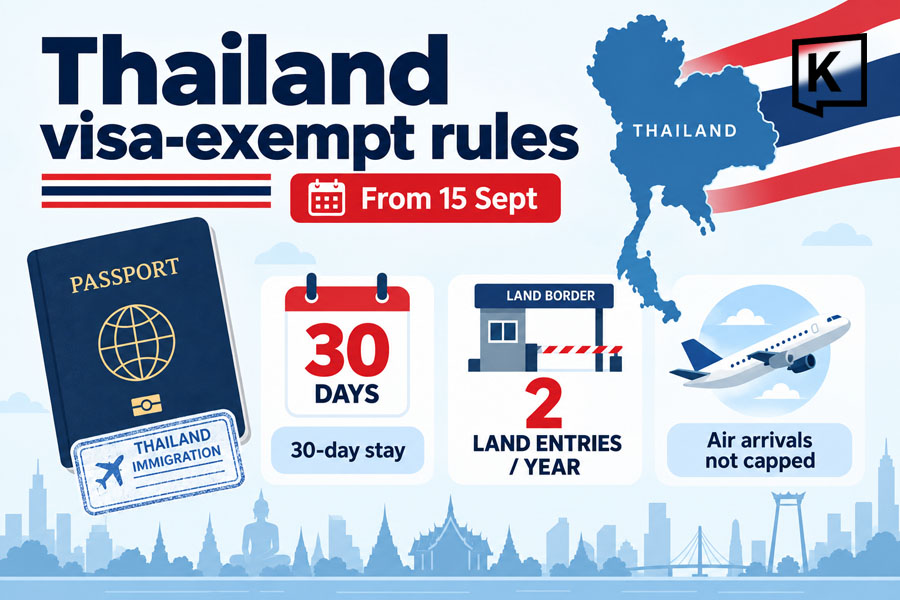
Thailand will reduce its standard visa-exempt stay from 60 to 30 days starting September 15, while also reintroducing a two-entry annual limit for most visa-exempt land crossings.
Thailand will cut its standard visa-exempt stay from 60 days to 30 days from 15 September, while also reintroducing a two-entry annual limit for most visa-exempt land crossings. The two-entry limit at land borders is not a new rule, but it will continue under the new 30-day scheme with tighter enforcement. Here is what travellers need to know. How long can I stay in Thailand without a visa? From 15 September, travellers using Thailand’s standard tourist visa exemption will be allowed to stay for up to 30 days per entry, down from the current 60 days. Travellers who enter before 15 September can remain until the expiry date already stamped in their passport. Which countries are visa-exempt? The new 30-day scheme covers 60 countries and territories, including Australia, Canada, India, Japan, Singapore, the United Kingdom and the United States. See the full list of 60 countries and territories Some other nationalities may qualify for visa-free entry under separate bilateral agreements with Thailand, with different permitted stays. What is the two-entry land cap? From 15 September, most travellers using Thailand’s tourist visa exemption may enter through land-border checkpoints no more than twice per calendar year. Thailand has used a similar cap before, but the hard two-entry limit was not part of the 60-day visa-exemption scheme introduced in July 2024. Nationals of Malaysia, Brunei, Indonesia and Singapore are exempt and may make more than two visa-exempt land entries per calendar year. The interior minister may also designate other nationalities for exemption. Do my entries from before 15 September count? It is unclear. The two-entry cap takes effect as part of the new 30-day scheme on 15 September, but the published rules describe the limit as two entries “per calendar year” without explaining how the transition will be handled. Authorities have not clarified whether visa-exempt land entries made under the outgoing 60-day scheme earlier in 2024 will count towards the new limit. Travellers should therefore not assume that 15 September gives them two fresh land entries for the remainder of 2024. What about air travel? The two-entry cap does not apply to arrivals by air. However, this does not mean unlimited visa runs by air are guaranteed. Immigration has separately tightened screening of foreigners who repeatedly leave and re-enter Thailand under visa exemption in a pattern that does not resemble normal tourism. Immigration has said travellers making repeated visa runs without a reasonable explanation may be refused entry and told to obtain a visa appropriate for their actual purpose of stay. See official Immigration guidance on repeated visa runs (Thai) What happens if I am already in Thailand? If you enter Thailand before 15 September, you can stay until the expiry date already stamped in your passport. Your existing 60-day permission to stay will not automatically be shortened when the new rules take effect. See the Foreign Ministry’s clarification (item 4) What else is changing? The new 30-day exemption is for tourism purposes. Nationals of Seychelles and Mauritius will have a separate 15-day visa exemption, while Visa on Arrival will be available to nationals of only Azerbaijan, Belarus and Serbia. Travellers entering Thailand for work, business or another purpose should check whether they need an appropriate visa rather than relying on tourist visa exemption. What do I need to know before doing a border run? If you have already used your two visa-exempt land entries this calendar year, do not assume the count starts again on 15 September. A further visa-exempt land entry may be refused unless you fall under one of the nationality exemptions. Even if you have not reached the land-border cap, entry is never guaranteed. Immigration officers can still examine your travel history and purpose of visit. Thailand has also stepped up immigration enforcement more broadly. Immigration has ordered closer screening of repeated visa runs at both airports and land borders, while new deportation procedures introduced in August cover foreigners who enter or remain illegally, work illegally or fall under other specified grounds. All foreign travellers must also submit a Thailand Digital Arrival Card (TDAC) before entering Thailand, including by land. A new TDAC is required for each entry and can be submitted within three days of arrival. Official Thailand Digital Arrival Card website The bottom line 60 days becomes 30: The standard tourist visa exemption falls to 30 days from 15 September. 60 countries and territories: The new 30-day scheme applies to passport holders on the revised eligibility list. Two land entries: Most visa-exempt travellers are limited to two land-border entries per calendar year. The cap is not new: It already applies under the current visa-exemption scheme. Four nationalities are exempt from the cap: Malaysia, Brunei, Indonesia and Singapore. No September reset has been announced: Do not assume you receive two new land entries on 15 September. Air arrivals are not covered by the two-entry cap: Frequent visa-run patterns may still face closer scrutiny. Existing stays remain valid: Anyone admitted before 15 September can stay until the date already stamped in their passport. The post Understanding Thailand’s upcoming visa changes appeared first on Khaosod English.
Original source
Khaosod English