General articles are free for 24 hours after publish.
Vietnam Mourns Passing of Professor Vu Van Dinh, Pioneer of Critical Care Medicine
Professor Vu Van Dinh, a foundational figure in Vietnam's critical care medicine, has passed away at 94. Hundreds of doctors and patients at Bach Mai Hospital mourned his passing, honoring his significant contributions, including establishing modern intensive care units and developing antivenom.
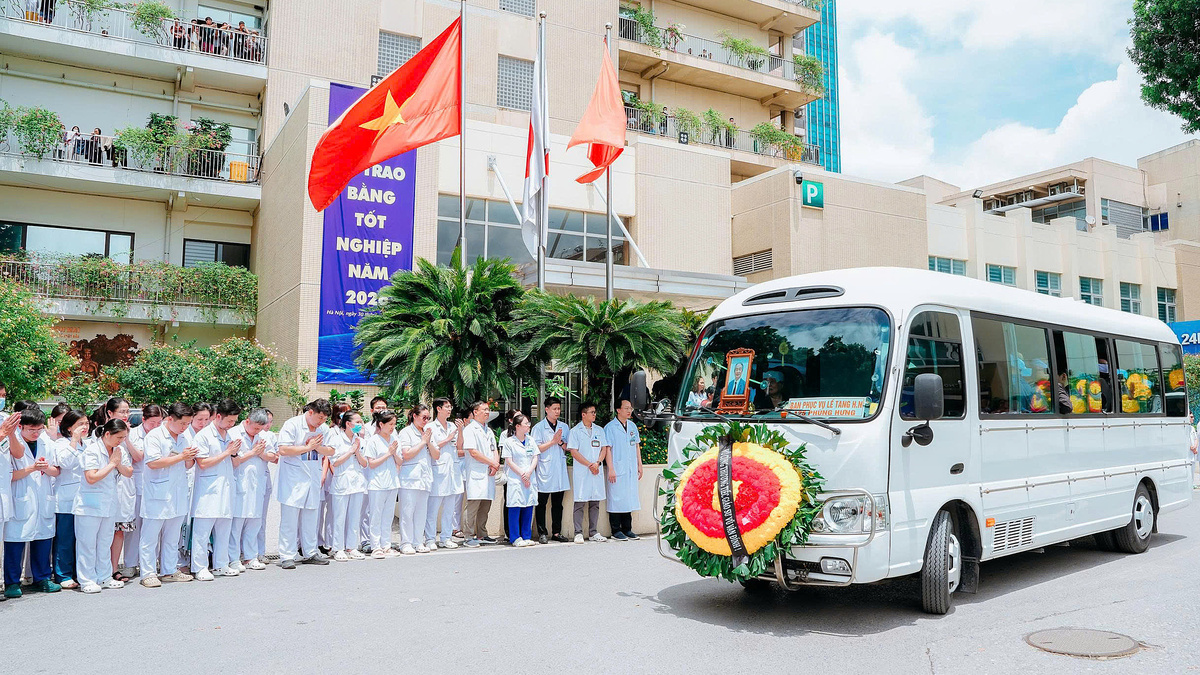
Professor Vu Van Dinh, widely regarded as the father of modern critical care medicine in Vietnam, has passed away at the age of 94 due to old age. On August 1, hundreds of medical staff and patients at Bach Mai Hospital in Hanoi silently bid farewell to the esteemed professor as his hearse passed through the hospital grounds on its way to Van Dien cemetery. Dr. Dao Xuan Co, Director of Bach Mai Hospital, emotionally recalled the indelible marks Professor Dinh left on the hospital's development and the field of critical care. "The flame of passion that the professor ignited in the career of caring for, protecting, and improving people's health will be preserved by generations of his students," stated Dr. Co. Born in 1933 in Hai Duong province (now part of Hai Phong city), Professor Vu Van Dinh graduated from Hanoi Medical University in 1959 and dedicated nearly his entire life to Bach Mai Hospital and Hanoi Medical University. His name is closely associated with the A9 Department of Critical Care, often described as the "gateway between life and death" at Bach Mai Hospital. From the early days of scarcity, he and his colleagues established a modern critical care model, introducing advanced techniques such as defibrillation, pacemaker implantation, artificial ventilation, peritoneal dialysis, and continuous hemodialysis. These innovations opened up life-saving opportunities for thousands of critically ill patients. He also played a key role in advising on the establishment of an organizational model comprising three specialties: outpatient examination, emergency care, and intensive care. This model was subsequently replicated in numerous hospitals nationwide and remains the foundational structure for hospital emergency systems to this day. In 1994, Professor Dinh founded the Toxicology Department within the A9 unit, which served as the precursor to the current Center for Poison Control. Building upon this foundation, Bach Mai Hospital's emergency system evolved into specialized centers, including the A9 Emergency Center, the Intensive Care Center, the Center for Poison Control, and the Stroke Center, collectively saving tens of thousands of severely ill patients annually. Beyond his clinical pioneering, Professor Dinh directly established the Department of Critical Care at Hanoi Medical University, compiled textbooks, developed training programs, and mentored numerous generations of doctors across the country. Many of his students have become distinguished educators, scientists, and leading medical professionals in major hospitals. His scientific legacy is also recognized through numerous practical research works. Notably, his research on treating severe malaria significantly reduced mortality rates. He developed guidelines for diagnosis, treatment, and critical care technical procedures that were applied nationwide. One of the most frequently recounted stories by his students is his endeavor to "raise snakes to save lives." In the early 1980s, Vietnam did not produce antivenom, leading to many deaths from snakebites. He mobilized local communities and many areas to provide venomous snakes, establishing a breeding facility adjacent to the A9 department to harvest venom for research. He personally cared for and monitored various venomous snakes, including cobras, king cobras, banded kraits, and pit vipers. These research efforts significantly contributed to the development of antivenom in Vietnam, opening effective treatment avenues for patients and laying the groundwork for the country's toxicology field. Throughout his career, Professor Dinh held several important positions, including Head of the A9 Critical Care Department, Head of the Department of Critical Care at Hanoi Medical University, and Chairman of the Vietnam Association of Critical Care and Toxicology. He was awarded the title "People's Doctor" by the State, was honored twice as a "Labor Hero," received the Independence Medal, and numerous other prestigious awards. In 2012, he was presented with the "Lifetime Contribution" award for healthcare at the Asian Hospital Management Conference held in Hanoi. Concluding nearly a century of dedication, Professor Dinh has left the Vietnamese medical community not only with scientific works, specialized units, and pioneering techniques but also with a generation of physicians imbued with medical ethics, a spirit of dedication, and the unwavering aspiration to save lives. While one life has ended, the path he opened for Vietnam's critical care medicine continues to be preserved and advanced by successive generations.
Original source
VnExpress