General articles are free for 24 hours after publish.
Okinawa Elects New Governor Prioritizing Economy Over US Bases
Koja Genta, a 42-year-old former Naha City mayor, secured a decisive victory in Okinawa's gubernatorial election, signaling a shift in voter priorities from the long-standing US base issue to economic revitalization. The new governor faces the challenge of implementing economic development plans, including the utilization of returned base land.
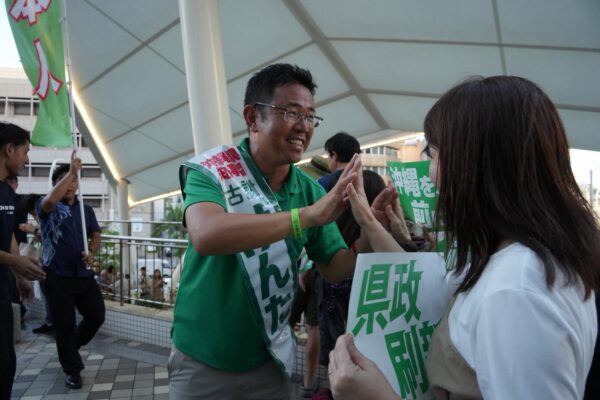
Read The Diplomat, Know The Asia-Pacific Koja Genta didn’t win because of his stance on U.S. bases. He won because of his vision for the economy. Koja Genta greets a supporter as he celebrates his victory in the Okinawa governor’s election, Sep. 13, 2026. On September 13, Japan’s Okinawa Prefecture held its gubernatorial election. Koja Genta, a 42-year-old former mayor of Naha City, emerged with a convincing victory – 59 percent (423,124 votes) to 38 percent (276,060 votes) – against incumbent Governor Denny Tamaki. His election can create genuine – and long overdue – momentum to transform the relationship between the Japanese government and Okinawa from the confrontation over U.S. bases in the prefecture into a partnership to move Okinawa forward. As a home to the U.S. Marines Third Expeditionary Force (III MEF) headquarters, local elections in Okinawa from the governor’s race on down always attract not only national attention but also a great deal of interest from the U.S. defense establishment. With the ongoing plan to realign and consolidate the U.S. Marine Corps’ presence in Okinawa, Sunday’s election was particularly critical. As a governor, Koja has a profile that is different from any of his predecessors. First and foremost, at the age of 42, he is the youngest governor that Okinawa has ever elected. Born in 1983, he is also the first governor who was born after Okinawa reverted to Japan in 1972. Furthermore, while he was born and grew up in Okinawa, he spent his formative years as a young adult in Tokyo as a college student, a civil servant at the Ministry of Internal Affairs and Communications, and a program manager in the private sector. His profile – born and grew up in Okinawa but left his hometown for mainland Japan for higher education and employment before returning to Okinawa to run for office – crystallizes the economic challenge that the working-age generation in Okinawa has long been facing. Okinawa’s economy lacks diversity; it is heavily dependent on tourism. This makes employment in the prefecture more seasonal and temporary in nature. Furthermore, while its aging population continues to create greater demand for workers in senior living management, medical assistants, and nursing, there are far fewer opportunities for high-skilled and well-paying jobs. The local economy makes it challenging for the working-age population, especially younger people, to live in Okinawa and raise families. Its unemployment rate is twice as high as the national average, with persistent structural unemployment. Mindful of this reality, Koja placed vitalization of the Okinawan economy front and center in his election campaign. His landslide victory – he earned the most votes in 40 out of 41 localities in Okinawa – demonstrates that Koja’s message of moving the Okinawan economy forward resonated much more than Tamaki’s message, which attempted to campaign by continuing to tap anti-base sentiment within the prefecture. This election exposed a clear generational divide. The exit polls showed that over 60 percent of voters younger than 60 years old voted for Koja, while Tamaki continued to retain strong support among older constituents. That said, this split should not be reduced to a simplistic contest between “younger” vs. “older” Okinawans, let alone the stereotypical explanation of the younger generation being “pro-base” because they see a greater threat from China while the older generation remains “anti-base” due to their memories of the Battle of Okinawa and its tragic ending. Kaja’s victory reflects a much deeper shift in priorities among Okinawans. For many voters in their working and family-raising years, kitchen-table issues – such as stagnant incomes, inflation, lack of well-paying employment and the island’s overall economic prospects – have become much more urgent than repeating political battles over U.S. bases. Those long-running political fights have produced little practical change, let alone improvement in the local economy. Exit polls clearly demonstrated this unmistakable shift, with a greater percentage of the voters identifying “economic growth” as their top issue of concern. Still, Koja’s position on relocating Marine Corps Air Station Futenma to Henoko – as agreed to by the U.S. and Japanese governments back in 1996 – is significant. Koja argued that his acceptance of the existing relocation plan is not an endorsement of Okinawa’s disproportionate base burden. Rather, he insisted that the fastest, most practical way to eliminate the risk posed by Futenma is to work with the government to ensure the completion of the relocation. Koja ran on a practical platform of a three-pronged approach: complete the relocation to Henoko, demand that Tokyo establish a credible return date for the land currently occupied by Futenma and additional land south of Kadena Air Force Base, and begin planning for how to utilize the property upon return. What comes next should be the center of the new administration’s agenda. The eventual return of Futenma and other U.S. facilities south of Kadena Air Base presents Okinawa with a rare development opportunity. Land-use decisions, transportation links, housing, education, research, tourism, and private investment cannot be improvised after the fences come down. Koja should convene municipalities, residents, businesses, universities, and the national government to produce a transparent redevelopment strategy with timelines, financing, and measurable benefits for local communities. If managed well, base consolidation can become not merely a security adjustment but a catalyst for higher productivity and durable growth. With Koja’s election, Okinawa will have a governor who has the backing not only from the ruling Liberal Democratic Party (LDP) and its coalition partner Nippon Ishin no Kai (the Japan Innovation Party) but also from other conservative and center-right political parties that endorsed Koja during the election. This allows the Takaichi government to attempt a “reset” of Tokyo’s relationship with Naha under Governor Koja as a partner. However, as tempting as it may be for the Japanese government to intensify its push toward completing the long-stalled Futenma relocation, Tokyo must first understand the drivers behind Koja’s decisive victory. In other words, Tokyo needs to appreciate the reality that Koja’s convincing victory reflects more than a change of administration. It is a reflection of a strong public demand for a new direction for Okinawa, especially in its economy. Koja’s landslide is therefore not a blank check. It is a mandate for results: reduce the danger at Futenma, complete the relocation without further unnecessary delay, return the land on a dependable schedule, and convert that land into opportunity for Okinawans. The voters have chosen a younger leader who promised to move forward. His success will depend on whether every party to the agreement now does the same. Subscribe today
Original source
The Diplomat Indonesia