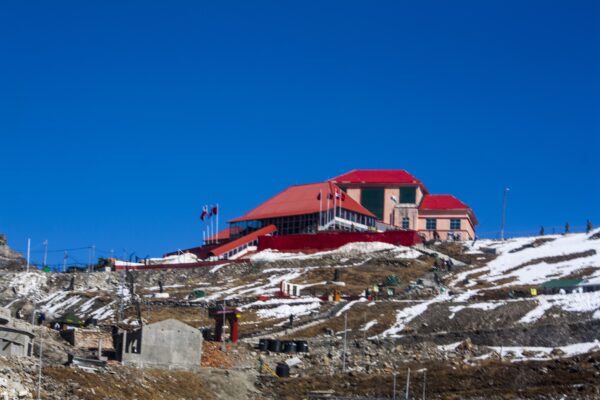
India and China Reopen Nathu La Pass Amid Cautious Diplomacy
Diplomacy
2026年7月31日
4
The Diplomat Indonesia

General articles are free for 24 hours after publish.

India and China Reopen Nathu La Pass Amid Cautious Diplomacy

Share
AI Summary

India and China will reopen the Nathu La pass for trade starting August 1, amidst ongoing bilateral tensions. This move signifies a cautious restoration of practical cooperation, contingent on peace along the border, and reflects an unstable stabilization of the relationship.

Some practical cooperation is being restored between the two neighbors, despite the serious differences that remain. The China-India border post at the Nathu La pass as viewed in 2011. The last six years have been a testing time for China-India relations. The boundary crisis in Eastern Ladakh in 2020, along with the loss of lives in the Galwan Valley in June 2020, brought the bilateral relationship to its lowest levels in decades. Trade through Nathu La, a mountain pass through the Himalayas linking India’s Sikkim state with Tibet, also stopped in 2020. The meeting between Indian External Affairs Minister S. Jaishankar with China’s Foreign Minister Wang Yi in Manila on July 22 focused on peace on the border and practical trade cooperation. A few days later, it was announced that the Nathu La pass would be reopened from August 1. This sequence of events is part of the cautious diplomacy that is now taking shape where serious differences will remain but some practical cooperation is slowly being restored. For centuries, the route through the Chumbi Valley carried Indian textiles up into Tibet and Tibetan wool down into India via the Nathu La pass. Merchants and pilgrims walked in both directions, connecting the Bengal plains with Lhasa. The 1962 Sino-Indian war shut down that passage, and it remained closed for more than four decades. When it was reopened in 2006, it was the result of patient diplomacy rather than overwhelming commercial demand. Trade continued on a modest, seasonal basis until it was suspended in 2020, when bilateral relations were entering their most difficult phase in years. The opening of the Nathu La pass from August 1 is one of the dividends of the slow, cautious, and calibrated stabilization of China-India relations, which was set in motion by the meetings between Prime Minister Narendra Modi and President Xi Jinping in Kazan in 2024 and Tianjin in 2025. Direct flights resumed in October 2025, and the Kailash Mansarovar Yatra resumed in 2025 and continued this year also, while official mechanisms, academic contacts, and think-tank exchanges have also resumed. India’s position through this period has remained constant, and it is not just a bargaining posture. As Jaishankar put it in his July 6 meeting with Wang, “Peace and tranquility in the border areas is obviously the prerequisite for normal ties.” Therefore, the relationship can only move forward when it is built on “mutual respect, mutual interest, and mutual sensitivity.” Border trade through Nathu La pass in the Himalayas will never resemble trade through ports or industrial corridors, because the volumes are small, the season is short, and logistics are determined by altitude and weather. But for people living on the frontier, the pass is important, since a predictable trading season gives transport operators and logistics providers work to do, and gives small businesses access to commercial activity that is difficult to sustain in remote mountain districts otherwise. Although the trade is seasonal and limited to designated goods, it will be transformative for the regional economy in border districts. Regular commerce helps to alleviate isolation, and gives local communities a direct stake in a stable China-India border. Trade does not generate trust overnight, but it can make cooperation appear more easy. The most obvious objection to the reopening of border trade at Nathu La is a matter of scale. The volume of bilateral trade between China and India is already nearing $151 billion in the 2025-26 fiscal year, while India’s deficit has reached around $112 billion. Trade at Nathu La will not bridge the gap, nor will it solve India’s concerns about market access and predictable supply chains, much less the boundary question. Therefore those issues will require sustained attention through established diplomatic and military channels. The biggest challenge for the reopening of the Nathu La pass is implementation of the agreement. Both sides should perhaps consider planning predictable annual calendars, transparent customs requirements, effective communication networks and adequate storage facilities. Operational issues will also require a speedy redress mechanism. Traders and local communities need to be consulted, as they are the ones who know the practical problems of the Nathu La route much better than anyone in either capital. Moreover, commercial activity at such high altitude must also take into account the fragility of the Himalayan environment. India and China are big neighbors whose decisions will have important consequences for the larger Asian order. Although differences will persist, including on high-stakes issues, the task of diplomacy is to engage, even as it seeks to identify areas where cooperation is possible and useful. The traders who will cross Nathu La on August 1 will not solve the boundary question, but the reopening shows what can be accomplished when political understandings are translated into meticulous administration. Geography has often divided India and China; however, diplomacy, pursued with patience and care, might succeed in joining them again. Subscribe today and join thousands of diplomats, analysts, policy professionals and business readers who rely on The Diplomat for expert Asia-Pacific coverage. Get unlimited access to in-depth analysis you won't find anywhere else, from South China Sea tensions to ASEAN diplomacy to India-Pakistan relations. More than 5,000 articles a year. Already have an account? Log in. Siddharth Singh is a senior research fellow at the India Foundation. Get briefed on the story of the week, and developing stories to watch across the Asia-Pacific.

0

Original source

The Diplomat Indonesia

原文を読む