General articles are free for 24 hours after publish.
Vietnam Proposes 7-Day Lunar New Year Holiday for Public Workers in 2027
Vietnam's Ministry of Home Affairs has proposed a seven-day Lunar New Year (Tet) holiday for public workers in 2027. The plan, formulated in accordance with labor laws, aims to balance workplace productivity with statutory leave entitlements.
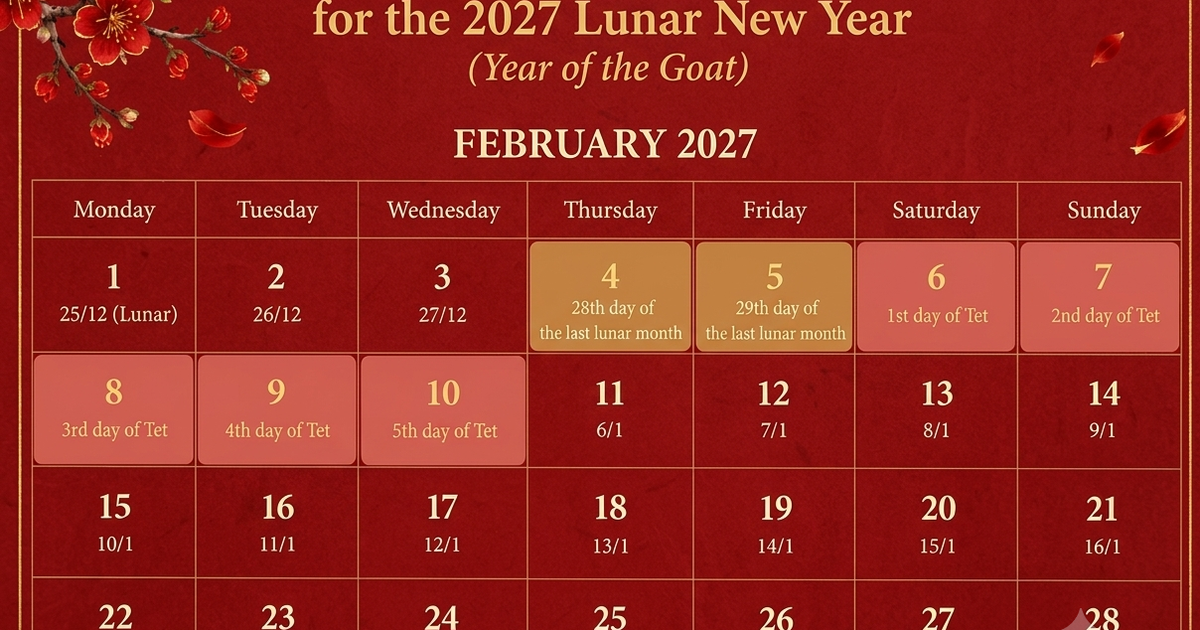
The Ministry of Home Affairs of Vietnam has submitted a proposal to the government to extend the Lunar New Year (Tet) holiday to seven consecutive days in 2027. If approved, public workers would enjoy a holiday period from Thursday, February 4, 2027 (the 28th day of the twelfth lunar month) to Wednesday, February 10, 2027 (the fifth day of the first lunar month). Nguyen Thi Quyen, Deputy Director General of the Department of Employment under the Ministry of Home Affairs, explained that the proposed schedule was formulated in strict accordance with current statutory frameworks, including the Labor Code, the Law on Cadres and Civil Servants, the Law on Public Employees, and the Law on the Organization of the Government. The aim is to balance workplace productivity with statutory leave entitlements. The plan was developed after the ministry collected feedback from relevant ministries and agencies. Earlier, the Ministry of Home Affairs also submitted a proposal for a four-day break for Viet Nam Culture Day (November 24), which would involve swapping Monday, November 23, with Saturday, November 28, as a working day to allow civil servants and public employees a four-day consecutive holiday from Saturday, November 21, through Tuesday, November 24. Tet is the most important holiday for Vietnamese people, traditionally a time for family reunions and travel. The extension of the Tet holiday for public workers to seven days is likely considered in light of its significance for national life. Within Vietnam's one-party system, government decisions directly influence legal and administrative changes, including holiday schedules. As Vietnam continues its economic growth, maintaining and improving labor productivity remains a key focus, alongside enhancing the quality of life and employee benefits for its citizens. This proposal can be seen as part of efforts to strike that balance. Furthermore, while Vietnam maintains strong economic ties with China, it pursues an independent foreign policy due to historical and political considerations; domestic stability and citizen welfare are crucial elements that can influence these broader foreign relations.
Original source
Bao Chinh Phu