Italy Boosts Defense Diplomacy with Aircraft Carrier Transfer to Indonesian Navy
Italy is intensifying its engagement in Southeast Asia through military and industrial partnerships, notably with the transfer of the aircraft carrier 'Giuseppe Garibaldi' to Indonesia, signaling a new defense industry-driven diplomatic strategy.
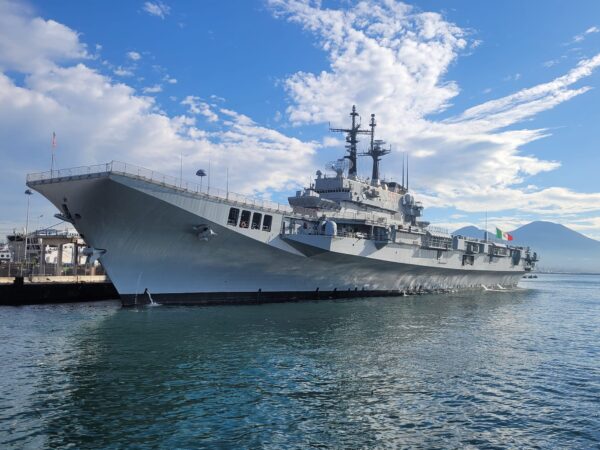
Read The Diplomat, Know The Asia-Pacific Italy is making an unexpectedly assertive return to Southeast Asia – not through trade or development aid, but through defense diplomacy. The Giuseppe Garibaldi aircraft carrier anchored in Naples, Oct. 25, 2024. The carrier is set to be transferred to the Indonesian navy by the end of 2026. When Italian Defense Minister Guido Crosetto attended this year’s Shangri-La Dialogue in Singapore, the visit attracted little attention in Europe. Yet Rome’s presence at Asia’s premier security forum was only one element of a broader pattern that has emerged over the past year. From expanding defense cooperation with Malaysia to Parliament’s approval of the transfer of the decommissioned aircraft carrier Giuseppe Garibaldi to Indonesia, Italy has quietly intensified its engagement with Southeast Asia through military and industrial partnerships rather than traditional diplomacy. The trend reflects both changing regional dynamics and Italy’s own comparative advantages. As strategic competition intensifies across the Indo-Pacific, Southeast Asian countries are investing heavily in naval modernization, maritime surveillance, and defense industrial cooperation. While major powers dominate the region’s security architecture, middle powers have found opportunities by offering technology, training, and industrial partnerships instead of formal security guarantees. Italy appears to be embracing precisely this model. Rather than competing militarily with larger actors, Rome has leveraged the strengths of its defense industry. Companies such as Leonardo and Fincantieri have become central to Italy’s regional presence, offering advanced naval platforms, aerospace technologies, and long-term industrial cooperation. At Malaysia’s DSA & NATSEC Asia exhibition earlier this year, for example, Fincantieri promoted its Landing Platform Dock proposal for the Royal Malaysian Navy alongside other naval solutions tailored to Kuala Lumpur’s modernization plans. Such initiatives illustrate that Italian engagement increasingly extends beyond arms exports to encompass technology transfer, industrial collaboration, and enduring defense partnerships. This convergence of industrial and diplomatic objectives is telling. Italy’s defense diplomacy increasingly serves as an enabling framework for its defense industry, while commercial partnerships reinforce Rome’s political relationships throughout Southeast Asia. The result is a mutually reinforcing strategy in which ministerial visits, naval cooperation agreements, military exchanges, and industrial proposals advance broader foreign policy objectives. Yet the growing coherence of Italy’s approach also exposes its limitations. Unlike France, which maintains permanent military assets and overseas territories in the Indo-Pacific, Italy possesses neither a sustained regional military presence nor the logistical infrastructure necessary to support an expansive security role. Its influence therefore depends on maintaining political engagement, naval deployments, industrial cooperation, and military exchanges over many years. Whether Rome possesses the financial, diplomatic, and military resources to sustain such a long-term commitment remains an open question. An equally important challenge relates to Europe as a whole. The European Union has repeatedly emphasized the strategic importance of the Indo-Pacific and has steadily expanded its political engagement with ASEAN. However, defense cooperation in the region continues to be driven overwhelmingly by individual member states. Italy’s recent initiatives illustrate this dynamic. While fully compatible with the EU’s broader objectives, they remain largely national in conception and implementation, reflecting Rome’s own industrial priorities and bilateral partnerships rather than a coordinated European framework. This creates an inherent strategic dilemma. If the European Union eventually develops a more integrated defense posture toward Southeast Asia, Italy may find itself needing to reconcile an extensive network of bilateral initiatives with common European priorities. Conversely, if European coordination remains limited, Rome risks assuming commitments that could prove difficult to sustain on its own. Italy’s expanding defense diplomacy should therefore not be interpreted simply as a series of successful arms deals or isolated diplomatic initiatives. Rather, it represents an evolving attempt to redefine Italy’s role in one of the world’s most strategically significant regions through naval cooperation, industrial partnerships, and defense engagement. Whether this strategy ultimately enhances Italy’s influence will depend less on the success of individual defense contracts than on Rome’s ability to transform growing industrial ties into a coherent regional policy. Unlike France, whose Indo-Pacific presence rests on overseas territories, permanent military assets, and decades of strategic engagement, Italy is attempting to build influence primarily through defense diplomacy and industrial partnerships. Whether this lighter and more commercially driven model proves sustainable – or eventually requires closer alignment with a broader European strategy – remains an open question. Subscribe today and join thousands of diplomats, analysts, policy professionals and business readers who rely on The Diplomat for expert Asia-Pacific coverage. Get unlimited access to in-depth analysis you won't find anywhere else, from South China Sea tensions to ASEAN diplomacy to India-Pakistan relations. More than 5,000 articles a year. Already have an account? Log in. Francesco Valacchi is an Italian geopolitical analyst specializing in Asia and Eurasia. He holds a Ph.D. in Political Science (Geopolitics) from the University of Pisa and degrees in Strategic Sciences (University of Turin) and International Studies (University of Pisa). He is the author of three books, including “A Nord dell’India,” and has published with institutions such as ISPI, IAI, and the European Scientific Journal. Get briefed on the story of the week, and developing stories to watch across the Asia-Pacific.
多角的分析
イタリアのインド太平洋地域、特に東南アジアへの防衛産業を通じた関与強化は、同国の防衛産業にとって新たな市場開拓の機会をもたらす。フィンカンティエリやレオナルドといった企業は、高度な技術力と製造能力を活かし、地域諸国の海軍近代化ニーズに応えることで、輸出拡大と技術移転による収益増を目指すと考えられる。これは、イタリア経済の輸出依存度を高め、防衛分野における国際競争力を維持・向上させるための戦略の一環である。
イタリアの防衛産業への投資は、地政学的な緊張の高まりを背景に、長期的な成長が見込まれる分野として注目される可能性がある。特に、東南アジア諸国が海軍力強化に注力する中、イタリア企業が提供するプラットフォームや技術は、競争力のある価格と品質で差別化を図れる可能性がある。ただし、投資家は、イタリア政府の外交政策の持続性、各国の調達プロセス、そして国際的な安全保障環境の変動リスクを慎重に評価する必要がある。
インドネシアへの空母譲渡は、同国の防衛能力向上に寄与する一方で、地域における軍備競争の可能性や、軍事費増大が国民生活に与える影響といった側面も孕んでいる。また、イタリアからの技術移転や産業協力は、インドネシア国内の関連産業の発展を促す可能性があるが、同時に、国内産業の育成とのバランスや、雇用の創出といった点も重要となる。ジャカルタの市民は、国防費の増減が社会福祉やインフラ整備にどう影響するかを注視するだろう。
インドネシア市民にとって、イタリアからの空母譲渡は、国家の安全保障強化という側面で肯定的に捉えられる可能性がある。しかし、その維持・運用コストが国家財政に与える影響や、軍事優先が他の公共サービスへの投資を圧迫する可能性も懸念される。特に、地方都市の住民は、国防よりも生活インフラや教育・医療への投資を優先すべきだと考える層も少なくないだろう。空母の存在が、周辺地域や漁業に与える環境的影響も、一部の市民にとっては関心事となりうる。
背景・歴史的文脈
イタリアが東南アジアへの防衛外交を強化する背景には、冷戦終結後の軍縮の流れから、近年再び高まる地政学的な緊張がある。特に、中国の海洋進出や地域大国間の競争激化は、東南アジア諸国に海軍力強化の必要性を認識させている。イタリアは、自国の防衛産業の強みを活かし、主要国とは異なるアプローチで地域への影響力を拡大しようとしている。これは、欧州連合(EU)がインド太平洋地域への関与を強める中、加盟国が独自の戦略を展開する一例とも言える。
原文ソース
The Diplomat Indonesia