General articles are free for 24 hours after publish.
Foreign-Linked Firms Own Over 1 Million Rai of Land, 76,840 Condo Units in Thailand
Thai authorities have revealed that foreign-linked companies hold over 1 million rai of land and 76,840 condominium units, as scrutiny intensifies on corporate structures potentially circumventing foreign ownership rules.
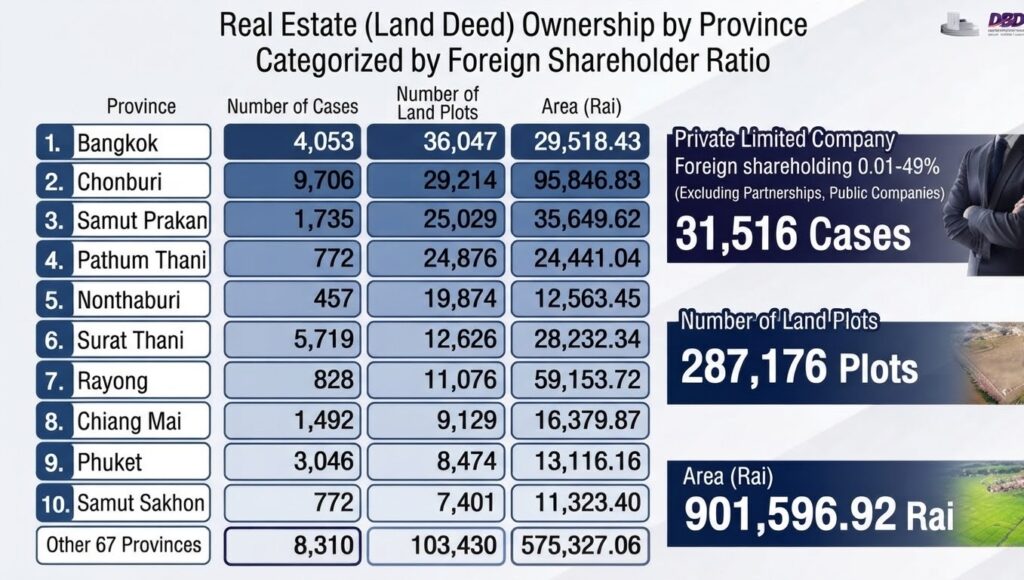
Companies with foreign investment in Thailand hold more than 1.06 million rai (1,702 square kilometres) of land and 76,840 condominium units, government data shows, as authorities intensify scrutiny of corporate structures that may be used to circumvent foreign-ownership rules. The figures, compiled by Thailand’s Department of Business Development (DBD) from records held by the Department of Lands, cover registered holdings as of July 17, 2026. The data provides one of the clearest snapshots of foreign participation in Thailand’s property market, although officials cautioned that foreign-linked ownership does not in itself indicate an illegal nominee arrangement. Foreign-linked firms hold 1.06 million rai The DBD reviewed land ownership records involving 144,706 legal entities, of which 125,622 were within its regulatory jurisdiction. Companies with some level of foreign participation accounted for: 36,277 companies, 305,838 land-title deeds, 1,064,265 rai of land. By comparison, 87,265 wholly Thai-owned companies held 963,488 land-title deeds covering about 3.44 million rai. Foreign-linked companies therefore accounted for about 23.6% of the land area held by the companies covered by the review. The figures encompass companies with widely differing ownership structures, from those with less than 1% foreign participation to companies that are wholly foreign-owned. Most holdings involve minority foreign stakes Companies with foreign ownership of between 0.01% and 49% represented the overwhelming majority of foreign-linked firms in the land data. They numbered 31,516 companies and held 901,596.92 rai, or roughly 85% of all land held by foreign-linked companies in the review. Bangkok, Chon Buri, Samut Prakan, Pathum Thani and Nonthaburi had the largest number of land-title deeds in this category. The DBD said the presence of foreign shareholders should not automatically be interpreted as evidence of nominee arrangements, noting that many companies may represent legitimate Thai-foreign joint ventures. Chon Buri, Rayong emerge as key centres Companies with foreign ownership of between 49.01% and 99.99% held 59,077 rai through 8,633 land-title deeds. Chon Buri and Rayong ranked among the largest markets in this category, alongside Bangkok, Samut Prakan and Chachoengsao. A further 3,450 wholly foreign-owned companies held 10,029 land-title deeds covering 103,591 rai. Chon Buri and Rayong again recorded the largest holdings. The concentration in Thailand’s eastern provinces reflects their importance as major tourism, industrial and investment centres, including areas covered by the government’s Eastern Economic Corridor development programme. Foreign-linked firms hold 76,840 condominium units The review also found that companies with foreign participation held 76,840 condominium units, equivalent to about 31.5% of the 244,115 units held by the legal entities examined. Those units had a combined floor area of approximately 4.1 million square metres. As with land, most condominium holdings were associated with companies where foreign investors held less than 50%. The breakdown was: 0.01%-49% foreign ownership: 73,786 units; 49.01%-99.99%: 1,875 units; 100% foreign owned: 1,179 units. The first category alone accounted for about 96% of all condominium units held by foreign-linked companies. Thailand steps up nominee investigations The data comes as Thai authorities increase efforts to identify companies that may be using Thai shareholders as nominees for foreign investors. Under Thai law, foreign ownership and control of certain businesses and land are subject to restrictions. Authorities have been investigating whether some companies use Thai shareholders nominally to avoid those restrictions. DBD Director-General Poonpong Naiyanapakorn said the department would continue investigations, particularly in major economic and tourism areas where foreign investment and property activity are concentrated. The DBD plans to share company-registration records, shareholder information and financial statements with relevant agencies, including the Department of Lands, Royal Thai Police, Department of Special Investigation and Anti-Money Laundering Office. Authorities will also examine links between companies to identify wider networks rather than focusing only on individual businesses. Investment versus circumvention The government faces a balancing act between attracting legitimate foreign investment and preventing the use of corporate structures to bypass restrictions designed to protect Thai businesses and property ownership. The latest figures do not establish that the properties held by foreign-linked companies were acquired illegally. Instead, they give authorities a basis for identifying ownership structures that may warrant further investigation. For investors, the distinction is significant: foreign participation in a Thai company is not necessarily unlawful, but using Thai shareholders as nominees to conceal foreign control can trigger regulatory and legal action. The DBD said its broader objective is to maintain a business environment that is transparent and fair while allowing legitimate foreign investment to continue.
Original source
Thai Enquirer