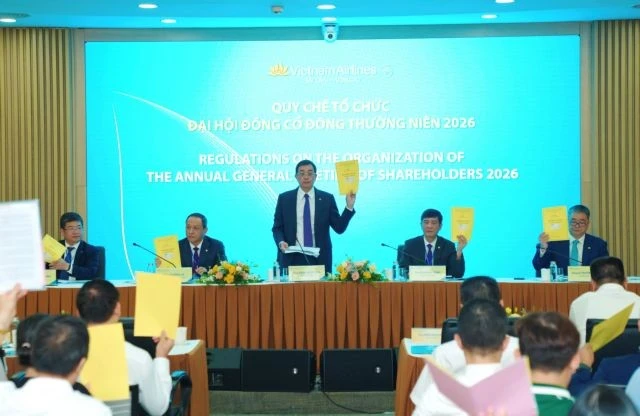
Vietnam Airlines aims for profit despite soaring fuel costs
Business
2026年6月29日
5
VietnamPlus English

Vietnam Airlines aims for profit despite soaring fuel costs

AI サマリー

Vietnam Airlines is aiming for full-year profitability by expanding aircraft leases and improving operational efficiency amidst soaring fuel costs. Meanwhile, Vietnam is pursuing diverse initiatives to support economic growth, including enhancing real estate market transparency, fostering the semiconductor industry, and establishing a carbon market.

Vietnam Airlines targets profit despite soaring fuel costs Under the plan, the national flag carrier will take delivery of an Airbus A320 on June 26 under a three-year lease agreement. Another Airbus A321 is scheduled to join the airline's fleet in July to support peak summer travel demand. Vietnam Airlines said the diversion was driven by the passenger’s condition, and the airline followed all operational safety rules. Ensuring timely medical assistance for passengers in such situations remains the airline’s top priority. To date, Vietnam Airlines remains the first and only airline in Vietnam to receive EXIM export credit guarantees for aircraft acquisition loans, including previous investments in Boeing 777 and Boeing 787 Dreamliner fleets. Vietnam is scheduled to launch a national housing and real estate market information system on July 1, assigning each property a unique identification code to improve market transparency, enhance state management and curb speculation, according to the Ministry of Construction. Minister of Finance Ngo Van Tuan highlighted OECD’s technical support for the ministry in improving the tax system to enhance transparency in line with international standards, supporting capital market development, and strengthening corporate governance capacity across both private enterprises and state-owned enterprises. Speaking to French business and financial news channel BFM Business, Mickaël Driol, CEO of Mekong Partners, noted that amid global trade tensions and geopolitical uncertainty, multinational companies are increasingly diversifying their supply chains, with Vietnam emerging as a key beneficiary of this trend. The Vietnamese southern economic hub’s programme attracted nearly 1,000 participants, with nine cooperation initiatives announced between municipal agencies and businesses and Chinese enterprises across sectors including artificial intelligence (AI), autonomous vehicles and smart mobility, high-tech healthcare, smart agriculture and aquaculture, smart urban centres, green materials, robotics and automation, innovation, digital transformation and innovation-driven finance. The Halal economy is opening up a new area of cooperation, further fostering the Comprehensive Strategic Partnership between the two countries, said Vietnamese Ambassador to Singapore Tran Phuoc Anh at a business seminar in Singapore on June 27. Ho Chi Minh City is positioning itself as a modern regional megacity and a value-added services hub by leveraging new development space created after the administrative merger. This a strategy seen as a core growth pillar to strengthen its role in global service supply chains. The launch marks a major milestone in the development of Vietnam's carbon market, contributing to implementing the country's commitments to greenhouse gas emissions reduction, and accelerating the green transition and promoting low-carbon economic growth. With a strategic location, improving transport infrastructure, ample industrial land and fast-improving investment climate, Tay Ninh aims to become a magnet for German firms in hi-tech manufacturing, industrial equipment, automation, semiconductors and digital transformation. Vietnamese coffee companies can go global by proactively building brand value and showcasing the unique character, quality and added value of their products, said Vietnamese Ambassador to Singapore Tran Phuoc Anh. As of early June, Hanoi had attracted 74.6 billion USD in foreign direct investment (FDI) through more than 9,250 valid projects. FDI inflows in the first six months were projected at 3.2 billion USD, surpassing the annual target by 116%, while nearly 16,000 new businesses were established in the first five months, up 34.4% year-on-year. Monetary policy should remain proactive and flexible, with close coordination with fiscal policy, while carefully managing core inflation, money supply, credit growth, exchange rates, and interest rates to curb imported inflation and stabilise market expectations. Regarding the semiconductor sector, Dung said Vietnam is promoting the development of a comprehensive ecosystem, gradually expanding its role in chip design, packaging, testing, materials production and equipment manufacturing, while focusing on high-quality human resources and attracting strategic investors. Construction began on the Trung Nguyen Legend coffee plant, designed as a sustainable, ecological energy-efficient facility meeting Net Zero standards. The first phase carries an investment value of 989 billion VND (37.58 million USD), with a spray-drying capacity of 1,000kg per hour across an area of 4.9 hectares. A report by the Ministry of Finance on the first year of implementing the resolution highlighted fresh momentum in diversifying capital sources and removing administrative bottlenecks. Under Directive No. 27/CT-TTg dated June 25, 2026, the PM called for stronger management and higher-quality preparation, appraisal and approval of ODA- and concessional loan-funded projects, with the goal of fully disbursing the annual public investment plan assigned by the Government leader. Under the agreement, the two sides plan to share electronic cargo manifest data in real time, or as quickly as possible, to support risk management and detect violations, including trade fraud, counterfeit goods, smuggling, origin fraud and tax evasion. WTO members including the US, the European Union, China, Japan, the United Kingdom, Canada, Australia, Singapore, Hong Kong (China), Chinese Taipei, Thailand and Switzerland welcomed Vietnam’s decision and commended the progress achieved since April. They described Vietnam as a key partner in global IT supply chains and pledged their support for the upcoming negotiations. With the current trading band of +/- 5%, the ceiling rate applicable for commercial banks during the day is 26,455 VND/USD, and the floor rate 23,935 VND/USD. The MoF said the extension would help stabilise the domestic petroleum market, strengthen energy security and support macroeconomic stability amid continued volatility in global energy markets. To support export expansion, Permanent Deputy PM Pham Gia Tuc asked the Ministry of Industry and Trade to work closely with ministries, sectors and localities to closely monitor market developments and regularly update production, business and trade data in order to make timely and effective policy responses. Copyright, VietnamPlus, Vietnam News Agency (VNA) Editor-in-chief, Mr. Tran Tien Duan.

多角的分析

経済的影響

ベトナム航空の燃料費高騰下での黒字化目標は、航空業界全体が直面する課題を反映している。同社は機材リース拡充で対応するが、これは短期的なコスト増を伴う。ベトナム経済全体としては、不動産市場の透明性向上、炭素市場創設、半導体エコシステム育成など、構造的な成長基盤強化策を推進しており、これらが長期的な経済安定に寄与すると考えられる。特に、国際的なサプライチェーン再編の恩恵を受ける形で、製造業へのFDI流入が堅調に推移している点は、経済の持続可能性を示す重要な指標である。

投資家心理

ベトナム航空への投資は、燃料費変動リスクと、夏季需要期に機材を増強する同社の戦略的判断のバランスを考慮する必要がある。一方で、ベトナム経済全体への投資は、不動産市場の透明性向上や半導体産業育成といった政府主導の構造改革が、投資環境の安定化と新たな成長機会の創出につながる可能性を秘めている。特に、FDIの堅調な流入は、国際市場からの信頼の証であり、長期的な資本収益への期待を高める要因となる。ただし、為替レートの変動バンド +/- 5% は、為替リスク管理の重要性を示唆している。

社会的影響

ベトナム航空の運航遅延や欠航は、乗客の旅行計画に直接的な影響を与える可能性がある。今回の事例のように、乗客の健康状態への対応は、航空会社の社会的責任として重要視される。ベトナム全体では、不動産市場情報システムの導入は、住宅購入者や投資家にとって、より公正で透明性の高い取引環境をもたらすことが期待される。しかし、地方における情報格差や、システム導入初期の混乱も懸念される。また、炭素市場の創設は、環境問題への意識を高める一方で、企業や個人への新たな負担となる可能性も指摘されている。

市民の声

ベトナム国民にとって、ベトナム航空の運航状況は、国内旅行や国際的な移動の際の重要な要素となる。燃料費高騰による運賃上昇は、家計に影響を与える可能性がある。不動産市場情報システムの導入は、住宅購入を検討している市民にとって、より安心して取引できる環境整備に繋がるだろう。しかし、地方に住む人々が、この情報システムにアクセスし、その恩恵を十分に受けられるかどうかが課題となる。また、炭素市場の創設は、長期的な環境保全に繋がる一方で、エネルギー価格への影響が市民生活にどう波及するか注視が必要である。

背景・歴史的文脈

ベトナム航空は、ベトナムの国営航空会社として、国内経済の発展と国際的な連携強化において重要な役割を担ってきた。燃料費の高騰は、航空業界全体に影響を与えており、ベトナム航空も例外ではない。同社が掲げる黒字化目標は、単なる企業経営の目標に留まらず、ベトナム経済の回復力と国際競争力を示す指標ともなりうる。ベトナム政府は、不動産市場の透明性向上や炭素市場の創設など、経済の持続的成長に向けた構造改革を推進しており、これらは過去の計画経済から市場経済への移行期を経て、より洗練された経済運営を目指す姿勢の表れである。

原文ソース

VietnamPlus English

原文を読む