General articles are free for 24 hours after publish.
Vietnam's Record Trade Surplus with the US: What's the Price?
In the first half of 2026, Vietnam emerged as the world's largest trade surplus partner with the US. While a sign of economic success, it also highlights vulnerabilities due to reliance on China and US protectionist policies.
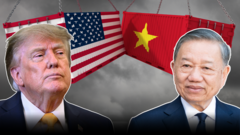
In the first half of 2026, Vietnam emerged as the world's largest trade surplus partner with the United States, surpassing China, Mexico, and Taiwan with a surplus of approximately $114 billion, according to Washington's figures. While Vietnam ranks as the fifth-largest exporter of goods to the US but imports relatively little, researcher Henry Storey at Dragoman, a political risk consultancy based in Melbourne, Australia, suggests this reflects Hanoi's "success and good fortune." However, Storey also argues that this increasingly exposes the 100-million-strong Southeast Asian nation's vulnerability. In a September 11 article published by the Lowy Institute, Storey highlights that under the current US administration, Vietnam's large and unbalanced trade surplus alone is sufficient to displease Washington. "Vietnam's vulnerability is further increased by its tight integration with China's supply chains, leading to persistent accusations that Vietnam is a transshipment point for Chinese goods," the researcher assesses. In the first six months of 2026 alone, Vietnam's trade surplus reached $114 billion, exceeding Mexico's $103 billion and China's $74 billion. This figure is already close to 93% of the $123 billion recorded for the entire year of 2024. The US imported $123 billion worth of goods from Vietnam during the same period, a 40% increase from the previous year, while imports from China decreased from $168 billion to $129 billion. Considering both goods and services, Vietnam was also the partner causing the largest trade deficit for the US in the second quarter of 2026, at $61.2 billion, higher than Taiwan's $53.1 billion and Mexico's $52.7 billion. Experts believe this indicates a continued strong flow of goods from Asia into the US, despite President Donald Trump's tariff policies aimed at reducing the trade deficit. Since early 2025, President Donald Trump has announced reciprocal tariff policies on imports from trading partners, with the goal of addressing large and persistent trade deficits, according to the White House website. For Vietnam, the US initially announced a reciprocal tariff rate of 46%. After a 90-day "pause," Vietnam was subject to a 10% tariff. At the end of this period, Vietnam faced a 20% tariff, effective August 7, 2025. However, after the US Supreme Court rejected these reciprocal tariffs, President Trump imposed new tariff policies on 60 economies in late July 2026, with Vietnam facing a 12.5% tariff, placing it among the countries with the highest tariffs. This decision is linked to the US enforcement of a ban on goods produced by forced labor, but it also falls within the context of the Trump administration using tariffs to reshape Washington's trade relationships, according to observers. In Vietnam's case, analysts suggest that the increase in the trade deficit with the US is not solely due to "Chinese goods disguised as Vietnamese goods" to evade US tariffs, as Washington often alleges, but also reflects the shift of production to Vietnam. Vietnam has been one of the beneficiaries of the US's continuously changing tariff policies targeting China since 2018. Other significant advantages for Vietnam largely stem from internal factors, including low labor costs, a dense network of free trade agreements, relatively business-friendly policies, and, most importantly, its proximity to supply chains in southern China. Henry Storey also points out in his Lowy article that Hanoi "is very cautious about crossing Beijing's red lines" – even as it strengthens security ties with the US and its allies. These combined factors make Vietnam an attractive "China Plus One" option for multinational corporations. Furthermore, data shows that Vietnam's exports to the US have increased not only due to transshipment. Approximately 60% of Vietnamese goods exported to the US fall into categories such as machinery, electronics, and home appliances, with the presence of corporations like Samsung, Intel, and Foxconn. The Wall Street Journal cited experts in August stating that the shift of production to Vietnam is a key factor behind the export growth. This scale of surplus has become an issue in Vietnam-US trade relations. Washington is particularly concerned about the possibility of Chinese goods being transshipped through Vietnam to avoid tariffs. In August, the White House estimated that the US loses $19-26 billion annually in tax revenue due to goods transshipped through third countries, including Vietnam. Regardless of the veracity of US claims, Vietnamese officials are certainly feeling the pressure. US customs officials have conducted unannounced inspections at factories linked to China in Vietnam, Bloomberg reported, citing sources familiar with the matter. Specifically, inspectors are examining records, raw material origins, and production processes to determine the value added in Vietnam before goods are exported to the US, while also looking for potential intellectual property violations related to software. However, as of that time, there was no significant evidence indicating that Chinese goods were being illegally transshipped through Vietnam for export to the US, according to sources. Hanoi has stated it will continue to dialogue with Washington on this issue. In the last week of August, Deputy Prime Minister Nguyen Van Thang visited Washington to seek the resumption of negotiations on a bilateral trade agreement. General Secretary and President To Lam, who recently visited Russia and France, is reportedly scheduled to visit the US, where he is expected to speak at the United Nations General Assembly, beginning September 21 with heads of state presenting their views, Reuters reported, citing three sources. To date, Vietnam and the United States have completed six rounds of negotiations on a Bilateral Countertrade Agreement, but no specific agreement has been reached yet. According to observers, the large trade surplus presents Hanoi with a difficult dilemma: how to maintain export advantages and attract foreign investment while meeting increasingly stringent US requirements regarding product origin and the prevention of illegal transshipment. Source: BBC Vietnamese
Original source
BBC Vietnamese