Sara Duterte’s defense: ‘Threats’ not impeachable ‘high crime’
Politics
2026年7月9日
5
Inquirer NewsInfo

Sara Duterte’s defense: ‘Threats’ not impeachable ‘high crime’

AI サマリー

During the impeachment trial of Philippine Vice President Sara Duterte, her defense team argued that her "threats" do not constitute "other high crimes" under the Constitution. They contended the remarks were a response to threats against her family and lacked evidence of hiring an assassin.

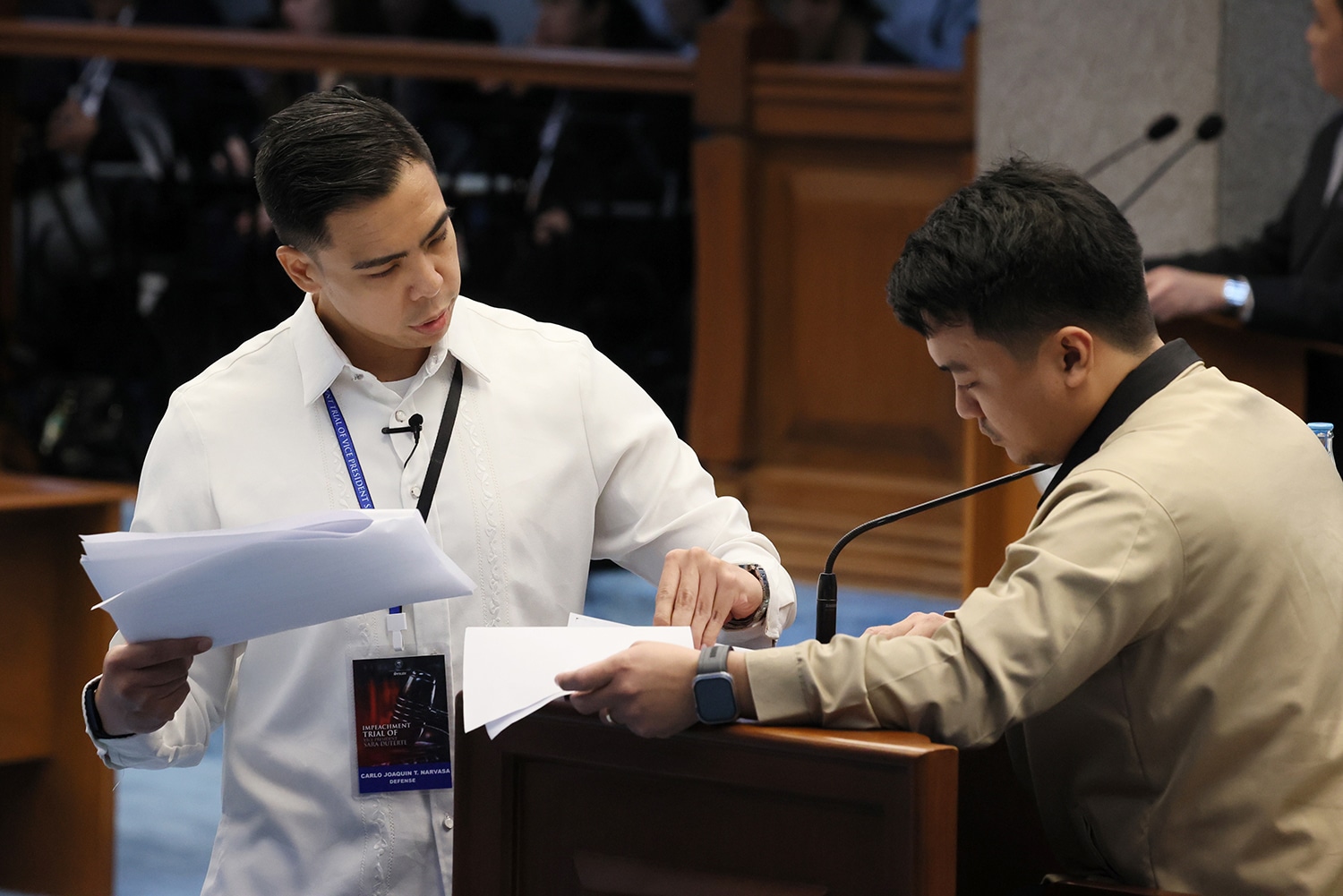
MANILA, Philippines — Vice President Sara Duterte’s defense team on Wednesday argued that the "threats" she made in 2024 against President Marcos, his wife Liza Araneta-Marcos, and former Speaker Martin Romualdez “are not ‘other high crimes’ contemplated by the Constitution as grounds for impeachment.” On the third day of the trial before the Senate impeachment court, defense lawyers focused their cross-examination on National Bureau of Investigation senior agent John Mark Calilung, questioning the basis of the bureau’s investigation and pointing to what they described as major gaps in the evidence linking Duterte to an alleged assassination plot. Defense counsel Mark Vinluan argued that House prosecutors failed to present evidence that Duterte had hired an assassin to kill the Marcos couple and Romualdez. “When VP Sara uttered those words, she was not responding as Sara Duterte, the Vice President, but as Sara Duterte the wife, mother, daughter and sister, who only sought to protect herself and her family. Operation Romanov is in place, and the threat against their lives is real,” Vinluan told the impeachment court. He claimed Duterte had been subjected to “unauthorized intelligence and surveillance operations by government agents that exposed her family to security threats, thereby causing intense trauma and uncontrollable fear.” “Her homes in Davao and Manila were profiled, and this is proven by classified gazing reports. Her trusted security personnel were removed,” Vinluan added. The proceedings centered on Article IV of the impeachment complaint, which accuses Duterte of issuing grave threats against Marcos, the first lady, and his cousin Romualdez during an online press briefing on Nov. 23, 2024. “There is no proof of any contracting of an assassin. The prosecution admitted that the video does not prove any fact other than its existence. The prosecution has no other competent evidence to prove that VP Sara contracted an assassin,” Vinluan told the court. He argued that the prosecution itself had acknowledged that Duterte’s remarks did not “100 percent” establish that she had hired an assassin, and that those statements alone could not be considered a high crime or an impeachable offense. The phrase “other high crimes” is contained in Article XI, Section 2 of the 1987 Constitution as part of a list of impeachable offenses. Also on the list are culpable violation of the Constitution, treason, bribery, graft and corruption, and betrayal of public trust. Vinluan said Duterte’s remarks should instead be viewed in the “proper context” of the threats against her and her family. “And while her response (to the threats) was unconventional, it was justified,” Vinluan said. The defense anchored its argument on the exchanges during Tuesday’s proceedings, when Sen. Risa Hontiveros asked the prosecution whether Duterte’s statements proved she had actually contracted an assassin to kill the Marcoses and Romualdez. Prosecution counsel Amando Ligutan then acknowledged that the recordings did not conclusively prove an assassin had been hired, but explained that they formed part of a series of statements demonstrating Duterte’s intent. At one point, the court’s presiding officer, Sen. Francis Escudero, noted that the discussion had already touched on the central issue before the impeachment court: whether Duterte’s acts amounted to impeachable offenses. Vinluan also maintained that the term “assassin” was supplied by other parties who interpreted Duterte’s remarks out of context. To establish what it insisted to be the context, the defense presented parts of the video of the Nov. 23 briefing, including clips of Duterte’s chief of staff Zuleika Lopez who that day was cited in contempt by the House committee investigating the confidential funds of the Office of the Vice President and the Department of Education. The video showed Lopez breaking down as she objected to her planned transfer to the Correctional Institution for Women in Mandaluyong City, saying she was not a criminal and expressing fears for her safety. The defense argued that Duterte’s statements were triggered by Lopez’s detention and by the government actions against the Vice President and her staff. When Hontiveros asked whether the defense was claiming the alleged threats stemmed from Lopez’s detention, defense lawyer Carlo Narvasa answered in the affirmative. Narvasa said Duterte and her associates had been subjected to “systematic oppression” by the House committee chaired by Rep. Joel Chua, now one of the House prosecutors. “There was a systematic oppression made by the House of Representatives dating back even before their mini-trial,” Narvasa said. Lopez was cited in contempt, he said, despite her cooperation and her lawyer was also prevented barred from accompanying her for the transfer. When Hontiveros asked whether that meant that grave threats could be justified if there were legitimate reasons behind them, Narvasa replied that this was not the defense team’s position. Escudero later reminded senator-judges to avoid posing questions that require counsels to draw legal conclusions, saying such matters are for closing arguments. Hontiveros said she respected the ruling but noted that previous impeachment trials allowed broader questioning by senator-judges. Narvasa also scrutinized the NBI investigation, noting the absence of sworn statements from the three targets of Duterte’s threats. Calilung acknowledged he had no personal knowledge of Marcos, Araneta-Marcos or Romualdez filing criminal complaints. He also confirmed that none of them personally appeared before the NBI. He said the bureau conducted its investigation motu proprio or without a formal complainant. The witness also admitted that the NBI’s revised affidavit dated Feb. 10, 2025, did not include affidavits from the offended parties or the journalists who attended Duterte’s press briefing. Narvasa then asked: “Did you really investigate this case?” Calilung did not answer after the prosecution objected. Calilung said he instead executed an affidavit attesting to the minutes of investigators’ interviews. The NBI also complied with the requirements set by the Department of Justice and secured a certification on the sufficiency of its preliminary investigation. he added. Sen. Bam Aquino underscored the seriousness of the alleged “hit man” angle b

多角的分析

経済的影響

副大統領の弾劾裁判という政治的不確実性は、国内および国際的な投資家の信頼に短期的な影響を与える可能性があります。特に、政治的安定性への懸念が高まると、フィリピンペソの変動や株式市場の低迷を招くことが過去の事例から示唆されます。しかし、今回の件は直接的な経済政策の変更に結びつくものではないため、その影響は限定的と考えられます。

投資家心理

今回の弾劾裁判の展開は、フィリピンの政治リスクを評価する投資家にとって注視すべき点です。特に、弾劾が進行し、副大統領の職務遂行能力に影響が生じる場合、政策の継続性や政府の安定性に対する懸念から、ポートフォリオのリバランスや新規投資の見送りにつながる可能性があります。ただし、現時点では「高位の犯罪」に該当しないという弁護側の主張が通れば、市場への影響は限定的でしょう。

社会的影響

副大統領の発言が「家族を守るための反応」と弁護団が主張している点は、フィリピン社会における家族の絆の強さと、公人であっても家族への脅威に対しては強い反応を示すという価値観を反映しています。一方で、公職にある者が発する言葉の重みと、それが社会に与える影響について、市民の間で議論を呼ぶ可能性があります。特に、権力者間の対立が、一般市民の安全や安心感にどう影響するかが問われます。

市民の声

副大統領の弾劾裁判は、国民の政治への関心を高める一方で、法的手続きの複雑さや、公的な発言の責任について、様々な意見を生んでいます。特に、弁護団が主張する「家族を守るための発言」という点は、多くの国民が共感する可能性もありますが、公職者としての言動の規範についても同時に議論されています。司法の独立性と、政治的影響力とのバランスが、国民の信頼を得る上で重要となります。

背景・歴史的文脈

フィリピンでは、大統領と副大統領が異なる政党から選出されることがあり、権力分立と監視のメカニズムが働きます。過去にも、政治的対立から弾劾の議論が起こることがありましたが、実際に罷免に至った例は少ないです。副大統領サラ・ドゥテルテ氏は、前大統領ロドリゴ・ドゥテルテ氏の娘であり、現大統領マルコス氏とは異なる政治勢力に属していると見られており、両者の関係は常に注目されています。今回の弾劾訴追は、このような政治的力学の中で発生したと考えられます。

原文ソース

Inquirer NewsInfo

原文を読む