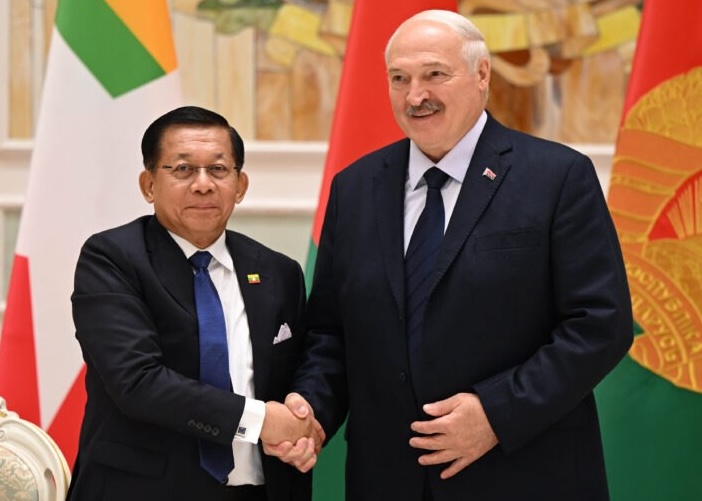
Belarus, Myanmar’s financial crisis and the search for regime survival
Guest contributor Linn Thant Myanmar’s military regime is confronting multiple crises at once. On the battlefield, resistance forces continue to challenge its authority and control over territory. Economically, the country faces mounting financial pressures, disrupted livelihoods and shortages of essential services. Politically, the military’s claim to legitimacy remains deeply contested, while its international isolation has limited its room for manoeuvre. Yet the regime is not simply waiting for its position to deteriorate. It is also searching for external partners, financial resources and technical assistance that could help it sustain its rule. Belarus has emerged as an important partner in this effort, with cooperation extending across defence-related affairs, state institutions, finance, energy and technical training. This relationship raises a fundamental question: is international cooperation helping Myanmar recover from its profound crisis, or is it strengthening the institutions through which the military maintains its power? A partnership built around mutual survival The growing relationship between Belarus and Myanmar should be understood in the context of two governments facing international criticism and seeking greater room to operate beyond Western influence. A BELPOL report published on October 29, titled An Alliance of Dictators: How Lukashenko’s Supporters and Myanmar Are Building a System of Mutual Survival, describes a broad framework for cooperation between Belarusian actors and Myanmar’s military authorities. The report examines a 2026–2028 cooperation roadmap signed in Naypyidaw on November 28, 2025 and outlines proposed collaboration involving military-related optics, police training, defence-linked education, state-bank lending, commodity exchanges and media or propaganda activities. These reported arrangements suggest that the relationship extends beyond conventional diplomatic engagement. It potentially connects financial support, technical cooperation and institutional capacity-building in ways that could strengthen the regime’s ability to withstand pressure. It is important, however, to distinguish between agreements, proposed cooperation and activities that have actually been implemented. The existence of a roadmap does not by itself establish that every proposed project has been completed or that every financing arrangement has been disbursed. Nevertheless, the breadth of the reported agenda deserves scrutiny, particularly when cooperation involves security institutions and state-controlled economic structures. For Myanmar’s military rulers, such partnerships could provide alternatives when access to other sources of finance, technology and diplomatic support becomes more difficult. For Belarus, closer engagement offers an opportunity to expand its influence and cultivate a partner with overlapping interests. The result is a relationship whose political significance cannot be measured solely by the number of agreements signed. Financial pressure and the cost of keeping the regime afloat Myanmar’s financial crisis is an essential part of this story. The military authorities must finance a costly war while confronting economic disruption, pressure on public revenues and growing demands for basic services. The loss of territorial control in parts of the country, the damage inflicted by conflict and the erosion of public confidence complicate the regime’s efforts to govern and generate revenue. In such circumstances, external credit can become politically significant. Loans may help finance state projects and meet immediate expenditure needs, but they also create future repayment obligations. Their real value depends on the interest rate, repayment period, currency risks, conditions attached and whether the funded projects generate benefits sufficient to justify their costs. Myanmar parliamentary and government reporting has discussed foreign-currency export-credit arrangements involving Belarusian financial institutions, including the Belarus Development Bank and Belinvestbank. Reported interest rates range from 2.25 to 9.33 per cent, with loan terms of up to five years. Those figures should not be interpreted as proof that every Belarus-linked loan carries the highest rate, or that all proposed financing has been disbursed. They do, however, highlight the importance of examining the terms of individual agreements rather than treating the announcement of a loan as an unqualified economic success. For a country experiencing severe economic difficulties, borrowing at commercially or politically unfavourable terms can shift costs into the future. Foreign-currency obligations may be especially burdensome when export earnings, foreign-exchange availability and public finances are under pressure. The central issue is therefore not simply whether the regime can obtain money. It is what the money will finance, who will benefit from it and who will ultimately bear the cost. If credit primarily sustains the institutions responsible for repression and warfare, it may strengthen the regime in the short term without addressing the economic foundations of Myanmar’s crisis. The public could then face the consequences through reduced spending on essential services, higher future debt-service costs or further economic instability. Under the investment laws of the National Unity Government of Myanmar, as amended and approved by the Committee Representing Pyidaungsu Hluttaw (CRPH)—composed of representatives duly elected by the people in the 2020 multi-party general election—international governments should take seriously the fact that high-interest loans taken out by the military junta are not guaranteed to be recognized or honoured by a future legitimate government of Myanmar. Belarus and Myanmar’s electricity crisis The energy sector provides a particularly revealing example of this relationship. On October 27, Myanmar’s so-called Minister of Electricity and Energy, Ko Ko Lwin, signed a bilateral cooperation roadmap with Belarus concerning the electricity and energy sectors. According to Myanmar’s state media, the proposed cooperation includes upgrading electricity transmission infrastructure, reducing transmission and distribution losses, developing smart generation and grid systems, and sending Myanmar personnel to Belarus for technical training. During the 30th Energy and Ecology Forum in Minsk, Myanmar’s so-called minister also invited foreign investors to par
Read up to 3 eligible full articles per Japan day (JST) for free
Create a free account to open up to 3 eligible full articles per Japan calendar day (JST). Headlines and summaries remain available across ASEAN 7.
Related articles
- UEC Announcement: Date for By-Elections in 55 Constituencies
The Union Election Commission (UEC) announced that by-elections will be held on April 4, 2027, to fill vacant seats in the Pyithu Hluttaw, Amyotha Hluttaw, and Region and State Hluttaws. According to Announcement No. 68/
- UEC announces constituencies for 2027 By-Elections
The Union Election Commission (UEC) announced the constituencies for the 2027 by-elections, which are scheduled to be held on April 4, 2027. Detailed lists of the constituencies and the respective polling areas for each
- Gold Feed Feed Mill Opens in Hpa-an Industrial Zone
YANGON November 5 To celebrate the upcoming 71st anniversary of Karen State Day on November 7, the Gold Feed feed mill was opened this morning in Zone No. 2 of the Hpa-an Industrial Zone, located on the Hpa-an-Lwegyi byp
- Minister Meets IOM Chief of Mission
NAY PYI TAW November 5 U Myint Swe, Union Minister for Labour, met with Mr. Daihei Mochizuki, Chief of Mission of the International Organization for Migration (IOM) Myanmar, and his delegation this morning in the Union M