General articles are free for 24 hours after publish.
Vietnam Designates Coastal Ruin as Climate Change Memorial Site
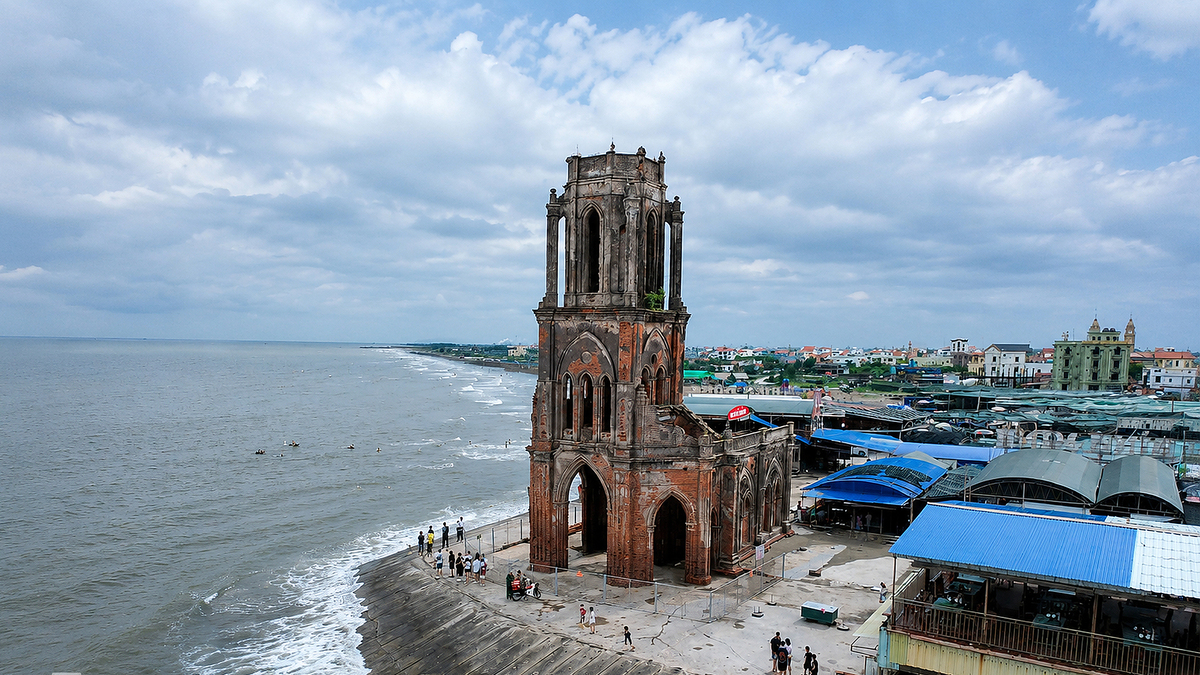
Ninh Binh Province in Vietnam has officially recognized the Hải Lý Church ruins and its bell tower, standing precariously close to the sea, as a "Climate Change Memorial Site." This marks Vietnam's first designation of its kind, aiming to leverage past lessons for the future.
Ninh Binh Province in northern Vietnam has officially recognized the ruins of a coastal church and its bell tower, a stark testament to climate change-induced erosion, as a "Climate Change Memorial Site." This marks the first designation of its kind in Vietnam. The dilapidated seaside church, approximately 100 years old, was once part of the Chúa Trái Tim Church. However, due to years of storms, high waves, and coastal erosion, particularly significant breaches and shoreline retreats in 1925, 1990, and 2005, the remnants of the church, especially its bell tower, now stand precariously close to the water's edge. These ruins are more than just remnants of an old structure. Dr. Vũ Cao Minh, from the Institute of Geology under the Vietnam Academy of Science and Technology, points out that the bell tower serves as a vivid, visual record of coastal changes and the historical efforts of people to reclaim and protect land in coastal areas. The fact that a structure built about 100 years ago is now located outside the current coastline is valuable data for studying coastal fluctuations and highlights the continuous need to reinforce dikes and protect land and production against natural forces, he explained. Internationally, examples of similar preservation exist. The twin towers of St. Mary's Church in Reculver, Kent, England, are maintained as a testament to coastal erosion. In the United States, relics related to extreme weather events like Hurricane Katrina are preserved in memorial parks and conservation areas. Taiwan established the Siaolin Landslide and Debris Flow Memorial Park after Typhoon Morakot in 2009, serving as a site for commemorating victims, disaster education, research, and experience exchange. Dr. Minh suggests that these international models demonstrate that natural disaster relics can become visual educational materials if preserved, documented, and utilized appropriately. He emphasizes that the value of a memorial site lies not only in preserving a structure but in helping people understand why it is located there, how the coastline has changed, and how humans have responded. Only then can the relic achieve scientific, educational, and tourism value. The area surrounding the Hải Lý church includes Thịnh Long beach, local coastal culture, cuisine, and the characteristic life of fishermen. With proper preservation, restoration, and promotion, the site could become a tourist destination linked to the history of settlement, land preservation efforts, and coastal changes. The recent designation opens opportunities to exploit the site's value while also posing the challenge of protecting the remaining structure, landscape, and documentation of coastal line transformations. Source: VnExpress
Original source
VnExpress