General articles are free for 24 hours after publish.
High Rice Prices in Philippines Blamed on Peso Weakness, Possible Trader Cartel
Despite lower import tariffs, rice prices in the Philippines remain high, with officials and economists citing higher import costs due to a weak peso, elevated farmgate prices, and possible anti-competitive practices by grain traders. The government has requested an investigation by the Philippine Competition Commission.
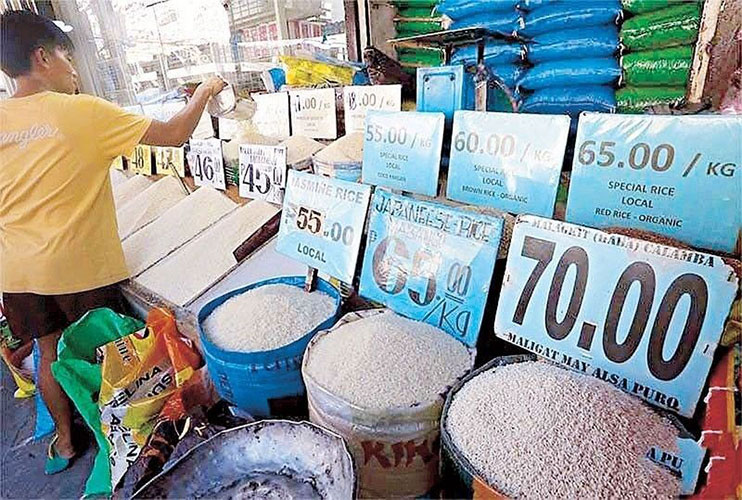
HIGH RICE PRICES despite lower import tariffs could be driven by higher import costs, a weak peso, elevated farmgate prices, and possible competition issues within the rice trade, officials and economists said. Agriculture Secretary Francisco P. Tiu Laurel, Jr. pointed to rising import costs due to the weak peso and high freight costs. “In general, the main driver of the increase in the price of imported rice is that it is more expensive from the origin,” he said in a message. Mr. Laurel said imported rice cost about $400-$420 per metric ton early this year but had risen to around $520 per ton by the end of July. The peso weakened to around P62.80 against the dollar from about P57 previously, while freight costs have also increased, he said. For domestic rice, Mr. Laurel said retail prices remain elevated because palay (unmilled rice) fetched high prices at the last harvest. He said retail rice prices of around P45-P50 per kilo are reasonable given the current cost levels, though some stores may be charging more in the absence of a price ceiling. Assuming imported rice priced at $480 per ton, a 15% tariff and an exchange rate of P63 to the dollar, Mr. Laurel estimated that the landed cost would be around P39 per kilo. Adding about P10 per kilo in additional costs to bring such rice to market, it should retail for roughly P49 per kilo, plus or minus P1-P2, he said. The Philippine Statistics Authority (PSA) has reported that regular-milled rice averaged P49.96 per kilo in the first five days of September, up from P40.31 a year earlier. This also exceeded the P49.61 recorded at mid-August and P49.64 a month earlier. Rice inflation accelerated to 19.4% in August from 17.1% in July. Cereals and cereal products were the biggest contributor to food inflation during the month, according to the PSA. Economy Secretary Arsenio M. Balisacan said possible anti-competitive practices may partly explain why rice prices remained high. The government lowered the tariff on imported rice to 15% from 35% in July 2024, to temper inflationary pressures and preserve consumer purchasing power. At a Senate budget hearing on Monday, Mr. Balisacan said retail prices seem to have shrugged off the tariff cut. “To our surprise, the retail prices did not behave as we expected.” “We cannot exclude the possibility of an anti-competitive market,” he said. “I think it’s not so much in retail… it’s in the trading, as in the wholesaling and the importation,” he added. Mr. Balisacan, a former competition regulator, said the government has asked the Philippine Competition Commission (PCC) to investigate the industry. He also cited logistics bottlenecks and the government’s approach to importing rice as factors that affect how the market works. University of Asia and the Pacific economist George N. Manzano said production costs could also be a factor. “Anti-competitive behavior can lead to persistently high prices. However, other factors may also be at work, such as rising rice production costs,” he said in via Viber. “Higher oil prices and a weak peso can raise the cost of imported inputs used in rice farming, while adverse weather conditions, including floods, may reduce productivity and increase logistics costs,” he added. Mr. Manzano said the PCC could initiate an investigation if it finds reason to suspect price manipulation or other anti-competitive practices. He added that supply-chain reform could be pursued at the same time. Foundation for Economic Freedom President Calixto V. Chikiamco said the government should investigate the possibility of a rice cartel, although he added it is unclear whether one exists. “It’s possible there might be a cartel that’s manipulating prices for rice, but I don’t know whether that’s true or not as of now,” he said via telephone. Mr. Chikiamco said the government’s suspension of rice imports could also have reduced inventory and contributed to elevated prices. “The other cause of the high price could be the DA’s ban on rice imports for a time,” he said. “It could be because the inventories of the rice traders are down because of the lack of imports,” he added. The government suspended most rice imports from September through December last year to support farmgate palay prices. The DA said in August that it would not repeat the suspension this year as it prepares for potential supply disruptions from El Niño. — Justine Irish D. Tabile
Original source
BusinessWorld Economy