General articles are free for 24 hours after publish.
Cockroach Jolt Opens Up Opposition Space for Mocking Modi
A satirical protest movement in India, calling itself the Cockroach Janta Party (CJP), is normalizing mockery of Prime Minister Narendra Modi and expanding opposition space. Fueled by youth anger over recruitment and examination issues, the movement uses the cockroach as its symbol, with satirical actions spreading rapidly on social media and at rallies.
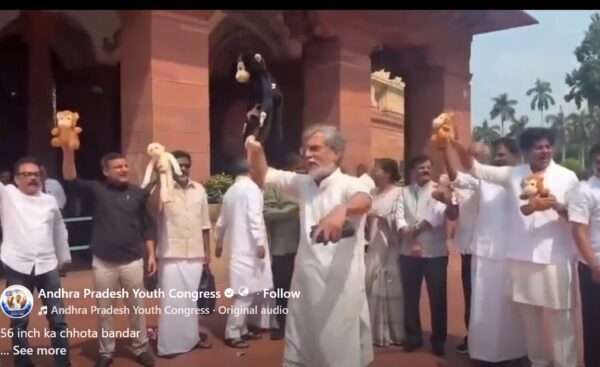
Read The Diplomat, Know The Asia-Pacific Can the Modi regime survive a wave of mockery that has moved from meme pages to protest sites, political rallies and even parliament? A screenshot of an Andhra Pradesh Youth Congress video showing Congress MP Pavan Khera holding up a toy monkey outside parliament to mock India’s Prime Minister Narendra Modi, New Delhi, India, August 13, 2026. No great movement designed to change the world (or a nation) can bear being laughed at or belittled, argued Czech-French novelist Milan Kundera in his 1967 novel, “The Joke.” “Mockery is a rust that corrodes all it touches,” he wrote. In the summer of 2026, a satirical protest movement calling itself the Cockroach Janta Party (CJP) — a wry play on India’s ruling Bharatiya Janata Party (BJP) — did something few observers thought possible in Narendra Modi’s India: it made mockery of the prime minister feel normal. The movement was born out of the mockery of a remark by the chief justice of India and quickly resonated with youth anger over recruitment and examination controversies. Examination paper leaks became a rallying point. Demonstrators adopted the cockroach as their emblem — a creature that has survived fumigation, starvation, and every known odds. During agitations in the national capital, young protestors carried posters with caricatures of Modi, performed skits mimicking Modi’s mannerisms, and chanted slogans laced with profanity directed at the prime minister. Videos of these performances spread rapidly across Instagram, X and WhatsApp. Modi has been ruling the country with tight control since 2014. His government does not respond well to dissent and criticism. Satirists and stand-up comedians have had an increasingly tough time in Modi’s India. Cracking jokes at ruling party politicians, or anything even obliquely related to the Hindu faith and practices, can lead to court cases or mob violence. Kundera’s larger insight was that authoritarian structures rely on total obedience, absolute gravity, and a carefully manufactured image of infallibility. Jokes, satire and parodies of state propaganda weaken the regime’s psychological control. But once the powerful become objects of collective laughter, their aura of inevitability can begin to crack. In India, July 2026 unleashed waves of mockery. A chant that emerged from the demonstrations — “Chhappan inch ka chhota bandar” (the 56-inch little monkey) answered by the crowd’s refrain of “Baal Narendra, Baal Narendra” (little Narendra) — went viral as a direct jab at Modi. The slogan drew on two long-running political references. During his 2014 campaign, Modi famously invoked his “56-inch chest” as a symbol of strength. Around the same time, an illustrated children’s book titled “Bal Narendra,” based on stories from his childhood, hit markets. Protesters fused the two into a mocking refrain that soon appeared in graffiti and memes depicting a “56-inch-high monkey.” When Modi first appeared in a midnight address on social media on July 23 to break his silence on the protests, that too triggered a wave of reels and memes — some making fun of his camera angles, others mocking the content of his speech. Modi was visibly unnerved when he appeared in another video at midnight on July 31. In the address, he said he was forgiving “misguided children” who had abused him and his late mother, while expressing concern that girls and young women were using abusive language. It was a “cultural shock,” he said. This speech, too, faced a wave of meme attacks. The BJP ecosystem was in no way ready to take these attacks like sitting ducks. After the protests were called off, allegations of police action and harassment against participants emerged. Police cases were registered in several states. BJP social media functionaries circulated videos seeking to identify participants. Opposition parties and civil liberties groups described these actions as intimidation, while BJP leaders argued they were responding to abusive and unlawful conduct. One such student is a 15-year-old identified in press reports by the pseudonym Ruchika Singh, whose abusive slogan against Modi went viral during the protests. She was named in a police case. A day after Modi’s speech promising forgiveness, Singh appeared in a video with folded hands apologizing “from the heart.” She said she had been swept up by the crowd and insisted she was not under pressure. She described it as her “first and last mistake.” The apology did not end the episode. Singh’s mother told reporters that police officers, television crews and aggressive strangers showed up daily at their rented accommodation. This eventually forced the family to leave the city altogether. But the courage of India’s youth had emboldened the political opposition by then. By mid-August, senior Congress leader and former Chhattisgarh Chief Minister Bhupesh Baghel was using the “56-inch ka chhota bandar” slogan in his rallies. The chant also entered parliament. Congress MP Pawan Khera held up a toy monkey and chanted “Chhappan inch ka chhota bandar, kabhi to aao Sadan ke andar” (56-inch little monkey, come inside the House at least sometimes), mocking Modi’s limited attendance during the recent monsoon session of parliament. At the end of August, another video went viral. Here, Singh says she has had enough. She had apologized under pressure, but what she has endured since then has erased her fears. “Mr. Modi, you have made my life hell… you’re a coward,” she said in the latest video. Whatever she had previously is all gone, she said. She can neither go anywhere nor live freely. She has nothing more to lose. “I won’t back down this time,” Singh asserted. Opposition parties shared this video from their social media platforms, criticizing the government’s response to dissent. Meanwhile, in a major victory for the CJP, the Supreme Court on September 2 quashed all police complaints against student protesters in different states. Whether this will have any lasting impact remains to be seen. The cockroach movement has, nevertheless, demonstrated that satire aimed at Modi’s carefully constructed image of invincibility could travel, resonate, and survive an extensive state and party communication apparatus. Even if briefly, it has expanded the social space in which publicly mocking India’s most powerful political leader became less exceptional. Subscribe today and join thousands of diplomats, analysts, policy professionals and business readers who rely on The Diplomat for expert Asia-Pacific coverage. Get unlimited access to in-depth analysis you won't find anywhere else, from South China Sea tensions to ASEAN diplomacy to India-Pakistan relations. More than 5,000 articles a year. Already have an account? Log in. Snigdhendu Bhattacharya, the author of two non-fiction books on India’s ultra-Left and the Hindu right, writes and comments on India’s politics, environment, human rights and culture. Get briefed on the
Original source
The Diplomat Indonesia