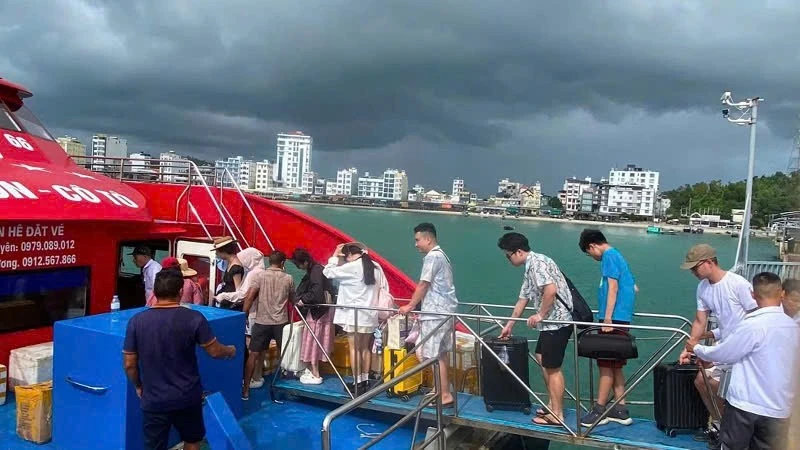
Over 3,000 evacuated from Co To Island to mainland ahead of Typhoon No. 1
In response to the approaching Typhoon No. 1, over 3,147 tourists and residents were safely evacuated from Co To Island in Vietnam's Quang Ninh province to the mainland. All vessels were secured in safe shelters as maritime operations were suspended from 5 PM.
In response to the approaching Typhoon No. 1, the island of Co To in Quang Ninh province, Vietnam, safely evacuated 3,147 tourists and residents to the mainland on the afternoon of July 3. Following directives from the Quang Ninh Provincial People's Committee and relevant authorities, maritime operations from the island were suspended at 5 PM on the same day. In response, the Co To Island Special Zone promptly implemented evacuation plans. In the afternoon of July 3, in coordination with transport companies, 18 vessels were arranged. The final vessel departed Co To Port at 4 PM, carrying 248 passengers to the mainland, completing the transfer before the scheduled suspension of vessel departure permits. By 5 PM, all vessels operating in the area had been called to safe shelters in the Northern Bay Fishing Logistics Service Area and the Kho Gao region. Mooring and vessel counting were conducted strictly, ensuring the safety of people and property before the typhoon's direct impact. The Co To Island Special Zone continues to maintain a 24-hour duty system, closely monitoring the typhoon's developments and preparing to implement response plans based on the "4 at the local level" principle to minimize damage from natural disasters. On the afternoon of July 3, the Waterway Police Team, under the Traffic Police Department of the Quang Ninh Provincial Public Security, mobilized one ship and six motorboats, deploying multiple task forces to call for and guide vessels to safe havens. For cargo ships from other localities unfamiliar with the routes, the Waterway Police assigned officers and soldiers to each vessel to provide information and guidance for moving to the nearest shelters. By 4 PM on the same day, nearly 1,000 vessels operating in the waters of Ha Long Bay and Bai Tu Long Bay had received information from the Waterway Police Team regarding the typhoon's affected areas, trajectory, and locations of shelters. Regarding the situation of typhoon prevention and control, Mr. Nguyen Van Cong, Vice Chairman of the Quang Ninh Provincial People's Committee and Standing Vice Head of the Provincial Steering Committee for Natural Disaster Prevention, Search and Rescue, and Civil Defense, stated that Quang Ninh has proactively implemented synchronized response plans for Typhoon No. 1. The province promptly informed residents and tourists about the typhoon's developments, imposed a sea ban from 12 PM on July 3, called all vessels at sea to safe shelters, reviewed aquaculture areas, cages, fishing boats, and areas with potential risks, and prepared evacuation plans for people and assets in coastal areas and regions prone to flooding and landslides. Furthermore, the coal industry has proactively implemented production safety measures, and localities have strengthened inspections of dikes, reservoirs, and key projects, preparing adequate forces, equipment, and materials according to the "4 at the local level" principle. Also on the afternoon of July 3, the Quang Ninh Provincial People's Committee held an online meeting with localities across the province, directing the synchronized implementation of response plans and the readiness of forces and equipment to ensure the safety of the people and minimize damage caused by Typhoon No. 1.
多角的分析
今回の避難措置は、台風という自然災害への対応であり、直接的な経済活動への影響は一時的と見られる。しかし、観光業への影響は避けられず、特にコト島のような観光依存度の高い地域では、今後の台風シーズンにおける観光客の安全確保とインフラ復旧が経済活動の早期回復の鍵となる。また、クアンニン省の主要産業である石炭産業においても、生産施設の安全確保は継続的な課題である。
投資家にとっては、自然災害リスクへの対応能力は、ベトナムのインフラ整備やリスク管理体制の成熟度を示す指標となる。今回の迅速な避難措置は、ベトナム当局の危機管理能力の一側面を示すものだが、長期的な投資判断においては、気候変動による自然災害の頻度増加と、それに伴うインフラ投資の必要性、そしてサプライチェーンへの潜在的影響を考慮する必要がある。
コト島からの3,147人という大規模な避難は、住民と観光客の安全確保という点で迅速かつ効果的に行われた。しかし、台風接近という状況下での急な避難は、特に高齢者や子供連れの観光客にとって、移動の負担や精神的なストレスを伴う可能性がある。また、避難場所での衛生管理や食料供給、そして避難後の生活再建といった課題も、社会的な支援体制の重要性を示唆している。
今回の避難は、多くの市民、特にコト島を訪れていた観光客にとって、予期せぬ状況への対応を迫られる経験となった。旅行計画の変更や、移動中の不安など、直接的な影響を受けた市民も少なくない。一方で、迅速な避難措置は、人命を守るための行政の努力を示すものであり、地域住民や観光客からは、安全確保への感謝の声も聞かれるだろう。しかし、台風通過後のインフラ被害や生活への影響については、今後の情報が待たれる。
背景・歴史的文脈
ベトナムは、特に北部沿岸地域において、毎年夏に台風の影響を受ける。クアンニン省は、ハロン湾などの景勝地を抱え、観光業が盛んな地域であると同時に、石炭産業も重要な産業基盤となっている。過去にも、台風や洪水による被害が発生しており、ベトナム政府は「4つの現地対応」(指揮、人員、資材、訓練を現地で行う)を原則とした災害対策を推進している。今回の台風1号への対応は、これらの経験に基づいた、政府主導による迅速な避難・安全確保措置の一環として実施された。
原文ソース
Nhan Dan