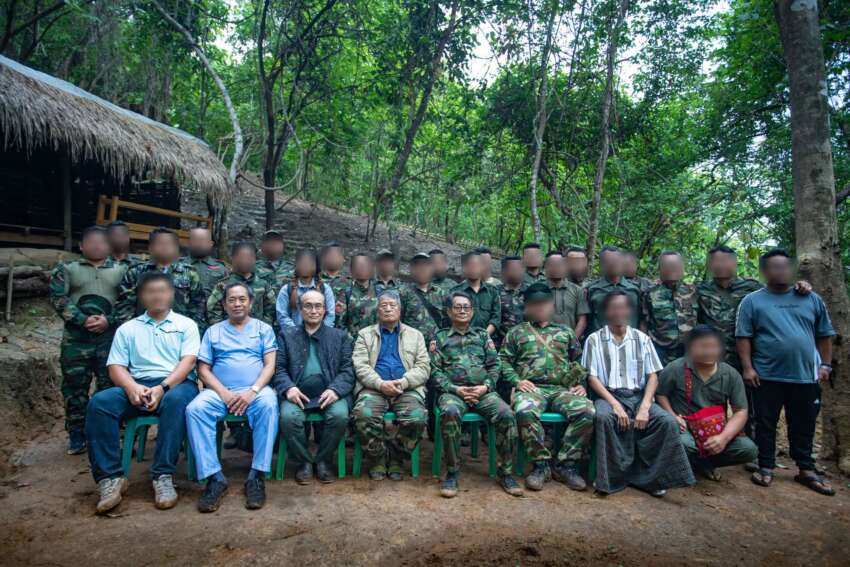
The administration of Myanmar is no longer solely controlled by Naypyidaw, and the relevant people are carrying out activities in many parts of the country, SCEF announced
Yangon, July 16 The Federal Democratic Union Steering Council (SCEF) announced that the administration of Myanmar is no longer in a situation where it can be solely controlled by Naypyidaw, and that regional authorities
Yangon, July 16 The Federal Democratic Union Steering Council (SCEF) announced that the administration of Myanmar is no longer in a situation where it can be solely controlled by Naypyidaw, and that regional authorities representing the people are taking responsibility for governance, judicial affairs, public security, and public services in various regions across the country. This announcement is in relation to the consultative meetings held on July 12 and 13 in Thailand, at the invitation of the ASEAN Chair's Special Envoy on Myanmar, the Foreign Minister of the Philippines. Representatives from the Karen National Union (KNU), Kachin Independence Organization (KIO), Chin National Front (CNF), and representatives from the Karenni side, who are members of the SCEF, participated in the meetings. The SCEF stated that the political situation in Myanmar has fundamentally changed. Currently, Naypyidaw is no longer in a position to control and administer the entire country. Instead, administrative mechanisms established by state and regional authorities are responsible for governance, judicial affairs, public security, and public services within their territories, representing the political will of the local people. Due to these circumstances, the political landscape of Myanmar has fundamentally changed, and therefore, any peace process that is trustworthy needs to recognize and engage with these legitimate political forces and regional authorities, the SCEF said. It also pointed out that processes based on previous political assumptions will not be able to foster sustainable peace, and attempts to hastily return to a normal situation before the political conditions are met could further exacerbate the current political crisis. The SCEF noted that it is aware of ASEAN's assessment that "there has been no visible progress on the ground." It stated that the current time is not yet at the stage where formal political dialogues can begin, and it is a time to prioritize political preparations. Furthermore, it announced that it is necessary to first build a common understanding among Myanmar's political forces regarding the objectives, basic principles, structure, and implementation stages of the peace and political transition process. Within the SCEF itself, further discussions and coordination will take place among the three pillars to establish a collective political framework. The SCEF emphasized that the peace process must be a process owned by the people of Myanmar, and while regional and international partners can provide support, they do not have the right to determine the direction, structure, and political outcomes of Myanmar's political transition. While welcoming engagement from Thailand, the Philippines, ASEAN, and international partners, the SCEF stated that external processes should not be hastily pushed or outcomes predetermined before the political situation is ripe. The peace process in Myanmar must be a process owned and led by the people of Myanmar. The SCEF is committed to achieving a political solution through negotiation, but stated that negotiation is a means, not an end. Their objective is to end the military's dominance of political power and build a federal democratic union based on equality, self-determination, democratic participation, the rule of law, and civilian government. Furthermore, it was clarified that these meetings were not between SCEF and representatives of the military junta, but rather separate meetings between the SCEF and ASEAN. It was advised not to interpret these meetings as the beginning of formal political engagement with the military junta. The SCEF representatives stated at the meeting that ASEAN's Five-Point Consensus must be implemented, not just announced. To achieve this, it is necessary to immediately release political prisoners, allow humanitarian assistance to reach civilians freely, and quickly implement practical mechanisms that can reduce violence, according to the statement. The SCEF pointed out that the military junta has not yet demonstrated political will through concrete actions to date for meaningful political dialogues to occur. The responsibility to demonstrate political will lies solely with Min Aung Hlaing and the military leaders, and this responsibility cannot be transferred to the revolutionary forces. The SCEF demanded the immediate cessation of aerial attacks on civilians and civilian infrastructure, the cessation of attacks on hospitals, schools, and religious buildings, the immediate release of political prisoners, and the free provision of humanitarian assistance for confidence-building measures. The Federal Democratic Union Steering Council (SCEF) also stated that inviting for political dialogue while continuing attacks on civilians cannot lead to a meaningful political dialogue.
多角的分析
直接の経済ニュースではありませんが、治安と司法の信頼は地域経済の土台です。職場での暴力や未成年者保護への不安が強まると、夜間営業、観光、雇用、地域サービス業のリスク認識が高まります。
投資家目線では、個別事件よりも法執行の予見可能性が焦点です。加害者への対応が曖昧になれば、ローカルビジネスの統治リスクや従業員保護の弱さとして評価されやすくなります。
ミャンマーで問われるのは、加害者個人だけでなく、雇用主、警察、近隣社会が被害のサインをどう扱ったかです。住民が声を上げたことで、事件は噂話ではなく、記録され検証される公共問題に変わります。
市民にとっては、自分や家族が被害に遭った時に公正な手続きへアクセスできるのかが最大の関心です。地域団体が声を上げることで、事件の風化を防ぎ、被害者側の孤立を和らげる意味があります。
背景・歴史的文脈
このニュースは、ミャンマーの地域社会で法の支配と弱者保護がどこまで機能しているかを映す事案です。暴力事件そのものに加え、女性団体や市民社会が司法手続きを求めて声を上げている点が重要です。軍政下では警察・司法への信頼が揺らぎやすく、個別事件が地域の不安や統治への不信に直結します。
原文ソース
Khit Thit Media