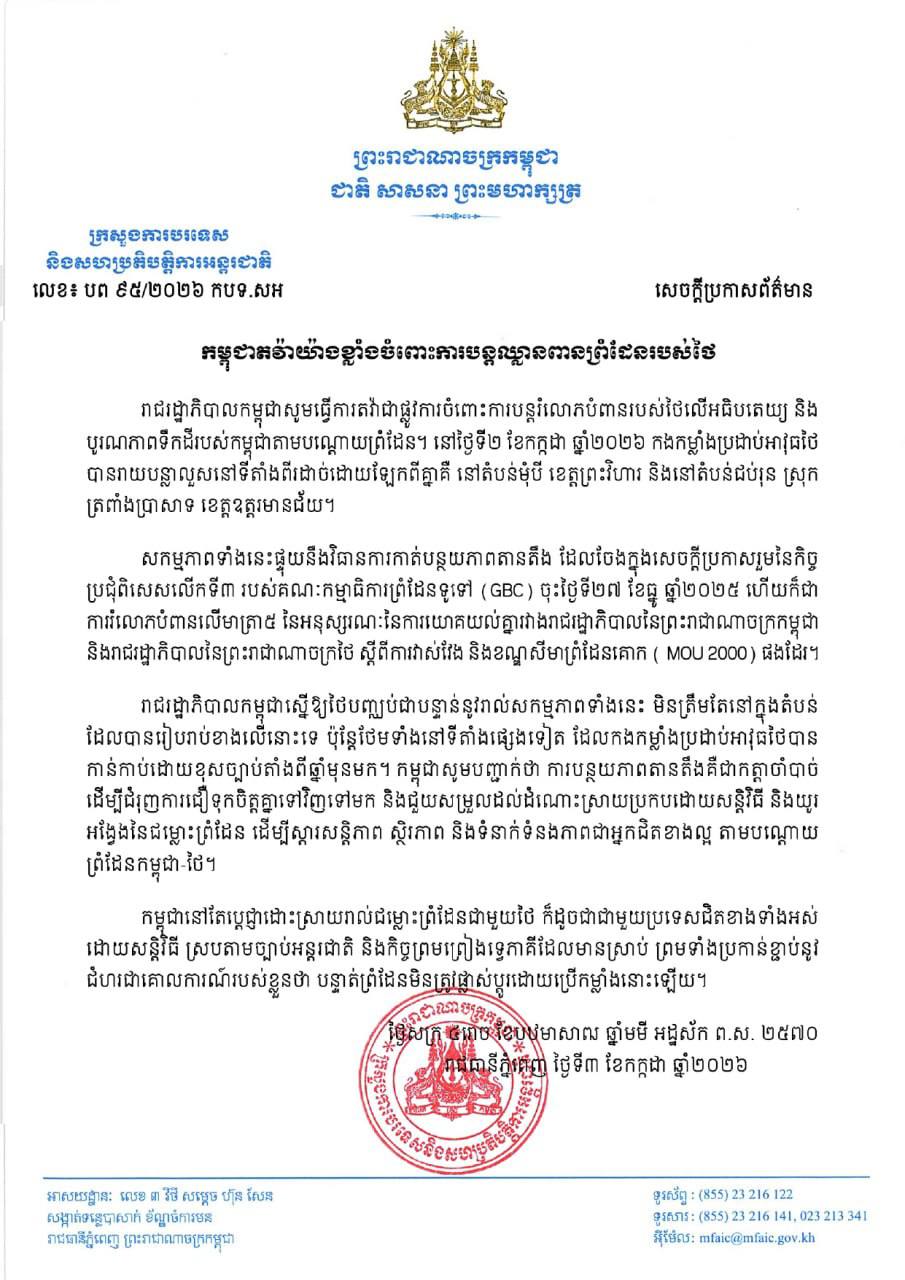
Cambodia Protests Thai Border Incursions
Security
2026年7月4日
4
AKP Khmer
Relations
🇰🇭Cambodia🇹🇭Thailand

Cambodia Protests Thai Border Incursions

AI サマリー

The Cambodian government has strongly protested alleged Thai military incursions and barbed wire installations along the border, deeming them violations of sovereignty and territorial integrity. Cambodia called for an immediate halt, citing breaches of de-escalation measures and the 2000 bilateral MOU.

The Cambodian government has officially lodged a strong protest against the Thai army's continued violations of Cambodian sovereignty and territorial integrity along the border. On July 2, 2026, Thai armed forces reportedly installed barbed wire in two separate locations: the tri-junction area in Preah Vihear province and the Jub Rum area in Trapaing Prasat district, Udor Meanchey province. These actions are contrary to the de-escalation measures stipulated in the joint declaration of the 3rd Extraordinary Meeting of the General Border Committee (GBC) on December 27, 2025, and also constitute a violation of Article 5 of the Memorandum of Understanding between the Royal Government of the Kingdom of Cambodia and the Royal Government of the Kingdom of Thailand on Land Border Measurement and Demarcation (MOU 2000). The Cambodian government urges Thailand to immediately cease all such activities, not only in the mentioned areas but also in other locations where Thai armed forces have been illegally occupying since last year. Cambodia affirms that de-escalation is essential to foster mutual trust and facilitate a peaceful and lasting resolution to border disputes, thereby restoring peace, stability, and good neighborly relations along the Cambodia-Thailand border. Cambodia remains committed to resolving all border disputes with Thailand, as well as with all neighboring countries, peacefully, in accordance with international law and existing bilateral agreements, while upholding its principled stance that border lines must not be changed by force.

多角的分析

経済的影響

国境紛争の激化は、両国間の貿易や物流に直接的な影響を与える可能性がある。特に、国境付近の経済特区や、タイからの投資に依存するカンボジアの産業は、不確実性の増大により投資リスクを懸念するだろう。長期化すれば、地域経済全体の安定性にも影響が及ぶ。

投資家心理

投資家にとって、国境紛争は地政学リスクの顕著な兆候となる。タイとの関係悪化は、カンボジアへの直接投資だけでなく、ASEAN地域全体の投資環境に対する懸念を高める可能性がある。特に、インフラ開発や観光業など、国境を越えた連携が重要な分野では、プロジェクトの遅延や中止のリスクが増大する。

社会的影響

国境地帯に住む住民は、タイ軍による有刺鉄線設置などの行為により、生活基盤への影響や移動の自由の制限を直接的に受ける。過去にも国境紛争は住民の不安を煽り、土地の利用や農作業に支障をきたしてきた。今回の事態は、地域社会における緊張感を再び高める可能性がある。

市民の声

国境地帯に住む市民は、タイ軍による有刺鉄線設置などの行為により、生活基盤への影響や移動の自由の制限を直接的に受ける。過去にも国境紛争は住民の不安を煽り、土地の利用や農作業に支障をきたしてきた。今回の事態は、地域社会における緊張感を再び高める可能性がある。

背景・歴史的文脈

カンボジアとタイの国境線は、フランス植民地時代に画定されたもので、一部に不明瞭な箇所が存在し、過去から度々領土問題や紛争の火種となってきた。特に、プレアビヒア寺院周辺の国境紛争は、国際司法裁判所に提訴されるなど、両国関係の緊張の象徴となっていた。2000年のMOUは、国境画定作業を進めるための枠組みだが、その履行には両国の政治的意志が不可欠であり、時として国内政治の駆け引きに影響されることがある。

原文ソース

AKP Khmer

原文を読む