General articles are free for 24 hours after publish.
Hundreds Brave Rain to Reinforce Dyke Against Floods in Hanoi Outskirts
Record rainfall has pushed rivers in Hanoi's outskirts to dangerous levels, prompting hundreds of residents and soldiers to work in the rain to reinforce dykes. Locals are also rushing to harvest crops and move livestock to mitigate potential damage.
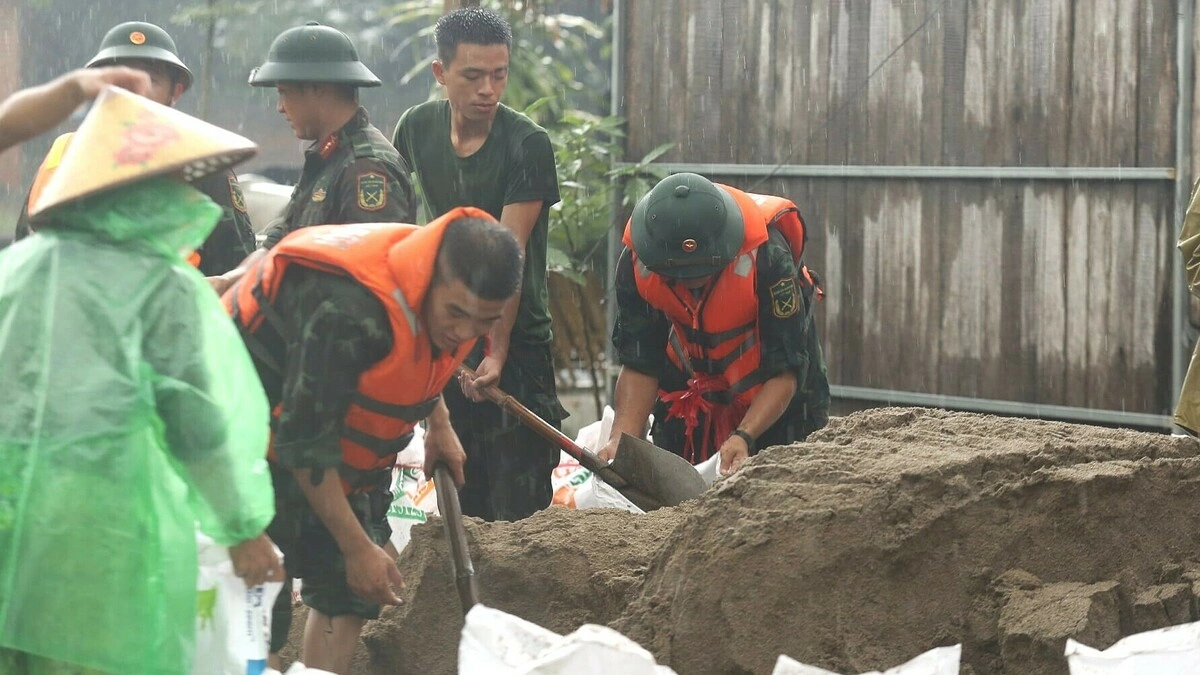
Hundreds of soldiers and residents are braving heavy rain to reinforce dykes in Hanoi's outskirts as the Bui River has breached flood alert levels, threatening to inundate local communities. As of 4 PM on September 16, the water level at Yen Duyet in Xuan Mai commune, western Hanoi, reached 7.22 meters, 0.22 meters above the third flood alert level, and is still rising. National weather forecasters predict the water level could reach 7.4 meters, exceeding the highest alert level by 40 centimeters. Some sections of the dyke, particularly lower-lying areas, have begun to overflow by about 20 centimeters, with water flowing into agricultural lands. Along a more than one-kilometer stretch of the Bui River dyke, hundreds of soldiers from the 201st Tank Brigade, police, militia, and local residents from Xuan Mai and Tran Phu communes are working in the downpour to strengthen the embankment. This 2.8-kilometer dyke, standing at an elevation of 6.7-7 meters, is crucial for preventing or slowing down floodwaters from entering the Tien Tien, Nam Phuong, and Viet An hamlets of Xuan Mai. Disaster response teams, local villagers, and 130 soldiers from Battalion 3 of Brigade 201 have been on-site since morning, focusing on reinforcing low-lying sections to prevent overflow. Xuan Mai Commune has mobilized vehicles and excavators to transport sand, sandbags, and materials to the scene. Soldiers are filling sandbags and arranging them along the dyke's edge, covering them with tarpaulins to mitigate the impact of strong currents that could damage the dyke's surface and slopes. Reinforcement efforts are underway at approximately five locations, each spanning 50-100 meters. Local forces are also patrolling the entire dyke line, monitoring vulnerable spots and signs of erosion for timely reinforcement. Inside the agricultural fields, residents are urgently harvesting crops and setting up stakes and nets to trap fish, proactively reducing potential losses from further water level increases. Nguyen Anh Duc, Chairman of the Xuan Mai Commune People's Committee, has instructed all agencies and units to strictly implement approved response plans, maintain 24-hour readiness, and continuously update rainfall, Bui River water levels, and upstream conditions for proactive response. In addition to dyke protection, the commune is prioritizing drainage to limit waterlogging. Residents have been advised to proactively harvest crops and aquaculture products, and livestock and poultry farmers are urged to move their animals away from potentially affected areas. The Song Day River Irrigation Company is operating four pumps, each with a capacity of approximately 5,200 cubic meters per hour, to actively drain water. In recent days, heavy rainfall has affected the northern and north-central regions of Vietnam due to the aftermath of a tropical depression and the influence of a cold spell. River water levels have risen significantly, particularly along the Bui River, which originates in Phu Tho province and flows through western Hanoi. The National Center for Hydro-Meteorological Forecasting indicates that from the evening of September 16 to September 17, Hanoi, Hai Phong, Lao Cai, Tuyen Quang, Phu Tho, Thai Nguyen, Bac Ninh, Hung Yen, Ninh Binh, Thanh Hoa, and Nghe An are expected to receive 50-90 mm of rain, with some areas exceeding 200 mm. Lang Son, Quang Ninh, and southern Son La may experience 30-50 mm, with isolated areas receiving over 90 mm. From the night of September 17, heavy rains in the northern regions, Thanh Hoa, and Nghe An are expected to gradually decrease. Source: VnExpress
Original source
VnExpress