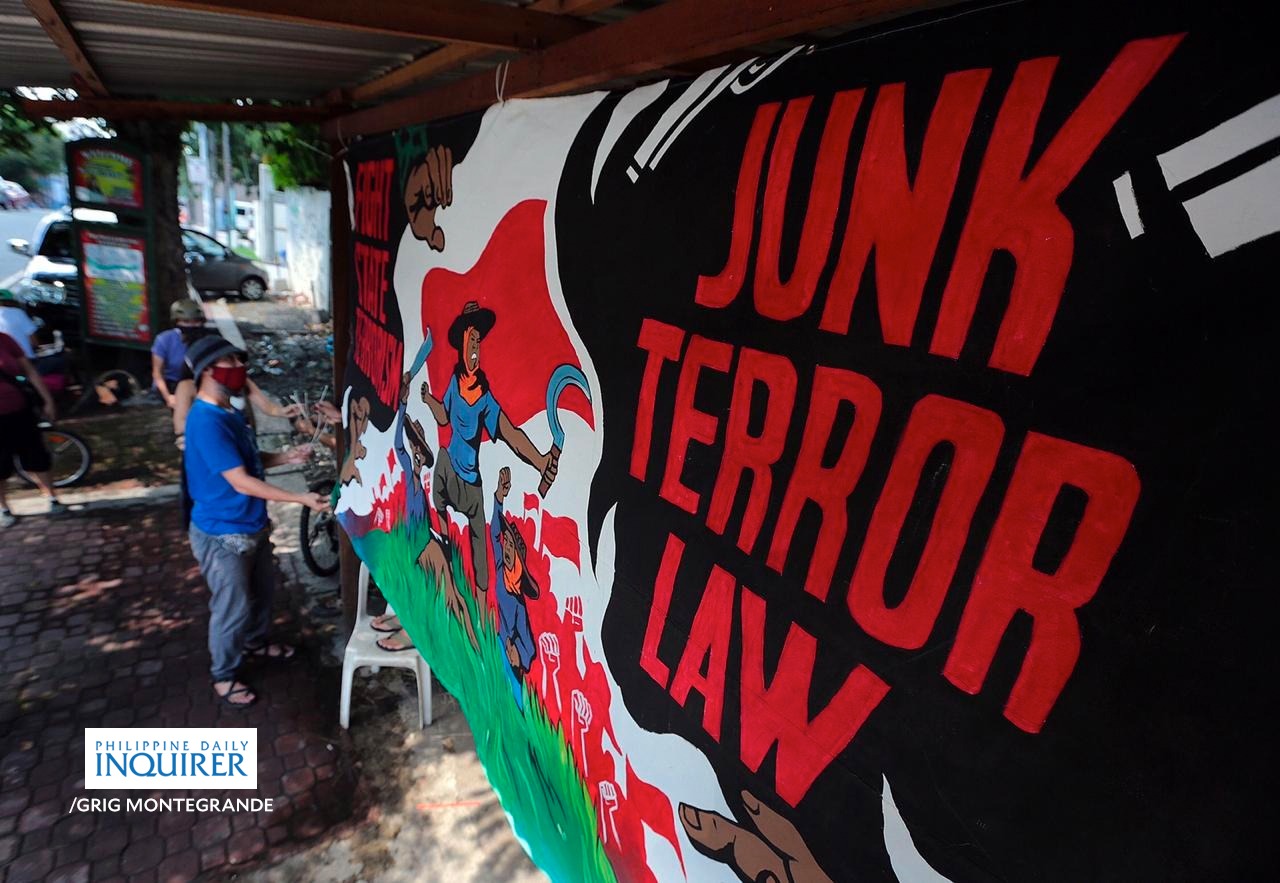
Groups Renew Call to Repeal Anti-Terror Laws, Citing Repression
Human rights advocates in the Philippines have renewed calls to repeal anti-terrorism laws, alleging they are used to silence critics. Over 256 individuals have been charged, with 25 reportedly remaining imprisoned.
Human rights advocates on Friday renewed calls to repeal two anti-terrorism laws, which they said have long been used to silence critics who were only expressing legitimate political dissent. “For years, the Anti-Terrorism Act and the Terrorism Financing Prevention and Suppression Act have served as legal weapons for unjust arrests, prolonged detention, bank account freezes and other forms of political repression, threatening the people’s fundamental rights and freedoms,” Karapatan Secretary General Cristina Palabay said in a statement. According to Karapatan, at least 256 activists and even ordinary Filipinos have been charged under the so-called “terror laws” or were designated as terrorists by the Anti-Terrorism Council. The group noted that 25 individuals remain imprisoned. “The Marcos Jr. administration continues to weaponize these laws to silence critics and suppress legitimate political dissent,” said Palabay. Members of Karapatan also held a protest in front of the Department of Justice on Friday to demand both laws to be repealed. The National Union of People’s Lawyers (NUPL) echoed the demand in a separate statement, pointing out that most terrorism and terrorism financing charges are often dismissed because of the lack of evidence. “The State’s own judicial record exposes the lie. Prosecutions for terrorism and terrorism financing under the ATA and its companion statute, the Terrorism Financing Prevention and Suppression Act, routinely collapse under judicial scrutiny,” it said. The group also criticized how the Anti-Terrorism Council is able to designate groups or individuals as terrorists without a prior notice or hearing, allowing the Anti-Money Laundering Council to freeze their assets. As a result, some organizations that had been tagged as terrorist groups are unable to continue conducting their humanitarian programs because of the lack of access to funds, NUPL said. Earlier on Wednesday, Windel Bolinget of the Cordillera People’s Alliance (CPA) said in a press briefing that there is a need to educate the public about the two laws, noting that the majority of Filipinos do not fully understand what it means to be tagged as a terrorist and how much it can impact a group or individual. “When it comes to murder, rebellion, these kinds of political cases that were filed against us, it’s easy for them to understand. But for terrorism, it’s so hard to engage with them.” “For ATA, there is still a lack of education about it.” He recalled that in 2023, he was designated as a terrorist alongside three other members of the CPA “without due process.” However, Bolinget stressed that the CPA is not a terrorist group and that its activities cannot be proven as terrorism. Because of the designation, Bolinget recalled how the bank accounts of the three CPA members as well as their relatives were frozen by the ATC. “They think it’s no harm done, that it’s just a label,” Steve Tauli, also from CPA, said in the same briefing. “There is a need to understand how it really affects us, the family, and the community.”
多角的分析
テロ対策法による資産凍結は、経済活動、特に人道支援団体やNGOの資金調達能力に直接的な影響を与える。これにより、社会サービス提供の遅延や縮小が生じ、間接的に経済的機会の損失につながる可能性がある。また、投資家にとっては、法的な不確実性や政府による恣意的な規制のリスクとして映り、フィリピンへの投資意欲を減退させる要因となり得る。
テロ対策法(ATA)およびテロ資金供与防止・抑制法は、投資家にとって法的な不確実性を高める要因となる。特に、テロ対策評議会(ATC)が事前の通知や審理なしに個人や団体をテロリストに指定し、資産を凍結できる権限は、予見可能性を著しく低下させる。これにより、フィリピンでの事業展開や投資判断において、潜在的なリスクとして考慮される必要がある。
テロ対策法は、言論の自由や結社の自由といった基本的な市民的権利を侵害する可能性があると、人権団体は主張している。活動家や一般市民がテロリストに指定され、銀行口座が凍結されることで、生活基盤や活動の継続が困難になる事例が報告されている。これは、社会における多様な意見表明の萎縮につながり、民主的な社会の健全性を損なう懸念がある。
テロリスト指定や資産凍結は、単に法的な問題にとどまらず、当事者とその家族の生活に深刻な影響を与える。Cordillera People's Alliance (CPA)のメンバーとその親族の銀行口座が凍結された事例は、個人だけでなく、コミュニティ全体への不安と混乱をもたらす。ボリンゲト氏が指摘するように、テロリズムの定義の曖昧さが、一般市民の理解を困難にし、恣意的な運用への懸念を高めている。
背景・歴史的文脈
フィリピンにおけるテロ対策法を巡る議論は、長年にわたる人権侵害の歴史と、反政府活動への政府の厳しい姿勢に根差している。2020年に制定されたテロ対策法(ATA)は、その広範な定義と厳しい罰則により、活動家やジャーナリスト、少数民族グループなど、政府の政策に批判的な人々を標的にするために使用されてきたと非難されている。過去にも、類似の法律が政治的反対派を弾圧する目的で利用された事例があり、今回のATA廃止要求も、こうした歴史的背景を踏まえたものと言える。
原文ソース
Inquirer NewsInfo