General articles are free for 24 hours after publish.
Decoding Thailand's Air Quality: Understanding PM2.5 and AQI for Health
Understanding Thailand's Air Quality Index (AQI) and PM2.5 readings is crucial for making informed decisions about outdoor activities. This report explains how the Pollution Control Department (PCD) calculates AQI, its relationship to PM2.5, and compares it with WHO guidelines to promote healthier choices.
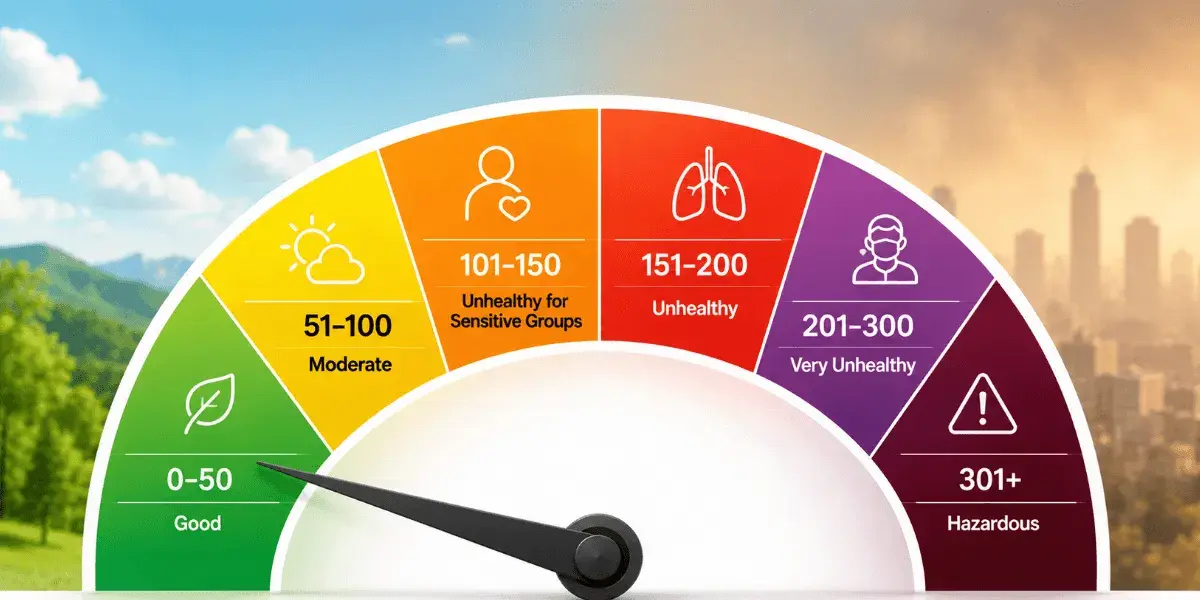
Last Updated on September 24, 2026 by Jeff Tomas Seeing an AQI or PM2.5 reading in Thailand and not knowing what to do with it is a common problem. The number can help you decide whether to exercise outdoors or limit time outside, but its meaning depends on the scale, the pollutant, and the averaging period. Thailand’s AQI is a unitless index, while PM2.5 is measured as a concentration in micrograms per cubic meter. Once you know which figure you’re looking at, you can read it in context and make safer daily choices. For local guidance, see understanding Chiang Rai AQI and PM2.5 levels. PM2.5 and AQI describe related parts of air quality, but they are different measurements. Thailand’s Pollution Control Department (PCD) calculates an AQI from pollutant-specific breakpoints. PM2.5 is one of six pollutants in the system, alongside PM10, ozone, carbon monoxide, nitrogen dioxide, and sulfur dioxide. PM2.5 refers to fine particles with a diameter of 2.5 micrometers or smaller. Their concentration is measured in micrograms per cubic meter, written as µg/m³. AQI, by contrast, is a unitless index that turns a pollutant reading into a scale that is easier to interpret. For example, a monitor might report a PM2.5 concentration of 40 µg/m³. That figure describes the amount of fine particles in a volume of air. The corresponding AQI is a separate number, calculated by comparing the concentration with Thailand’s breakpoint ranges. The PCD uses a 24-hour average for PM2.5 and breakpoint interpolation to calculate its sub-index, so a single live concentration is not automatically the same as the daily AQI. Thailand’s PCD categories group AQI values by air-quality level. The labels and color descriptions can vary between summaries, particularly at the highest readings. The EANET overview of Thailand’s AQI categories provides one reference for interpreting the scale. Since apps and reports may use different category names or scales, check the scale and health advice shown by your source. For local context, see the Thailand air quality report and PM2.5 levels. These simplified 24-hour PM2.5 breakpoints show how concentrations map to AQI bands: Higher AQI bands continue above these ranges. Because the calculation uses interpolation, a concentration near a breakpoint can move into another category as levels change. Check whether a service shows a current sensor reading or the 24-hour average before comparing its figures. A PM2.5 concentration tells you how much fine-particle pollution is in the air. An AQI turns that concentration into a health communication scale, but the result depends on the system and averaging period used. Check both before comparing app readings or deciding what a category means. Thailand and the United States use different AQI breakpoints and public-health categories. As a result, the same PM2.5 concentration can produce different index numbers or labels. Thailand’s official scale uses five color bands, while the US EPA’s AQI uses a 0-to-500 scale with six health categories. For example, the EPA places PM2.5 concentrations of 9.1 to 35.4 µg/m³ in its “Moderate” band. Thailand uses its own thresholds, so an app showing a Thai AQI and another showing US AQI may display different numbers for similar air conditions. The indices are not interchangeable. Before comparing readings, check the app’s settings or information panel for the scale it uses. You can also compare the reported PM2.5 concentration in µg/m³, provided both readings use a comparable averaging period. The EPA’s PM2.5 AQI breakpoint table shows how concentrations map to US categories. The World Health Organization’s 2021 air quality guidelines recommend PM2.5 levels of 5 µg/m³ for the annual mean and 15 µg/m³ for the 24-hour mean. These are health-based guideline values, not Thailand AQI categories. See the WHO air quality guidelines for their definitions and context. A Thai reading labeled “Good” or “Moderate” can still be above the WHO 24-hour guideline. That difference doesn’t make the Thai category incorrect: the systems answer different questions and use different thresholds. Also, the WHO 24-hour guideline is based on the 99th percentile of daily averages over a year, so it is not a simple daily safe-or-unsafe cutoff. PM2.5 can change by hour and location. A monitor beside a busy road may report different conditions from one in a residential area, and neither station describes every nearby street or home. Apps may also draw on different monitors or show different averaging periods, such as a live estimate versus a rolling 24-hour value. Check the reading’s timestamp, monitor location, data source, and averaging window. Then look at the recent trend rather than relying on one number. For added context, compare official reporting with local PM2.5 monitoring in Chiang Rai. A high PM2.5 reading is a cue to check current local conditions and adjust your plans. Use official updates for the local picture, then follow health guidance that fits your needs. Air4Thai is the Pollution Control Department’s public website and app for checking current air-quality readings. It provides station readings, maps, and available graphs or forecasts. You can find the app on Google Play. For advice on reducing health risks, also check updates from the Ministry of Public Health’s Department of Health. Before acting on a reading, check when it was updated and, when possible, choose a monitoring station near your home or destination. Conditions can vary across short distances, so a faraway station may not reflect the air where you are. Other apps can help you compare trends, but treat them as additional references. Check their data source, station location, and AQI scale before comparing their numbers with Air4Thai. When local advice recommends caution or pollution is high, reduce strenuous outdoor activity or move it indoors. You might shorten a run, choose an indoor workout, or reschedule outdoor work. Check the latest local guidance before making plans, since readings can change during the day. Children, older adults, pregnant people, and anyone with heart or lung disease may need extra care. If you develop symptoms, follow medical guidance and contact a healthcare professional when needed. A reading can help you plan, but it cannot diagnose a health problem or replace advice from your clinician. Seasonal haze, including smoke from fires and open burning, can push PM2.5 higher across northern Thailand. Levels may change quickly, and conditions can differ between towns, neighborhoods, and monitoring stations. Before outdoor travel or exercise, check the forecast as well as recent readings to see whether pollution is rising or easing. During the haze season, build flexibility into your plans. If conditions worsen, consider changing your route or postponing outdoor activity rather than relying on yesterday’s reading. Local measures can also change; for example, check current details about Chiang Rai’s
Original source
Chiang Rai Times