India's Delays Lead to Key Bangladeshi Projects Handed to China
Diplomacy
2026年7月6日
5
The Diplomat Indonesia

India's Delays Lead to Key Bangladeshi Projects Handed to China

AI サマリー

Bangladesh has handed over the Mongla Port Special Economic Zone and Teesta River Management projects, originally offered to India, to China due to New Delhi's delays. This raises national security concerns for India and highlights issues with its project execution and diplomatic effectiveness.

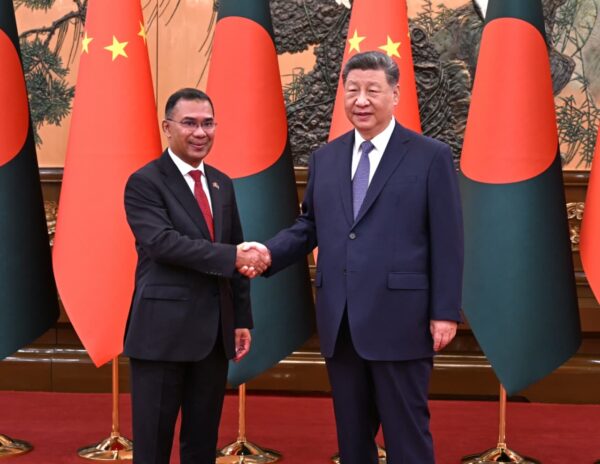
Read The Diplomat, Know The Asia-Pacific In 2015, Bangladesh allotted land to India for the development of an SEZ at Mongla port. India failed to start work on that project. Dhaka handed it to China. Bangladeshi Prime Minister Tarique Rahman shakes hands with Chinese President Xi Jinping at a bilateral meeting held at the Great Hall of the People in Beijing, China, June 26, 2026. Bangladeshi Prime Minister Tarique Rahman’s visit to China on June 22-26 saw the two sides sign 17 bilateral instruments. The two governments elevated “their comprehensive strategic cooperative partnership to jointly build a China-Bangladesh community with a shared future,” agreed to explore a 2+2 dialogue mechanism involving diplomacy and defense, and announced plans to implement a Bangladesh-China-Myanmar Economic Corridor. Two projects, in particular — the Mongla Port Facilities Modernization and Expansion Project and the Teesta River Comprehensive Management and Restoration Project (TRCMRP) — announced during Rahman’s visit have India worried as China’s involvement in these projects has implications for India’s national security. Mongla Port, Bangladesh’s second-largest and second-busiest seaport after Chattogram, is located on the east bank of the Pasur River, 71 nautical miles upstream from the Bay of Bengal. The project here involves developing a special economic zone (SEZ) on a 110-acre plot of land adjacent to the port. China’s state-owned Civil Engineering Construction Corporation will develop the SEZ and has proposed an investment of $650 million in manufacturing industries, warehouses and storage facilities at the SEZ. India’s concern over China’s involvement in the Mongla port SEZ is its location. It is just 80 km from the Indian border and 188 km from Kolkata. According to a CNN-News18 report, which cited Indian intelligence sources, there is a “high risk of Beijing installing advanced maritime surveillance systems and electronic intelligence infrastructure at the site.” It will enable China to monitor from close quarters “Indian naval deployments, coastal radar networks, and strategic movements around the Kolkata and Haldia ports.” Additionally, it would provide Beijing with access to yet another Bay of Bengal port, which could, in turn, increase China’s presence in the Indian Ocean. As for the TRCMRP, this is a river engineering initiative that involves dredging the Teesta and developing reclaimed land. With Chinese expertise, Bangladesh will be able to manage the Teesta’s waters better and deal with water shortages, floods, and riverbank erosion. India’s problem with the TRCMRP is its location. Although it is on the Bangladeshi side of the border, the proposed river management project is near India’s strategic Siliguri Corridor, a narrow sliver of land that links the Indian mainland with the restive Northeast. India’s concern over China’s involvement in the Mongla port SEZ and the TRCMRP is understandable to some extent given their proximity to the Indian border. However, these are far from the first projects China has executed in Bangladesh. China’s role and presence in Bangladesh have grown by leaps and bounds in recent decades. It has been involved in scores of infrastructure projects in Bangladesh, including the building of roads, bridges, and railway lines. Indeed, the Chinese are already engaged in building roads, bridges, and power plants in Rangpur division, Bangladesh’s northernmost district that borders the Siliguri corridor, and where much of the TRCMRP’s work will be focused. Dhaka’s decision to hand over the TRCMRP and the Mongla SEZ project to China may be part of “a broader policy shift to reroute regional transit dependency away from Indian networks.” However, India has only itself to blame for these projects being handed to the Chinese. Consider this: Bangladesh first offered India the project to develop an SEZ at Mongla port. Under a 2015 agreement with India, it allotted 110 acres of land for the SEZ. Subsequently, the Indian government appointed Indian developer Hiranandani Group’s subsidiary, Evita Constructions, to develop the SEZ. However, the project never took off. Finally, in October 2025, amid deteriorating Bangladesh-India relations, the interim administration under Muhammad Yunus delisted the project because the developer had failed to commence work. India’s implementation of projects abroad has a long history of not meeting deadlines. This habit cost it the Mongla SEZ. As for the TRCMRP, Bangladesh may not have turned to the Chinese to help manage the Teesta’s waters had India not dragged its feet on an agreement on sharing the waters of this river. Although the deal was ready by 2011, objections from the West Bengal government prevented New Delhi from signing the agreement with Dhaka. Frustrated with Delhi’s failure to deliver an agreement, in 2016, Dhaka began exploring the China option for better management of the Teesta river within Bangladesh’s borders. Pressure from Delhi kept Bangladesh under Sheikh Hasina from sealing a deal with the Chinese on the Teesta project. While India did, in May 2024, offer to finance the $1 billion project to dredge and manage the Teesta inside Bangladesh, it came too late. In August, Hasina was ousted from power, clearing the way for the interim government to ask China for help in managing the Teesta. If China has made deep inroads in India’s neighboring countries, this must be attributed not just to its financial clout but also its efficient and swift execution of infrastructure projects. Importantly, it has not hesitated to snap up projects with strategic value, even if these are not economically profitable. India has often dithered on such projects. Take the Hambantota port, for example. The Sri Lankan government first offered India the opportunity to develop the Hambantota port. India turned down the offer because it felt the port would not attract enough traffic. While Delhi may have been right in its assessment of the port’s capacity to draw business, its prioritization of the port’s short-term economic potential over the long-term strategic value proved costly. After stepping in to develop Hambantota port, China took over port operations in 2017 under a 99-year lease, when Sri Lanka failed to pay back loans. India’s loss was China’s gain. Geography, history, and a shared culture gave India a head start in building strong bonds with Bangladesh. However, India has frittered away these advantages, especially since the Hindu nationalist Bharatiya Janata Party (BJP) came to power nationally in 2014. The BJP government routinely demeans Bangladeshis not just in its rhetoric — Home Minister Amit Shah likened Bangladeshi immigrants to termites — but in its policies and actions as well. The ongoing “push back” of what Delhi terms as “illegal” or “undocumented Bangladeshi immigrants” has fueled anti-India sentiments in Bangladesh to unprecedented levels. At stake are not just a few projects or

多角的分析

経済的影響

インドの遅延は、バングラデシュにおけるインフラ開発の機会損失を意味する。中国による投資はバングラデシュ経済に短期的な恩恵をもたらす可能性があるが、長期的に見れば、インドとの経済連携が強化されていれば得られたであろう相乗効果を失うことになる。また、中国主導のプロジェクトは、バングラデシュの債務負担を増加させるリスクも孕んでおり、経済的自立性を損なう可能性も否定できない。

投資家心理

インドのプロジェクト遂行能力への懸念は、インド国外での投資機会におけるリスク要因として投資家が認識するだろう。特に、地理的に近く戦略的にも重要なバングラデシュのような市場で、インドが機会を逃し続けることは、インドを主要な投資先として検討する際の信頼性を低下させる。中国の迅速な実行力は、投資家にとって魅力的に映る可能性があるが、その透明性や債務の持続可能性については慎重な評価が必要となる。

社会的影響

モンラ港SEZ開発の遅延は、バングラデシュ国内の雇用創出や経済発展の機会を遅らせた。また、テスタ川プロジェクトの遅延は、洪水や水不足に苦しむ地域住民の生活改善を遠のかせた。バングラデシュ国民の間で高まる反印感情は、単なる政治的な問題に留まらず、人的交流や文化的な結びつきにも影響を及ぼす可能性がある。中国によるプロジェクト実行は、現地の労働条件や環境への配慮が十分でない場合、新たな社会摩擦を生むことも懸念される。

市民の声

モンラ港のSEZ開発が遅れたことで、バングラデシュ国民は新たな雇用機会の創出や経済成長の恩恵を受ける機会を逸した。テスタ川の管理・修復プロジェクトの遅延は、水害や水不足に悩む地域住民の生活に直接的な影響を与え続けている。インド政府の対応への不満が、国民感情として反印感情を高め、両国間の人的交流や文化的な理解にも影響を与える可能性がある。中国のプロジェクトが、地域社会の環境や労働条件にどのような影響を与えるかは、現地住民にとって大きな不安要素となっている。

背景・歴史的文脈

インドとバングラデシュは、地理的近接性、歴史的つながり、文化的な共通性から、伝統的に良好な関係を築いてきた。特に、1971年のバングラデシュ独立戦争におけるインドの支援は、両国関係の基盤となっている。しかし、近年、特に2014年にインド人民党(BJP)が政権を握って以降、インド国内でのバングラデシュ人移民に対する強硬な姿勢や、テスタ川の水利権交渉の遅延などが、バングラデシュ国内での反印感情を高める要因となっている。一方、中国は「一帯一路」構想の下、南アジア諸国へのインフラ投資を積極的に拡大しており、バングラデシュもその対象国の一つとなっている。インドのプロジェクト遂行能力の低さと、中国の積極的な投資攻勢が、現在の状況を生み出している。

原文ソース

The Diplomat Indonesia

原文を読む