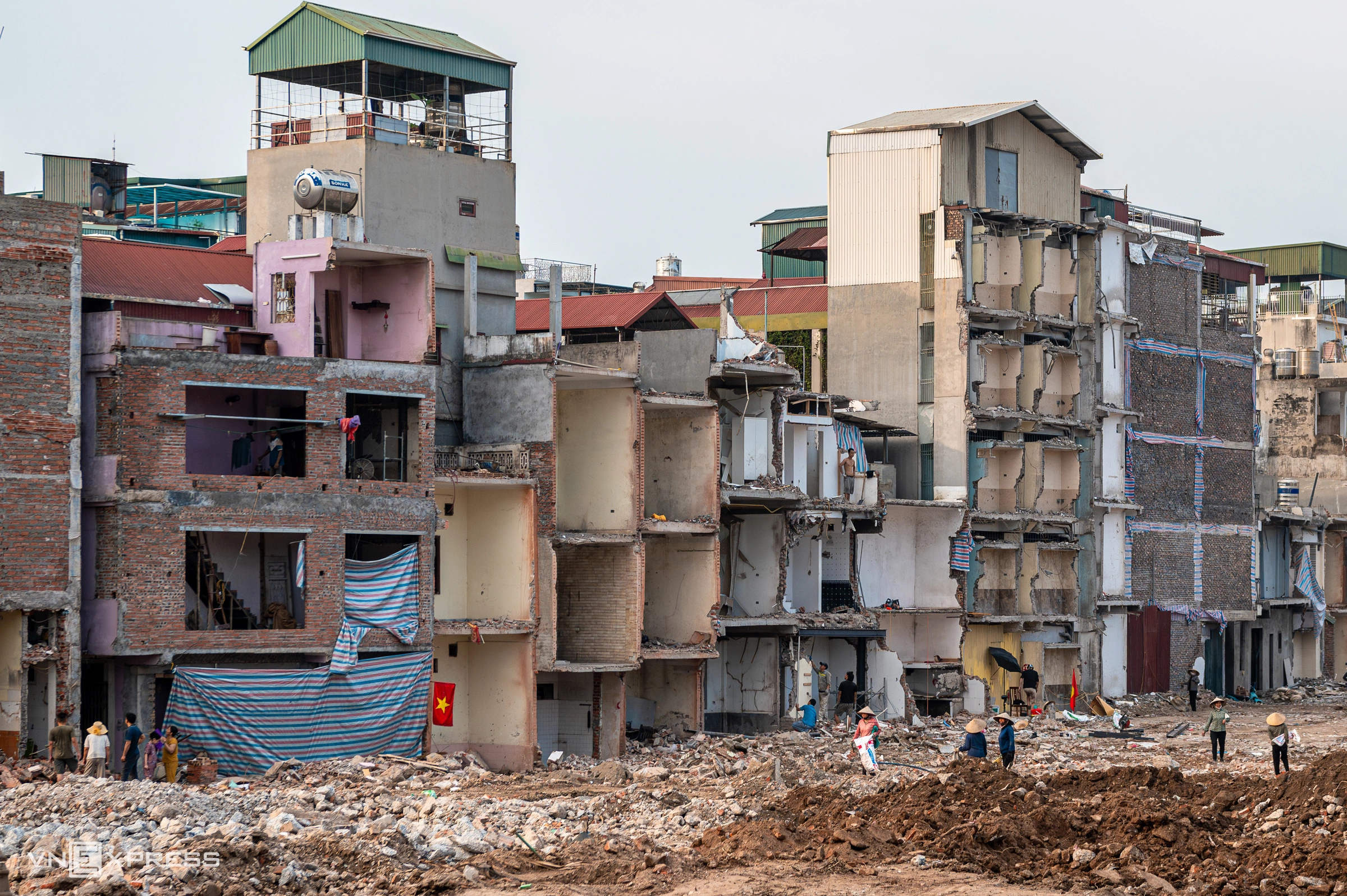
Hanoi's Sliced-Up Houses: The Grim Reality of Urban Demolition Amidst Development
Infrastructure
2026年7月7日
5
Vietnam Insider

Hanoi's Sliced-Up Houses: The Grim Reality of Urban Demolition Amidst Development

AI サマリー

Multiple infrastructure projects in Hanoi are simultaneously slicing through homes, leaving residents in limbo with inadequate compensation and unsafe living conditions. The urban landscape is being aggressively reshaped, but at a significant human cost.

The Urban Dissection Multiple key infrastructure and transit projects are tearing through Hanoi simultaneously, aggressively transforming the face of the city. Along the Tran Hung Dao bridge project, a wave of land clearances has left rows of houses brutally sliced open, exposing hollow, gaping rooms directly to the public street. On Ring Road 1, along the Hoang Cau – Voi Phuc section, demolition crews savagely cut down a five-story residence. The building once spanned nearly 300 square meters. The demolition reduced the structure to a precarious, makeshift shell. Yet, the family must go on living inside. Official agencies continue to freeze all repair and renovation permits, trapping the residents in limbo. Similarly, following land clearance for the expansion of Linh Nam Road, a nearly 200-square-meter home belonging to Mr. Nguyen Trong Hung in Vinh Hung ward was decimated, leaving only a tiny fraction behind. Hung stays in the ruined house alone; his elderly parents have already fled to another location for safer living conditions and to escape the suffocating clouds of construction dust. Trapped in the middle of an active construction zone, Hung admits he must keep his doors tightly sealed all day long to fight back the relentless onslaught of dust and noise. He only dares to open them in the dead of early morning or during brief lulls when the heavy machinery falls silent. Choking on Dust and Heavy Machinery The Ring Road 2.5 project cuts directly through Yen Hoa ward. Here, 70-year-old Mr. Nguyen Quang watched authorities seize nearly 30 square meters of his property. The seizure left behind a fractured footprint of just 51 square meters. Desperate to stabilize their upended lives, he and his wife poured hundreds of millions of VND into immediate renovations. However, the rebuilding process quickly devolved into an agonizing nightmare. Repairs have dragged on indefinitely due to a severe labor shortage. Hanoi’s simultaneous explosion of mega-projects spreads construction workers incredibly thin. The physical dissection of the house forced brutal structural compromises. Workers had to demolish the old staircase entirely. They did this just to stretch what little remained of the floor plan. The land seizure cost the house a massive section of its front facade, forcing this architectural sacrifice. This structural trauma quickly fractured the family dynamic as well. Previously, 10 family members coexisted closely under this single roof. Following the dissection of their home, the hazardous, exposed space drove away Mr. Quang’s children and grandchildren. They fled to other dwellings. This exodus left only the elderly couple behind. They now live isolated in the ruins to guard their remaining property during the grueling renovation. Meanwhile, the massive scope of the Tran Hung Dao bridge development swallowed Mr. Nguyen Anh Tu’s residence. Land clearance left his home mutilated, just like dozens of others nearby. The project severed over 10 square meters at the back of the house. This lost space once housed the family kitchen and bathroom. The family had to hand it over to the project. Theoretically, 51 square meters remain. However, the actual usable space of Tu’s house shrivels to just over 30 square meters. The demolition sliced the structure open, leaving multiple rooms completely exposed. Tu’s parents are frail octogenarians over 90 years old. They previously lived entirely on the ground floor. Now, the loss of both a kitchen and a toilet plagues their daily survival with profound inconvenience. Racing the Clock Against Structural Collapse Scarcely 30 meters away stands another house. Crews demolished over half of its structure to make way for the project. The destruction left behind a jagged 50 square meters. Ms. Nguyen Thị Thuy lives inside a hollow room. The demolition sliced this area into exposed compartments. She has stayed behind to watch over the property. Meanwhile, her family desperately scrambles to rebuild. The house was once spacious but hidden deep within a narrow alleyway. Now, the brutal clearance has chopped off half the structure. This violently warps both its architectural integrity and their entire living space. To ascend to the second floor, where the bedrooms miraculously remain intact, Thuy must navigate a broken, perilous staircase caught in a state of partial demolition, with exposed rebar jutting out like rusted bones. “My family is racing at full speed to repair the house to ensure structural safety and restore some decency to its appearance. We deeply pray the repairs finish quickly so our lives can finally return to normal,” Thuy shares. The relentless advance of the Ring Road 2.5 project almost entirely consumed another nearby house. The development devoured the home from a modest 33 square meters down to a claustrophobic, suffocating footprint of less than 7 square meters. The remnants of this dwelling sit on a raw plot of nearly 20 square meters. This tiny space serves as the cramped refuge for three separate brothers’ families. The extreme confinement has completely upended their lives. Cooking, eating, and resting are forced into this minuscule remaining space or out onto the front yard, which remains a chaotic wasteland of shattered concrete and debris. All across the construction zones, heavy machinery roars day and night, relentlessly tearing down the remaining structures trapped within the project’s unforgiving path. Across the construction sites, heavy machinery rumbles day and night, tearing down structures within the land clearance zones to make way for the projects. Image source: The Bang/VnExpress

多角的分析

経済的影響

ハノイにおける複数の大規模インフラプロジェクトの同時進行は、ベトナム経済の成長戦略の一環として理解できる。しかし、その実行過程で発生している家屋の切断や住民の生活困窮は、プロジェクトの非効率性や、土地収用・補償に関する現行制度の不備を示唆している。特に、労働力不足が改修工事の遅延を招いている点は、ベトナム経済が直面する構造的な課題(例えば、熟練労働者の不足や、地方から都市への労働力移動の非効率性)を浮き彫りにしている。これらの問題は、プロジェクトの遅延によるコスト増大や、経済成長の持続可能性への懸念に繋がる可能性がある。

投資家心理

投資家にとって、ハノイでのインフラ開発は潜在的な機会を提供する一方で、リスクも内包している。都市開発は不動産市場の活性化や関連産業への投資機会を生む可能性がある。しかし、本件のように、プロジェクトの実行段階で住民との軋轢や、予期せぬ遅延、コスト超過が発生するケースは、プロジェクトの実行リスクや、ベトナムにおける法規制・行政手続きの不透明性を示唆する。特に、修繕許可の凍結や、補償に関する明確な基準の欠如は、投資家が直面しうる行政リスクや、事業計画の不確実性を高める要因となる。より透明性の高い土地収用プロセスと、住民への適切な補償・移転支援が確立されない限り、大規模開発プロジェクトへの投資は慎重な検討を要する。

社会的影響

ハノイの「切断された家々」は、急速な都市開発が地域社会に与える深刻な影響を示している。グエン・チョン・フン氏の例では、粉塵と騒音から逃れるために家を閉め切らねばならず、日常生活が著しく制限されている。グエン・クアン氏の家族のように、土地収用が原因で家族が離散し、高齢者のみが残されるケースは、コミュニティの崩壊や、社会的弱者の孤立といった問題を生じさせている。また、グエン・アン・トゥー氏の家屋でキッチンとトイレが失われたことは、高齢者の基本的な生活ニーズさえ満たされなくなるという、切実な生活困難を示している。これは、開発の恩恵が一部に集中する一方で、その犠牲を強いられる人々の声が届きにくい、ベトナム社会における構造的な課題を浮き彫りにしている。

市民の声

ハノイ市民、特に開発地域に住む人々は、インフラプロジェクトの犠牲者となっている。グエン・チョン・フン氏のように、自宅が工事現場に囲まれ、粉塵と騒音に耐えながら生活を強いられている人々がいる。グエン・クアン氏の家族は、土地収用によって自宅が分断され、家族が離散するという悲劇に見舞われた。グエン・アン・トゥー氏の家屋のように、キッチンやトイレといった生活必需品が失われ、高齢者の生活が困難になるケースもある。これらの住民は、補償や再建の目処が立たないまま、劣悪な環境での生活を余儀なくされており、彼らの声が行政に届きにくい状況にあることが示唆される。

背景・歴史的文脈

ベトナムでは、1986年のドイモイ(刷新)政策以降、市場経済化と対外開放を進め、目覚ましい経済成長を遂げてきた。特に都市部では、インフラ整備が経済成長の鍵とされ、ハノイやホーチミン市を中心に大規模な都市開発プロジェクトが相次いでいる。これらのプロジェクトは、交通網の整備、都市機能の向上、外国からの投資誘致を目的としている。しかし、急速な開発に伴い、土地収用や住民移転に関する問題が頻繁に発生しており、住民の権利保護や、開発による環境・社会への影響に対する懸念も高まっている。特に、政府による土地収用は、補償額や移転先の条件などにおいて、住民との間でしばしば紛争の原因となっている。

原文ソース

Vietnam Insider

原文を読む