General articles are free for 24 hours after publish.
Vietnam pilots 6,000 drone flights to test low-altitude airspace economy
Vietnam has launched a sandbox trial for developing a low-altitude airspace economy in the mountainous province of Dien Bien. Approximately 6,000 test drone flights will be conducted to validate application models in agriculture, transportation, and public services, aiming to reduce costs and improve efficiency. This initiative marks a significant step towards the widespread adoption of drone technology and the cultivation of related industries.
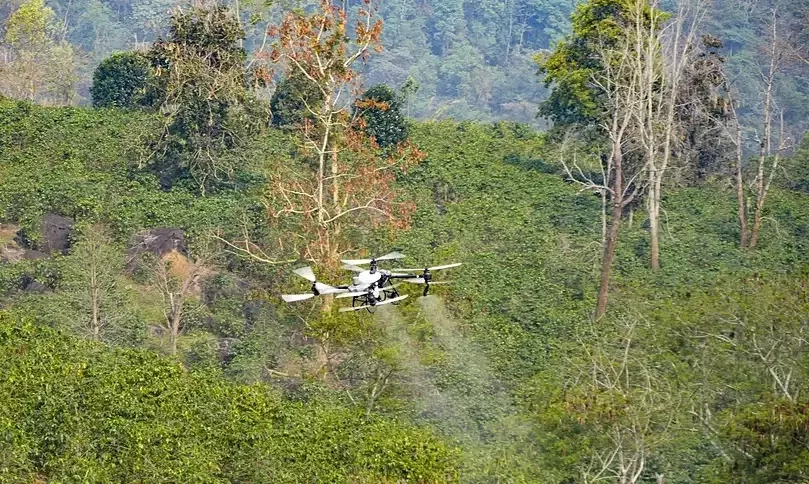
At the end of June, its people's committee approved a sandbox trial for developing a low-altitude airspace economy after nearly six months of coordination with the Ministries of Science and National Defence, Vietnam Post, and FPT. Around 6,000 test flights will be conducted, with Vietnam Post leading operations and FPT Group alongside other UAV manufacturers handling the technical side, supplying technology solutions, equipment, and flight control software. The scheme aims to validate three to five typical UAV application models with the goal of reducing time or costs by 20-30% compared to conventional methods. Nguyen Van Thuat, deputy director of the Department of Digital Economy and Digital Society. Photo by Trong Dat At the Ministry of Science and Technology's regular press briefing on July 31, Nguyen Van Thuat, deputy director of the Department of Digital Economy and Digital Society, said the choice of location was deliberate. Dien Bien is a mountainous province with rugged terrain, making travel and the transportation of goods costly and difficult. Many of its remote communities also have limited access to healthcare, markets, and essential production supplies. It shares a border with Laos and China and has extensive forest cover, and frequent demand for resource monitoring, forest fire prevention and response, search and rescue operations, and disaster management, he said. "These are all problems where low-altitude airspace technology can make a clear difference compared to traditional methods." The partners conducted field surveys, assessed terrains and socio-economic development needs, and analyzed requirements related to national defence, security, flight safety, and potential risks before determining test zones, flight corridors, application sectors, and inter-agency coordination mechanisms. A UAV developed by FPT and Truong Thinh Drone sprays pesticides during a trial at Ang Cang Lake in Manh Danh Village, Muong Muong Commune, Dien Bien Province. Photo by VNA The program has three main targets. In agriculture, UAVs are used for seeding, crop protection spraying, crop monitoring, and transporting supplies and post-harvest produce. In transport, aerial vehicles are used to deliver medicines, medical supplies, specimens, and essential goods to remote and deep-lying areas. The final aspect involves digital mapping, terrain monitoring, forest and resource management, disaster early warning, and public service support. The program will enable controlled exemptions, creating conditions for technology companies, particularly domestic UAV manufacturers, to research and refine their technology in real-world conditions. Specifically, companies may be exempt from, or allowed greater flexibility in meeting, two minimum flight requirements. This reduces the number of mandatory testing and evaluation criteria from 69 to just nine, including tests for radio frequency, electromagnetic compatibility, anti-interference, and other key quality standards. Thuat said the results from the country’s first such program would serve as a reference point for refining policy on low-altitude airspace economy development, which is emerging as a new growth driver. Globally, China has designated it a strategic economic sector, while the U.S., Japan, South Korea, and many European countries are also trialing new service models based on low-altitude aerial vehicles. These countries are not only developing the vehicles themselves but also building industrial and service ecosystems. "UAVs are just the vehicle; the economic value lies in the technology ecosystem, data, and accompanying services," Thuat said. This is the approach the Ministry of Science and Technology is taking in its research into developing a low-altitude airspace economy in Vietnam, he said. At the press briefing, Deputy Minister of Science and Technology Bui Hoang Phuong said the program is proof that the legal framework for piloting new models is already in place, even in a complex area such as UAVs. "The mechanism is complete; what remains is implementation." Subsidiary of VnExpress License number: 71/GP-CBC, Ministry of Information andCommunications, September 22, 2021 Editor-in-Chief: Pham Van Hieu Email: [email protected]: 028 7300 9999 - Ext 8556 10th floor, Block A FPT Tower, 10 Pham Van Bach, Cau Giay Ward, Hanoi
Original source
VnExpress International