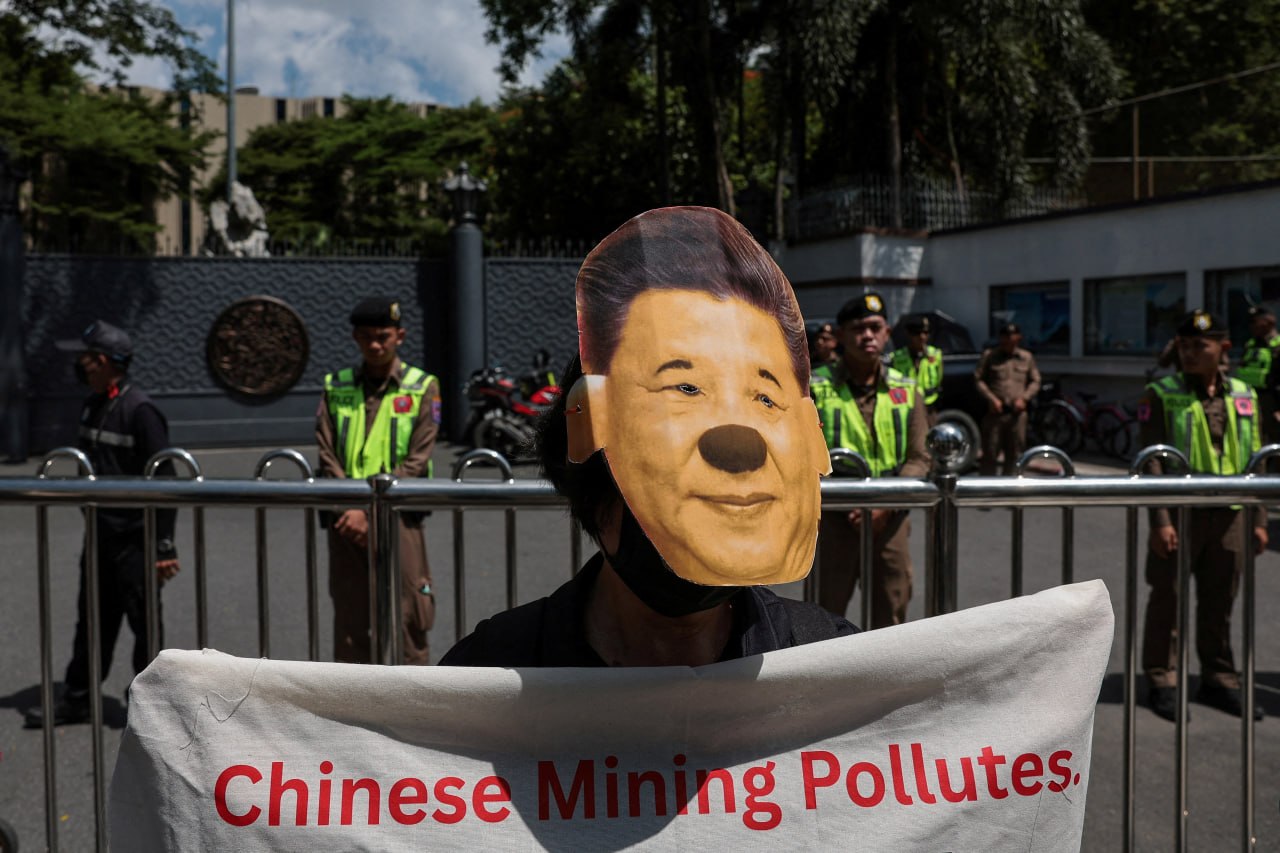
Activists escalate protests at Chinese Embassy in Bangkok over Myanmar mining runoff
Environmental defenders and civil society networks converged on the Chinese Embassy in Bangkok, Thailand, on Wednesday to demand immediate accountability from Beijing for toxic transboundary pollution destroying northern
Environmental defenders and civil society networks converged on the Chinese Embassy in Bangkok, Thailand, on Wednesday to demand immediate accountability from Beijing for toxic transboundary pollution destroying northern Thailand’s waterways. The demonstration, organized by the NGO Coordinating Committee on Development (NGO-COD) and allied public networks, also served as a fierce condemnation of the Royal Thai Police following an altercation with peaceful demonstrators in Chiang Mai just two days prior. Visual defiance and core demands Demonstrators utilized high-impact visual symbols to convey their message, donning masks of Chinese President Xi Jinping and holding plastic bottles filled with murky water collected from the contaminated Kok, Sai, Ruak, and Mekong rivers. Banners reading “Pollution has no borders, and responsibility shouldn’t either” were displayed alongside highly provocative placards reading “This is Thailand, not Tiananmen,” highlighting deep domestic concerns regarding transnational political pressure and environmental neglect. The civil society networks presented a unified list of demands to the Chinese government: Timeline of escalating tensions The crisis has rapidly shifted from an environmental dispute into a volatile human rights confrontation: Past 12+ Months | Toxic Runoff Detected Thailand’s Pollution Control Department repeatedly finds dangerous levels of arsenic, lead, and cadmium in northern rivers. The source: unregulated, Chinese-backed gold and rare-earth mines upstream in Myanmar’s Shan State. Impact | 20,000+ Families Threatened The toxins directly affect farming households across 8 districts in Chiang Mai and Chiang Rai, poisoning irrigation water and entering the food chain through fish and rice crops. July 6 | Chiang Mai Consulate Clash 50 activists try to deliver a petition to the Chinese Consulate in Chiang Mai. Thai police block the march, causing a scuffle that leaves two protesters injured. One activist suffers a severe double arm fracture requiring surgery. July 8 | Bangkok Embassy Protest Protesters march on the Chinese Embassy in Bangkok wearing Xi Jinping masks and holding bottles of murky river water. In defiance of police brutality, they switch to masks of the injured activist to demand legal accountability. Impact on public health and livelihoods The environmental fallout directly threatens more than 20,000 farming households across eight districts in Chiang Mai and Chiang Rai provinces. Because the affected rivers are heavily utilized for drinking water, agricultural irrigation, and local fisheries, heavy metals have rapidly bioaccumulated within the local food chain via fish, rice, and vegetable crops. The Chinese Embassy previously stated that it attaches great importance to environmental safety, countering that some Thai government reports showed river water quality generally met safety standards. This defense has drawn heavy criticism from Thai academics, who warn that continuous, long-term exposure to these toxins poses a severe, systemic threat to human health that standard surface-level tests may minimize. The mobilizing networks are currently demanding immediate legal action and accountability for the Thai police officers responsible for using excessive force against peaceful environmental defenders.
多角的分析
直接の経済ニュースではありませんが、治安と司法の信頼は地域経済の土台です。職場での暴力や未成年者保護への不安が強まると、夜間営業、観光、雇用、地域サービス業のリスク認識が高まります。
投資家目線では、個別事件よりも法執行の予見可能性が焦点です。加害者への対応が曖昧になれば、ローカルビジネスの統治リスクや従業員保護の弱さとして評価されやすくなります。
ミャンマー鉱山の現場では、環境を「個人間の事件」で片づけず、誰が守り、誰が説明するのかを可視化する圧力が強まります。警察の動きは、被害者側が孤立しやすい環境で、沈黙より手続きを選ぶための足場になります。
市民にとっては、自分や家族が被害に遭った時に公正な手続きへアクセスできるのかが最大の関心です。地域団体が声を上げることで、事件の風化を防ぎ、被害者側の孤立を和らげる意味があります。
背景・歴史的文脈
このニュースは、ミャンマーの地域社会で法の支配と弱者保護がどこまで機能しているかを映す事案です。暴力事件そのものに加え、女性団体や市民社会が司法手続きを求めて声を上げている点が重要です。軍政下では警察・司法への信頼が揺らぎやすく、個別事件が地域の不安や統治への不信に直結します。
原文ソース
DVB