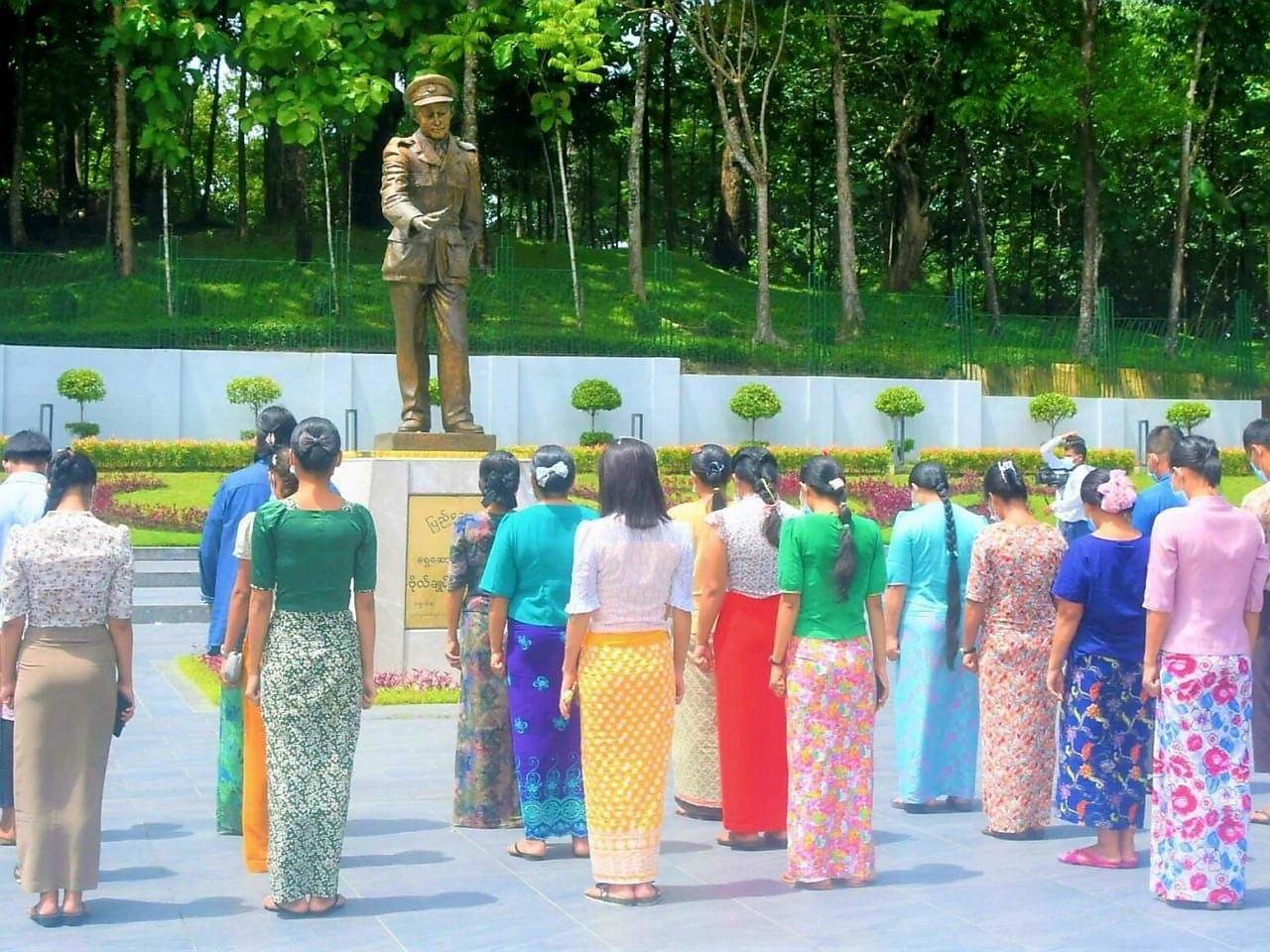
Legal experts challenge Myanmar regime’s rationale for tearing down Aung San statues
The Burma Lawyers’ Council (BLC) is fiercely contesting the military regime’s legal justification for its escalating, nationwide campaign to dismantle statues of Myanmar’s independence hero, General Aung San. Following a
The Burma Lawyers’ Council (BLC) is fiercely contesting the military regime’s legal justification for its escalating, nationwide campaign to dismantle statues of Myanmar’s independence hero, General Aung San. Following a surge in public outrage and media coverage regarding the clandestine removals, regime spokesperson Khaing Khaing Soe claimed on July 10 that Naypyidaw is acting in accordance with the Protection and Preservation of Ancient Monuments Law (1962). She argued that the statues were not being outright banned, but rather, “substandard” statues with “incorrect proportions and shapes” were being removed for lacking the appropriate “dignity” befitting the General. A lack of legal clarity and criteria Legal experts argue the regime’s defense is fundamentally flawed and legally ambiguous. Myint Thein Aung, the General Secretary of the BLC, told DVB that the regime’s explanation “lacks legal clarity” because the spokesperson failed to provide any objective criteria or transparent process used to determine which statues are deemed “substandard.” Furthermore, the BLC asserts that the unilateral destruction of these monuments—most of which were erected using public donations—violates the law rather than upholds it. The BLC argues the demolitions constitute criminal mischief under Section 425 of the Penal Code, an offense that carries a prison sentence of up to seven years. A legal expert speaking on the condition of anonymity pointed out that while the regime targets statues erected during the National League for Democracy (NLD) administration, which governed Myanmar from 2016 up until it was ousted during the military coup on Feb. 1, 2021, an unknown number of the removed statues were actually built long before the NLD took power. Erasure by night According to DVB data, at least 16 statues of General Aung San have been systematically removed or destroyed since the February 2021 military coup. Residents frequently report that regime authorities carry out these demolitions under the cover of darkness to avoid public pushback. The statue demolitions are part of a broader, sustained campaign to erase the legacy of General Aung San and his daughter, jailed State Counsellor Aung San Suu Kyi. In June, authorities stripped NLD symbols from the party’s headquarters and removed a portrait of Aung San from the walls outside 54 University Avenue in Yangon—the historic family residence where Suu Kyi spent 15 years under house arrest. The regime previously renamed the General Aung San Bridge (connecting Mawlamyine to Belu Island) to the Thanlwin Bridge in June 2021. The NLD issued a formal statement on July 8, decrying the systematic removals as a calculated attempt by the military to “destroy Myanmar’s national identity and history”. A history of controversy The monuments have long been a flashpoint in Myanmar’s complex political landscape. Even during the civilian NLD administration (2016-2021), the installation of Aung San statues faced severe opposition in ethnic minority regions. In 2017, local political parties and civil society organizations in Kachin, Mon, and Chin states successfully blocked NLD proposals to install the statues. In February 2019, police were accused of injuring over 20 protesters who staged a public rally against the unveiling of a statue in the Karenni State capital Loikaw. Despite the historical complexities, the current regime’s aggressive, nocturnal demolition campaign is widely viewed not as a response to ethnic grievances, but as a deliberate strategy to dismantle symbols of the pro-democracy resistance.
多角的分析
直接の経済ニュースではありませんが、治安と司法の信頼は地域経済の土台です。職場での暴力や未成年者保護への不安が強まると、夜間営業、観光、雇用、地域サービス業のリスク認識が高まります。
投資家目線では、個別事件よりも法執行の予見可能性が焦点です。加害者への対応が曖昧になれば、ローカルビジネスの統治リスクや従業員保護の弱さとして評価されやすくなります。
ベル島で問われるのは、加害者個人だけでなく、雇用主、警察、近隣社会が被害のサインをどう扱ったかです。軍が声を上げたことで、事件は噂話ではなく、記録され検証される公共問題に変わります。
市民にとっては、自分や家族が被害に遭った時に公正な手続きへアクセスできるのかが最大の関心です。地域団体が声を上げることで、事件の風化を防ぎ、被害者側の孤立を和らげる意味があります。
背景・歴史的文脈
このニュースは、ミャンマーの地域社会で法の支配と弱者保護がどこまで機能しているかを映す事案です。暴力事件そのものに加え、女性団体や市民社会が司法手続きを求めて声を上げている点が重要です。軍政下では警察・司法への信頼が揺らぎやすく、個別事件が地域の不安や統治への不信に直結します。
原文ソース
DVB