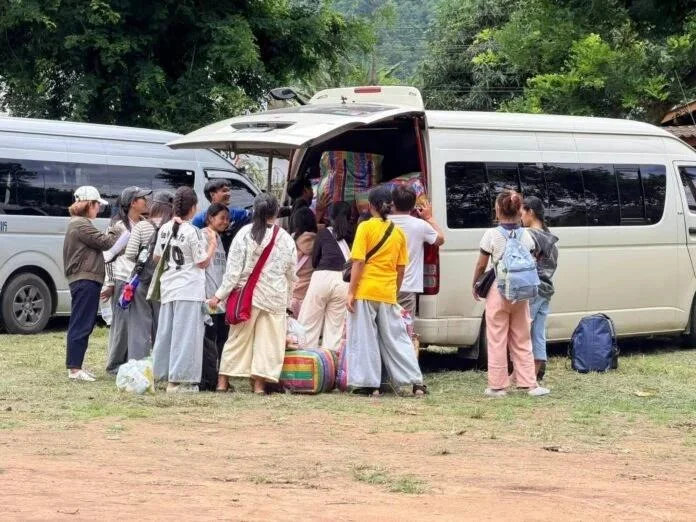
Karenni Refugees in Bangkok Struggle with the Imbalance Between Wages and Living Costs
Some refugees from Karenni Refugee Camp No. (1), who were granted permission to work in Bangkok, Thailand, are returning to the camp due to the imbalance between their wages and living expenses. According to records from the Karenni Refugee Committee (KnRC), there are a total of 1,437 refugees who have left the camp to work outside, with 914 men and 523 women. So far, 172 people have returned to the camp. Most of them returned due to difficulties with employment. Most Karenni refugees from the camp are employed in fruit picking and construction, particularly masonry. While those working in construction appear to have relatively stable employment, some fruit pickers say they face irregular working hours and low wages. “What is happening now is that even if we work from early morning until late at night, we only earn around 180 baht. The problem is that we do not get paid for the amount of work we do,” said a male fruit picker who had returned to the camp. Normally, wages are paid based on the amount of fruit each worker can pick and their working capacity, so their earnings can vary from day to day. “Sometimes, when it doesn’t rain and there is fruit to pick until late at night, we can make around 250 to 300 baht. But when there is no work, and there is no fruit to pick up, we only earn around 40 to 50 baht a day,” he said. According to some workers, they have to leave for work as early as 6 a.m. The distance to their workplaces also varies. Although workers can earn more on days when work is available, their income drops significantly on days when there is no fruit-picking work. One worker said that this makes it difficult to sustain a living in a major city like Bangkok. “We buy food and eat together as a group, but sometimes each person spends 100 baht, and other times it can be 200 baht a day,” he said. In addition, workers have to cover the costs of their work permits, food, and other daily expenses themselves. While their wages can cover these expenses on days when work is available, having too many days without work makes it difficult for them to sustain themselves in the long term. “The work situation isn’t good. We have to pay for our own food and living expenses. Sometimes there is work, sometimes there isn’t, which is not okay for us. Now, everyone wants to return,” said another male worker who had returned to the camp. According to KnRC records, 172 workers have returned to the camp, and there are others who want to return as well. However, workers continue to stay there because they cannot afford the transportation cost to travel back, according to those who have already returned. Some of those who have managed to return also had to ask for help from families and relatives due to the travel expenses. “Those who have returned so far are mostly people whose families were able to support them. Those who remain will also return when they can afford the transportation fee,” said the male worker who had returned to the camp. However, not everyone currently working in Bangkok has decided to return to the camp. A woman who continues to work in the city said she had not heard of anyone in her group planning to return. “Now, no one in our group has decided to return yet. I haven’t heard anything about it,” she said. The Karenni Refugee Committee has been visiting workers and employers regarding workers’ difficulties. According to KnRC Chairperson Nay Kaw Htoo, refugees who leave the camp for employment often face workplace challenges because they do not speak Thai. This makes it difficult for them to complain when problems arise at work. There are also some weaknesses regarding workplace rules and regulations. “Before they went there, we provided them with complaint mechanisms. Who should they report problems to? So instead of approaching the responsible person, they went to complain about their problems to people who were not responsible for addressing them. Thus, they just came back without first consulting or negotiating with the relevant people,” said Nay Kaw Htoo, KnRC Chairperson. The Karenni Refugee Committee has also been facilitating discussions between workers and employers, which it says the mutual understanding for each other has improved. Nay Kaw Htoo added that workers themselves also need to build confidence and stand up for their rights while working. “We have been able to bring employers and workers together for discussions and negotiations. Through these meetings, workers become more understanding of the companies’ working conditions. We have also noticed that our visits have helped improve workers’ motivation. We also saw that understanding and trust between workers and employers improved,” he said. Nevertheless, addressing the ongoing problems of low wages and unstable employment remains an important challenge that requires long-term solutions. Meanwhile, Nay Kaw Htoo has urged refugees to work hard for their own livelihoods, as there is a possibility that assistance to refugee camps could face further reductions or cuts. Ensuring fair wages and stable employment for refugees working outside the camps, establishing mechanisms to address workplace difficulties, and creating income-generating opportunities within the camps remain important challenges in securing sustainable livelihoods for Karenni refugees.
Read up to 3 eligible full articles per Japan day (JST) for free
Create a free account to open up to 3 eligible full articles per Japan calendar day (JST). Headlines and summaries remain available across ASEAN 7.
Related articles
- Military Council continuously bombs 5 townships in Rakhine and Paletwa regions, killing 14 civilians including children and pregnant women
Ayeyarwaddy Times November 18 The Military Council has continuously bombed civilian residential areas and schools in five townships, including Thandwe, Kyauk Taw, Sane (Kyaukphyu) in Rakhine State, and Paletwa in Chin St
- Over 12,000 Myanmar nationals deported from Malaysia since January
Malaysia’s Ministry of Home Affairs reported on Tuesday that a total of 12,176 Myanmar nationals were repatriated from Malaysia between January 1 and October 31, 2026, while clarifying that its official deportation logs
- Reduce, reuse and recycle plastic waste
Cooperation is underway to address plastic pollution not only as a national concern for Myanmar but also as a regional and global issue. Myanmar is working together with relevant government departments, the private secto
- Myanmar activist Bo Kyi accepts Ramon Magsaysay Award in shirt bearing names of the dead
Myanmar human rights activist Bo Kyi urged Southeast Asian governments on Nov. 15 not to engage or cooperate with the country’s military junta, speaking as he accepted the 2026 Ramon Magsaysay Award in Manila while weari