General articles are free for 24 hours after publish.
Australia's Hardline Stance on China Questioned
Within Australia, a growing chorus advocates for prioritizing economic ties and diplomatic engagement with China over military confrontation. Analysis suggests military conflict is impractical, with economic interdependence wielding greater influence.
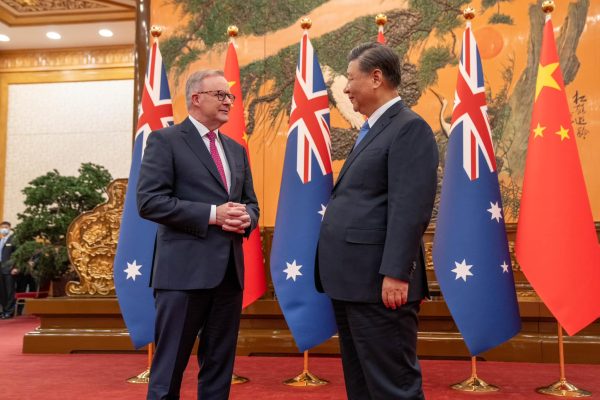
A debate is intensifying within Australia regarding its foreign and security policy in response to China's growing power. Some commentators argue that prioritizing economic ties and diplomatic engagement, rather than military confrontation, is the more prudent approach. Greg Sheridan, foreign editor of The Australian, advocates for Australia to fully embrace American military power, supporting the U.S. Navy base at HMAS Stirling and drawing up "common battle plans" with the U.S. to prepare for conflict with China. This view is informed by the People's Liberation Army's (PLA) enhanced capabilities, which allow it to assert military ascendancy in the South China Sea and beyond. However, this hardline stance is met with caution from figures like former Australian Ambassador to China, Dr. Geoff Raby, who urge Australia to rely more on diplomacy and statecraft. They warn that security pacts like AUKUS send a clear signal of hostility to China, suggesting that cooperative regional diplomacy with ASEAN nations and respectful engagement with China are far preferable to stoking hostility and inciting a conflict Australia cannot win. Analysis indicates that China is Australia's largest trading partner, with two-way trade valued at A$200 billion annually. China possesses the capacity to economically subdue Australia without firing a shot, while also having the ability to continue making Australia prosperous. This economic interdependence is highlighted as a far more potent influence than military confrontation. Furthermore, with signs of diminishing U.S. influence in the Asia-Pacific, attempts by Australia to build an alliance of microstates to contain China are seen as unrealistic. It is suggested that influencing China's behavior through middle-power statecraft would be more effective.
Original source
The Diplomat Indonesia