Ancient Layers Uncovered Beneath Korat City Wall, Including Ayutthaya-Era Fortifications
Culture
2026年8月8日
5
Khaosod English
Relations
🇹🇭Thailand🇲🇲Myanmar🇰🇭Cambodia

General articles are free for 24 hours after publish.

Ancient Layers Uncovered Beneath Korat City Wall, Including Ayutthaya-Era Fortifications

Share
AI Summary

An excavation in Nakhon Ratchasima has unearthed ancient layers dating back 2,500 years and an Ayutthaya-era city wall. This discovery offers a valuable opportunity to deepen understanding of the region's historical heritage.

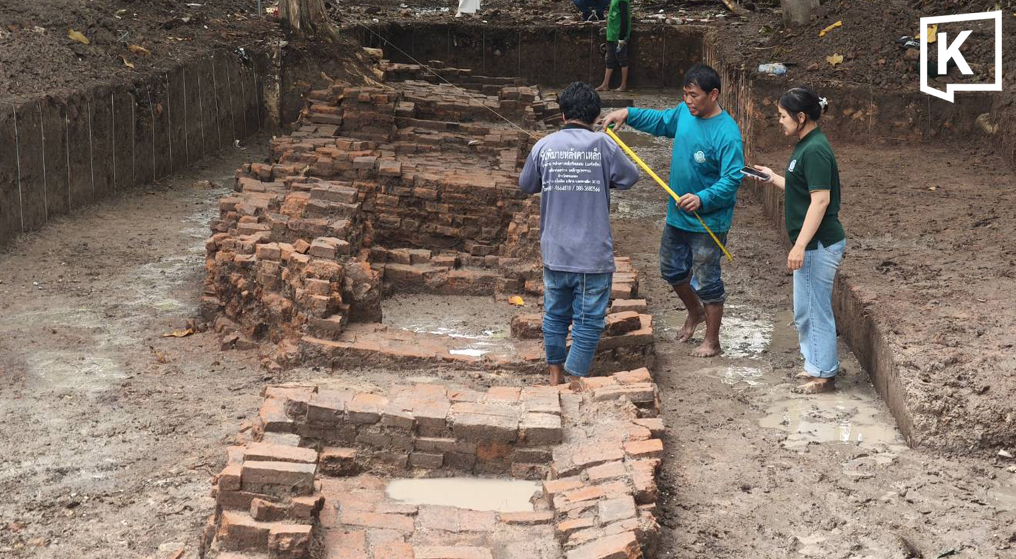
NAKHON RATCHASIMA — Archaeologists have uncovered an Ayutthaya-era city wall and evidence of human settlement dating back as far as 2,500 years during a 20-day excavation in Nakhon Ratchasima. The excavation at the eastern section of Nakhon Ratchasima’s old city wall, known as Phon Lan Gate or Phon Lan Fort, along Phon Lan Road, concluded on 8 August. The project was jointly conducted by the 10th Regional Fine Arts Office in Nakhon Ratchasima and Nakhon Ratchasima Municipality from 20 July. Archaeologists expanded an excavation pit to 10 by 11 metres to further trace the city wall before preparing to backfill it to the original wall level. Somdet Leelamanotham, director of the Archaeology Group at the 10th Regional Fine Arts Office, along with archaeologist Wannaphong Palakawong Na Ayutthaya and staff collected soil samples before the site was backfilled. The samples will undergo scientific dating to establish the age of the city wall and the cultural layers found beneath it, including remains dating to the late prehistoric Iron Age. Students from Nakhon Ratchasima Rajabhat University and young volunteers also took part in the archaeological work. Wannaphong described the excavation as a major discovery in the past 20 years, saying archaeological evidence must be examined before any landscape improvements are made around the old city moat because the area forms part of Nakhon Ratchasima’s historic city. The excavation uncovered evidence of human settlement from the prehistoric Bronze Age through the Iron Age and into the historic period. Finds included animal bones, pottery fragments, charcoal, soot, ash and seashells, shedding light on how people lived and survived in the area around 1,500–2,500 years ago. Some parts of the site had previously been disturbed by land use, including the construction of government housing over ancient cultural layers. Archaeologists collected organic material beneath brick foundations, as well as bricks bearing traces of rice husks, for scientific dating. The results are expected to help establish when the city wall, city gates and fortifications were constructed. The expanded excavation has also revealed a section of the wall extending from north to south, consistent with historical records. The Fine Arts Office plans to meet Nakhon Ratchasima Municipality, which owns the site, to discuss developing the area as a historical tourism landmark where future generations can learn about the past through its archaeological remains and historic architecture. Long history of conservation Previous conservation work on Nakhon Ratchasima’s city wall and gates included excavations of the northeastern wall and fort in 1999 and 2000, with restoration and landscape improvements carried out during the latter project. Further excavation of the western section of the city wall took place in 2006. Historical records from the reign of King Rama V describe Nakhon Ratchasima’s old city as roughly rectangular, with the eastern and western sides measuring about 1,000 metres and the northern and southern sides about 1,600–1,650 metres. The total perimeter was estimated at around 5,200 metres. The brick walls were reportedly about 4 metres high and 2.6 metres thick, with an inner walkway and an outer moat measuring about 10 metres wide. The records also describe 15 round defensive towers and approximately 5,300 battlements around the walls. Archaeological work in 1999 provided evidence of how the wall was constructed. Workers first prepared the foundations by digging and compacting layers of soil, each around 60 centimetres thick, before laying bricks and filling the base with soil. The bricks measured roughly 30 by 15 by 7 centimetres or 25 by 13 by 5 centimetres and were joined using earth rather than mortar. Archaeologists found that the bricks were arranged in alternating patterns to strengthen the wall. During the latest excavation, the city wall was identified after 11 days of work. Archaeologists are collecting soil from beneath the lowest bricks for scientific dating to determine when the wall was actually built. Although historical accounts have traditionally associated the construction of Nakhon Ratchasima’s city wall with the reign of King Narai, there is no surviving written evidence explicitly confirming when it was built. Scientific dating could therefore help clarify the period in which the area was incorporated into the Ayutthaya-era city. The excavation also revealed cultural layers predating the city wall, including evidence associated with ancient Khmer culture and the late prehistoric Iron Age. Archaeological work carried out over the past two years has uncovered evidence of human activity dating back to the Bronze Age, with human remains and grave goods dated to around 2,544–2,194 years ago. The excavation of the “Non Phon Lan” cultural layers has continued since 2024, providing an academic database for the Fine Arts Department and Nakhon Ratchasima Municipality. Authorities also plan to develop the excavation area as a public learning site, where visitors can learn about archaeological methods and young people can gain practical experience in archaeological work. The project is being developed under the concept of “Advancing knowledge, integrating the community”, with the aim of fostering awareness and appreciation of archaeological evidence as part of Thailand’s national cultural heritage. The post Archaeologists uncover ancient layers beneath Korat city wall appeared first on Khaosod English.

0

Original source

Khaosod English

原文を読む