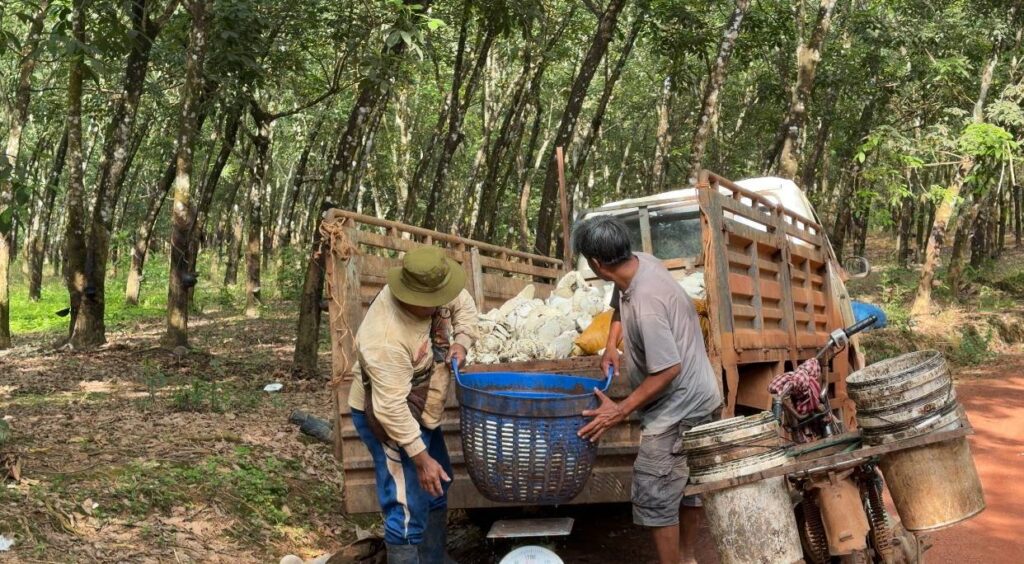
Mondulkiri Rubber Cultivation Continues to Support Farmers' Livelihoods Despite Slight Price Drop
Society
2026年6月30日
5
Kampuchea Thmey Local
Relations
🇰🇭Cambodia🇻🇳Vietnam🇨🇳China

Mondulkiri Rubber Cultivation Continues to Support Farmers' Livelihoods Despite Slight Price Drop

AI サマリー

Despite a slight drop in rubber prices, rubber cultivation remains a vital economic crop in Mondulkiri province, supporting farmers' livelihoods and increasing household income. Diversification efforts are also underway.

Rubber cultivation in Cambodia's Mondulkiri province continues to be a vital economic crop for farmers, supporting their livelihoods despite a recent slight drop in rubber prices. Many farmers recognize this long-term, continuously yielding crop as a source of daily income, funds for their children's education, and capital for further agricultural investments. Chhon Saran, a 45-year-old farmer residing in Ou Am village, Sre Khum commune, Keo Seima district, Mondulkiri province, stated, "Rubber trees are a long-term crop that provides continuous income. Especially when rubber prices are stable, farmers can earn enough to cover daily living expenses, pay for their children's education, and invest in other agricultural activities." Mr. Saran owns a 3-hectare rubber plantation, capable of producing between 50 to 60 kilograms of latex per day. He sells processed rubber to traders at prices ranging from 3,500 to 3,600 riels per kilogram (approximately $0.85 to $0.88 USD). He emphasized that despite a slight decrease in rubber prices compared to the beginning of the year, for farmers with extensive land, rubber cultivation still provides a good income and helps improve household living standards. In addition to rubber, Mr. Saran also cultivates mixed crops such as cashew nuts and pepper to diversify income sources and mitigate risks associated with market price fluctuations or natural disasters. Mondulkiri province is considered a region with high potential for rubber cultivation due to its suitable climate and soil conditions. In recent years, rubber cultivation has not only contributed to improving household economies but has also created job opportunities and boosted economic activities in rural communities. Currently, the total area of permanent rubber plantations owned by families and companies across Keo Seima district amounts to 2,584.80 hectares. Meanwhile, technical officials are urging farmers to pay close attention to proper plantation maintenance, implement appropriate agricultural techniques, and manage their farms efficiently to ensure good yields, high quality, and responsiveness to market demands.

多角的分析

経済的影響

ゴム価格の下落は、カンボジアの農村経済、特にゴム栽培に依存する地域に直接的な影響を与えている。しかし、モンドルキリ州の事例は、価格変動リスクを軽減するための作物多様化の重要性を示唆している。カシューナッツやコショウといった他の作物への投資は、農家の収入源を安定させ、経済的レジリエンスを高める戦略として有効である。これは、カンボジア経済全体の持続可能性を高める上で、小規模農家レベルでのリスク管理が不可欠であることを示している。

投資家心理

ゴム価格の短期的な下落は、ゴム農園への新規投資や既存事業の拡大を検討する投資家にとって、一時的な懸念材料となりうる。しかし、モンドルキリ州のような潜在力の高い地域でのゴム栽培は、長期的な視点で見れば依然として魅力的である。農家による複合栽培への取り組みは、市場の多様化と安定化への期待を示唆しており、これは投資家にとって、より安定した収益を見込める可能性を示唆している。ただし、価格変動リスクと、気候変動や国際市場の動向といった外部要因を慎重に評価する必要がある。

社会的影響

モンドルキリ州の農家、特にチョン・サレン氏のような個人農家にとって、ゴム栽培は単なる収入源以上の意味を持つ。それは、子供たちの教育機会の確保、将来への投資、そして地域経済への貢献を可能にする生計手段である。価格下落は、これらの生活基盤に直接的な影響を及ぼすが、複合栽培への移行は、家族の安定した生活と地域社会の持続可能性を維持しようとする農家の努力を示している。これは、農村部における経済的安定と教育機会へのアクセスという、公共の課題を浮き彫りにしている。

市民の声

ゴム価格の変動は、モンドルキリ州の農家の家計に直接的な影響を与えています。チョン・サレンさんのように、ゴム栽培で生計を立てている人々にとって、価格が下がると、子供たちの学費や日々の生活費が圧迫される可能性があります。しかし、彼はカシューナッツやコショウといった他の作物を栽培することで、リスクを分散しようとしています。これは、多くの農家が直面する経済的な課題と、それに対する彼らの適応策を示しています。

背景・歴史的文脈

カンボジアにおけるゴム栽培は、1960年代から経済の重要な柱の一つであった。ポル・ポト政権下で一時衰退したが、1980年代以降、経済自由化とともに回復し、特に中国やベトナムからの投資が増加した。モンドルキリ州は、その気候と土壌条件から、近年ゴム栽培が盛んになった地域の一つである。2010年代には、ゴムがカンボジアの主要輸出品目の一つとなり、経済成長に大きく貢献してきた。しかし、国際市場におけるゴム価格の変動は、常に農家の収入に影響を与えてきた。近年、中国経済の減速や、合成ゴムの普及などが、天然ゴム価格の下落要因として指摘されている。

原文ソース

Kampuchea Thmey Local

原文を読む