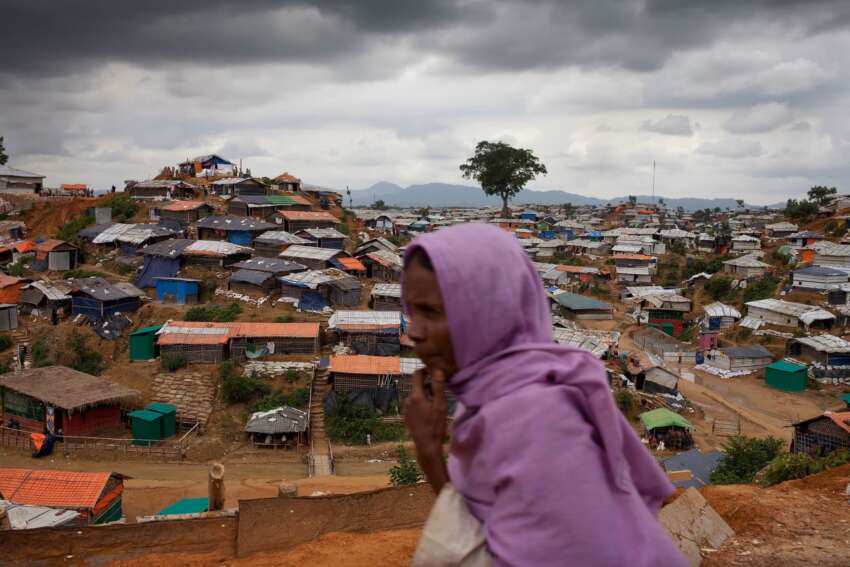
UN Human Rights Council Continues to Demand Accountability for Crimes Committed by Myanmar Military Against Rohingya
Yangon, July 9 The UN Human Rights Council has called for accountability for the crimes committed by the Myanmar military against Rohingya who fled Rakhine State. The UN Human Rights Council (UN Human Rights Council) app
Yangon, July 9 The UN Human Rights Council has called for accountability for the crimes committed by the Myanmar military against Rohingya who fled Rakhine State. The UN Human Rights Council (UN Human Rights Council) approved a new resolution this week concerning the human rights situation of the Rohingya in Myanmar, reiterating demands for accountability for the crimes committed by the Myanmar military against the Rohingya, the restoration of Rohingya citizenship rights, and the safe and dignified return of over one million Rohingya refugees sheltering in countries including Bangladesh. The resolution notes that the Rohingya issue has become more complex than before, and despite the International Court of Justice (ICJ) issuing provisional measures, violence against the Rohingya continues. Human rights activists have expressed concerns about the intensification of fighting within Rakhine State, instability in border areas, and the decrease in humanitarian funding. The UN Human Rights Council has adopted over 40 resolutions related to Myanmar since 2006, about half of which have focused on the situation of the Rohingya and other ethnic minorities. A Fact-Finding Mission on Myanmar was established in 2017, and in 2018, the Independent Investigative Mechanism for Myanmar (IIMM) was further established to collect and preserve evidence for future prosecutions. Due to these efforts, the Rohingya issue has transformed from a previously neglected humanitarian crisis into one of the most well-documented genocide cases in the world. Furthermore, in 2019, The Gambia filed a case against Myanmar at the ICJ for violating the Genocide Convention, and the International Criminal Court (ICC) also launched an investigation into the forced displacement and torture of the Rohingya. Subsequently, in 2024 and 2025, the ICC continued to pursue arrest warrant requests, and Argentina also took steps in 2025 under the Universal Jurisdiction law to prosecute General Min Aung Hlaing and top Myanmar military officials for genocide and crimes against humanity against the Rohingya. However, despite progress in the process of achieving justice at the international level, the actual living conditions of the Rohingya have not seen significant improvement, according to the international community. Nearly a decade after the mass atrocities against the Rohingya in 2017, over one million Rohingya remain displaced, with no prospect of safe return. Furthermore, political support is gradually decreasing in the countries hosting the refugees. This situation indicates that the main challenge of the Rohingya issue is no longer confined to Myanmar but is increasingly dependent on the political, economic, and social conditions of regional countries, according to analyses. In Bangladesh, after hosting over one million Rohingya refugees for nearly a decade, pressure is mounting for the repatriation of Rohingya due to declining humanitarian aid, deteriorating conditions in refugee camps, and rising tensions with the local population. However, with ongoing fighting and airstrikes in Rakhine State, the conditions for safe return are not yet in place. Similarly, in Malaysia, negative perceptions of refugees are increasing due to economic difficulties, misinformation, and declining support for the Rohingya. In Indonesia, some analysts say that humanitarian spirit has weakened due to issues such as human trafficking, resource scarcity, and online misinformation. In Thailand, the Rohingya are increasingly viewed not as refugees but as issues of border security, illegal immigration, and human trafficking, leading to the increased implementation of policies such as detention and pushbacks at sea. Over the past 20 years, the efforts of the UN Human Rights Council have succeeded in documenting the crimes committed against the Rohingya to prevent them from disappearing from history and have laid a solid foundation for achieving justice. However, it has not yet created the regional political will and cooperation to provide long-term protection for the Rohingya, according to analyses. Therefore, in the future, the UN Human Rights Council's efforts on the Rohingya issue should not only focus on documenting human rights violations in Myanmar and pursuing accountability but should also place greater emphasis on providing more support to host countries, assisting local communities, combating misinformation, promoting regional burden-sharing, and developing policies that can provide long-term protection for Rohingya refugees, according to analyses and recommendations.
多角的分析
直接の経済ニュースではありませんが、治安と司法の信頼は地域経済の土台です。職場での暴力や未成年者保護への不安が強まると、夜間営業、観光、雇用、地域サービス業のリスク認識が高まります。
投資家目線では、個別事件よりも法執行の予見可能性が焦点です。加害者への対応が曖昧になれば、ローカルビジネスの統治リスクや従業員保護の弱さとして評価されやすくなります。
7月9日 ラカイン州の現場では、避難を「個人間の事件」で片づけず、誰が守り、誰が説明するのかを可視化する圧力が強まります。UN Human Rights Councilの動きは、被害者側が孤立しやすい環境で、沈黙より手続きを選ぶための足場になります。
市民にとっては、自分や家族が被害に遭った時に公正な手続きへアクセスできるのかが最大の関心です。地域団体が声を上げることで、事件の風化を防ぎ、被害者側の孤立を和らげる意味があります。
背景・歴史的文脈
このニュースは、ミャンマーの地域社会で法の支配と弱者保護がどこまで機能しているかを映す事案です。暴力事件そのものに加え、女性団体や市民社会が司法手続きを求めて声を上げている点が重要です。軍政下では警察・司法への信頼が揺らぎやすく、個別事件が地域の不安や統治への不信に直結します。
原文ソース
Khit Thit Media