General articles are free for 24 hours after publish.
Bangka Belitung's Traditional 'Kelekak' Forests: Guardians of Water and Wildlife
In Indonesia's Bangka Belitung Islands, traditional 'kelekak' agroforestry forests are crucial for securing water during droughts and providing habitats for wildlife. However, their existence is threatened by oil palm plantations and illegal tin mining.
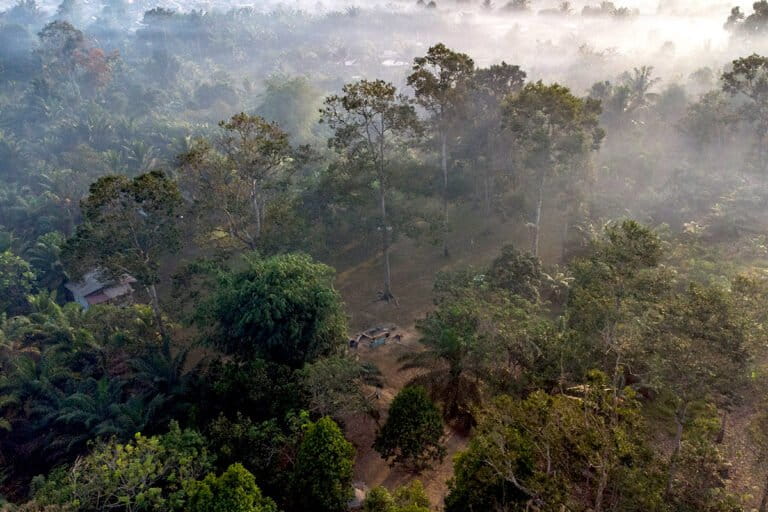
In Zed village, Mendo Barat district, Bangka Regency, Bangka Belitung Islands, the prolonged drought of 2015 caused much of the forest and oil palm plantations to dry out and some to burn. This led to significant difficulties for the community in obtaining clean water, as wells, rivers, and small swamps largely dried up. After the dry season ended, Asmadi (60) and his son Andre, gradually cut down dozens of five-year-old oil palm trees in their garden. Their reason was they did not want the water-intensive oil palm trees to cause their garden to dry up again. They decided to keep only durian, rambutan, and duku trees. Before being planted with oil palm, Asmadi's garden was a kelekak, a traditional agroforestry forest, hundreds of years old, covering one hectare. The kelekak was created by his ancestors and planted with various fruits such as durian, rambutan, mangosteen, puren, ketapi, pelen, tampui, duku, windu, nyatoh, cempedak, and ketep. When it was converted into an oil palm plantation, most of these fruit trees were cut down. "My father wanted the garden to return to being a kelekak," said Andre (30) in late August 2026. They then planted seedlings of nyatoh, pelawan, aren, puren, durian, mentaon, binjai puspa, and langsat trees. A kelekak is an agroforestry, a traditional forest of the Malay community in the Bangka Belitung Islands. These traditional forests are owned by each clan or family and are inherited from generation to generation. Kelekak are located around pepper and rubber plantations. For hundreds of years, no kelekak has turned into a rubber or pepper plantation. However, since the development of oil palm plantations and illegal tin mining in the Bangka Belitung Islands, many kelekak have been lost or their functions have changed. The kelekak managed by the Kelekak Bangka Community has become a home for various types of wildlife. Source: Mongabay Indonesia
Original source
Mongabay Indonesia