General articles are free for 24 hours after publish.
Vietnam Rushes to Address Textbook Shortages Ahead of New School Year
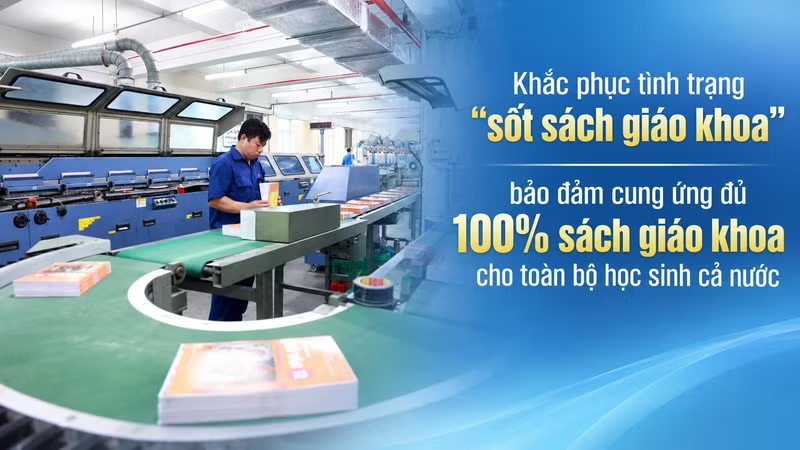
As the 2026-2027 school year approaches, Vietnam faces a surge in textbook demand. The Vietnam Education Publishing House is accelerating production, replenishing stock, coordinating distribution to provinces, and expanding sales channels to ensure 100% supply for students nationwide.
As the 2026-2027 school year rapidly approaches, Vietnam is experiencing a significant surge in demand for textbooks. In response, the Vietnam Education Publishing House (Nhà xuất bản Giáo dục Việt Nam) is accelerating its production, securing additional inventory, coordinating distribution to various provinces, and expanding its sales channels. The ultimate goal is to ensure a 100% supply of textbooks for all students across the country. The urgency of this situation is highlighted by reports of parents in Hanoi rushing to find textbooks for their children ahead of the new academic year, as depicted in accompanying photographs. The Ministry of Education and Training has also issued directives mandating sufficient textbook supply to schools by August 30th. Local authorities in provinces such as Can Tho and Ca Mau are actively working to prepare educational materials and establish support systems for the upcoming school year. Notably, a policy has been announced to reduce the average price of textbooks by 13.3% starting from the 2026-2027 academic year. Furthermore, textbooks will be provided free of charge to all students nationwide from the 2029-2030 academic year onwards. This is understood as part of a long-term initiative to enhance educational equity. Additionally, all teachers are undergoing training on teaching methodologies aligned with the new unified set of textbooks, indicating a push towards standardization in educational content. Under Vietnam's one-party system, policy decisions in the education sector tend to be implemented swiftly and centrally. The current response to textbook shortages reflects the government's emphasis on educational uniformity and public service provision. As Vietnam continues its economic growth, investment in education is crucial for nurturing future human capital, and the government is prioritizing the establishment of a stable educational environment. Concurrently, in its relationship with China, Vietnam maintains a strategy of deepening economic ties while balancing security interests, and the development of domestic social infrastructure can be viewed as part of this broader approach.
Original source
Nhan Dan