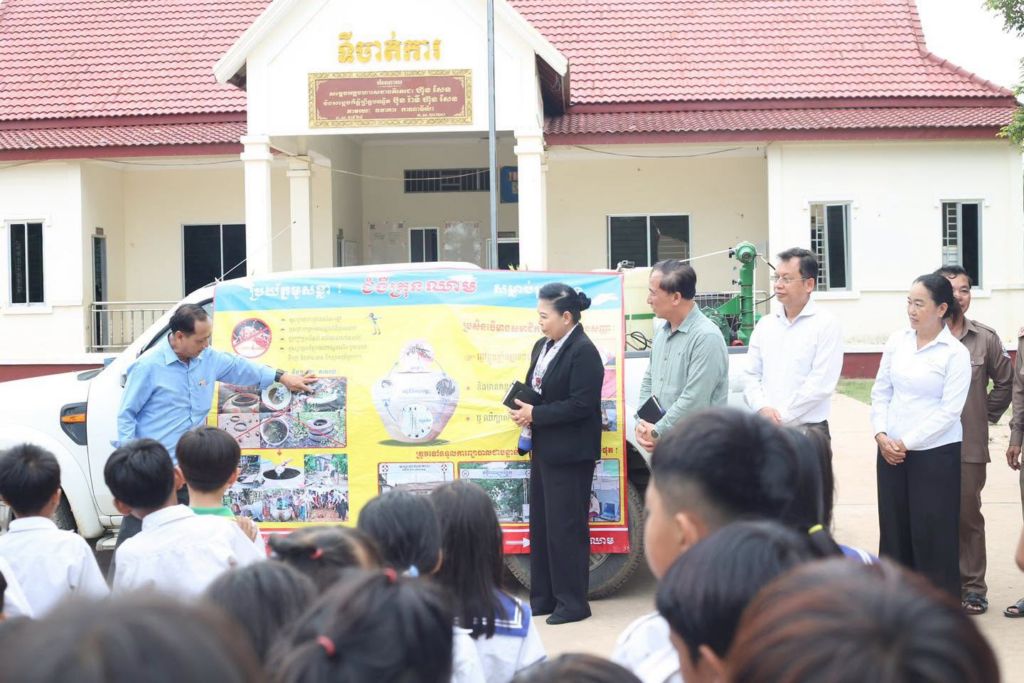
Cambodia's Health Ministry Conducts Dengue Fever Awareness for Students in Kandal's Koh Thom District
Cambodia's Ministry of Health has intervened and disseminated information on dengue fever to students in Koh Thom District, Kandal Province, in response to rising cases. Between June 16 and July 4, 578 patients were recorded, with no fatalities.
This article requires PRO
This article is outside the free access window or is a special report. PRO unlocks it and the full archive.
Related articles
- Battambang Governor Visits Orphanages, Distributes Aid on Pchum Ben Festival
The Governor of Battambang Province visited orphanages during the Pchum Ben festival, encouraging staff and children. Donations of food, supplies, and cash were provided, with emphasis on academic pursuits and health for the children's future.
- Dr. Pich Chanmony Hun Manet Presides Over Health Sciences University's Scientific Conference
Dr. Pich Chanmony Hun Manet, wife of Prime Minister Hun Manet, presided over the opening of the Scientific Conference of the University of Health Sciences (USH) on October 6, 2026, celebrating its 80th anniversary. The university has a long history of training medical professionals for Cambodia.
- Cambodia's Healthcare Future: Emphasizing Responsibility and Lifelong Learning
At the 80th anniversary of the University of Health Sciences, Dr. Petch Chanthamony Hun Manynet urged students that a healthcare profession entails profound responsibility beyond degrees. She stressed lifelong learning and ethical practice.
- Vietnam Funds US$8 Million Friendship School Project in Phnom Penh
Phnom Penh and Ho Chi Minh City have signed an MOU for an US$8 million Cambodia-Vietnam Friendship School project, funded by Vietnam. The initiative aims to enhance educational facilities and strengthen bilateral ties, with construction expected to take approximately one year.