General articles are free for 24 hours after publish.
PHL students more dependent on AI than peers in OECD — PISA
Filipino students are using AI chatbots for learning at higher rates than their OECD peers, according to the 2025 Programme for International Student Assessment (PISA). Despite this, student academic performance reached its highest scores to date.
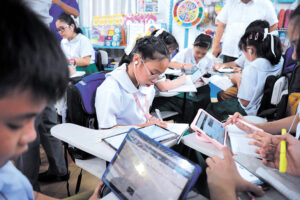
By Justine Irish D. Tabile, Senior Reporter FILIPINO STUDENTS are turning to artificial intelligence (AI) for schoolwork at higher rates than their peers in most Organisation for Economic Co-operation and Development (OECD) countries, according to the 2025 Programme for International Student Assessment (PISA). “Students in most education systems use AI chatbots for schoolwork, creating new challenges and opportunities for their learning. In the Philippines, 55% of students reported using AI chatbots to help them learn at least once a week,” the OECD said in a country note. The corresponding rate for OECD students is 46%. PISA is an OECD-led international assessment that measures the knowledge, skills and attitudes of 15-year-old students, including how well they can solve complex problems, think critically and communicate effectively. More than 760,000 students from 91 countries and economies participated in the PISA in 2025. In the Philippines, 8,072 students from 208 schools completed the assessment. About 37% of Filipino students reported frequently using AI to conduct preliminary research on a new topic, higher than the OECD average of 31%. Meanwhile, 45% of Filipino students said they use AI to summarize a text they had to read, compared with the OECD average of 30%. Another 42% reported using AI to draft text for writing assignments, higher than the 29% OECD average. Only 5% of Filipino students reported never using AI chatbots for schoolwork, compared with 14% across the OECD. The report also found that Filipino students spend an average of 1.3 hours per day using digital devices at school for leisure, compared with the OECD average of 1.1 hours. About 39% of Filipino students reported that their peers were distracted by digital devices during most or all science lessons, higher than the OECD average of 28%. OECD Secretary-General Mathias Cormann warned of the potential negative impact of excessive screen use and digital devices on learning, particularly reading, during a briefing on Tuesday. “In reading, more screen time and less reading for pleasure have gone hand in hand with weaker results,” he said. “Since 2022, the share of students spending more than an hour a day on social media has risen by almost six percentage points.” “We’re also seeing more hasty reading, students rushing through a text and giving a quick wrong answer. The share of hasty readers has nearly doubled since 2018. Digital tools can of course help students learn, but they can also hold them back,” he added. Mr. Cormann said the impact of digital tools on student performance depends on how they are used. “Using devices for learning at school went with better science results up to a point. Beyond about five hours a day, results start to fall. And when devices are used for fun during class, results fall sharply,” he added. Despite these challenges, the Philippines posted its highest PISA scores to date in 2025, with the mean scores of 15-year-old Filipino students rising to 373 in science, 371 in mathematics and 367 in reading. “These results show that focused reforms, sustained commitment, and evidence-based interventions can lead to real improvements in learning outcomes for Filipino students,” Philippine Chamber of Commerce and Industry President Ferdinand A. Ferrer said in a statement on Wednesday. Compared with the 2022 assessment, Filipino students’ mean scores increased by 17 points in science, 16 points in mathematics and 20 points in reading. A 20-point increase is equivalent to roughly one year of formal schooling based on OECD benchmarks. The PCCI said the improvement reflects the impact of curriculum enhancements, targeted remediation programs and the work of the PISA 2025 Task Force. “The Chamber further encouraged (the Department of Education) to complement PISA with other indicators that assess whether learners are acquiring the competencies needed for lifelong learning, employment, and active citizenship,” it added. Mr. Ferrer said sustaining the improvement requires accelerated implementation of the recommendations of the Second Congressional Commission on Education (EDCOM II). “As the voice of Philippine business, we believe strengthening basic education is essential and must be complemented by better alignment across the entire education continuum,” he said. “Our goal should be an education system that equips every Filipino learner with the skills and opportunities needed to thrive and contribute meaningfully to national development,” he added. The Philippine Business for Education (PBEd) welcomed the results, saying improvement is possible when the focus is placed on learning and the government and stakeholders act with urgency. “The results tell us that reforms can work. However, the remaining gaps tell us that we need to do more, and do it differently,” PBEd said in a statement on Wednesday. “We must sustain what is working, identify what is driving improvement, and bring effective practices to every school — especially those serving learners who are furthest behind,” it added. PBEd also pointed to the need for “greater decentralization in education.” “We need to give schools and local education leaders more authority, resources, and accountability to respond to learning gaps — while maintaining clear national standards for outcomes,” it said.
Original source
BusinessWorld Economy