General articles are free for 24 hours after publish.
North Korea Courts Nicaragua Amid Foreign Policy Realignment
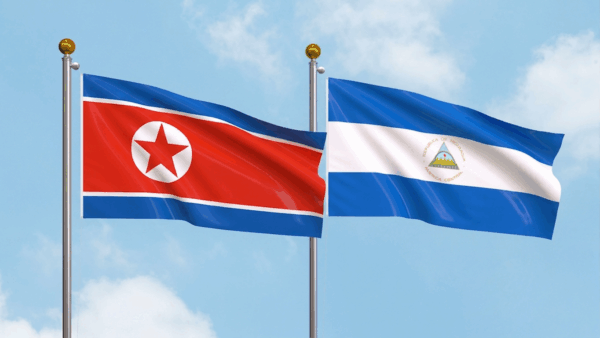
North Korea is intensifying diplomatic outreach to Nicaragua amidst a broader realignment of its foreign relationships. This renewed engagement follows a period of stagnation, with both nations historically linked through military aid and diplomatic support, now seeing a potential resurgence under Pyongyang's post-COVID foreign policy shift.
Read The Diplomat, Know The Asia-Pacific At a time when Pyongyang is restructuring its foreign relationships, its diplomatic focus on the Central American nation stands out. Since emerging from its self-imposed COVID-19 isolation, North Korea has closed a number of its diplomatic missions overseas while reshaping others. The government has concentrated on relationships it sees as strategically useful, focusing heavily on deepening ties with Russia, its burgeoning relations with Belarus, and, most recently, the rekindling of engagement with China. Yet, amid this diplomatic retrenchment, one unexpected country has received particular outreach and attention from the Kim Jong Un regime: Nicaragua. At a time when North Korea is restructuring its foreign relationships, its decision to court Nicaragua stands out, both for its geographic position and the fact that it came at the invitation of the Kim regime. While the two countries seem like natural partners given the nature of their authoritarian systems of government and long-standing history, the outreach is nevertheless a notable deviation from North Korea’s baseline behavior. Ultimately it could signal increased cooperation between the two countries as well a new trajectory for North Korea’s foreign policy designs going forward, one that exists outside China’s and Russia’s immediate orbit. Background on the Nicaragua-North Korea relationship North Korea’s relationship with Nicaragua has ebbed and flowed with changes in Managua’s government. Pyongyang avoided diplomatic relations with the U.S.-backed Nicaraguan government until 1979, when the Sandinista National Liberation Front took power. At the time, the Kim regime’s connections to the Sandinistas largely ran through its Cuban partner, although North Korea had reportedly provided military training to the group’s personnel in the lead-up to the revolution. Bilateral engagement between the two countries peaked in the 1980s. This included North Korean military assistance with the delivery of four patrol vessels valued at $8 million, as well as mutual diplomatic support. In 1986, Daniel Ortega, the Sandinista leader and then president of Nicaragua, traveled to Pyongyang for a first-of-its-kind summit between the two nations. Nicaragua followed this up with a show of solidarity by deciding to boycott the 1988 Olympics hosted in Seoul. Bilateral ties cooled after the Sandinistas fell out of power in 1990. This eventually led to the closure of the North Korean embassy in Managua in 1995. It was not until Ortega returned to power in 2006 that the two governments reestablished diplomatic relations. But it would still take another decade before the next notable development. In January 2017, a North Korean delegation headed by Choe Ryong Hae – one of Kim Jong Un’s top officials – attended the inauguration of Daniel Ortega for his third term as president of Nicaragua. There, the two governments lauded nearly 40 years of friendship and mutual diplomatic support. However, the practical depth of the relationship remained shallow. In 2017, North Korea’s exports to Nicaragua were reportedly worth just $1.8 million, while reciprocal trade was minimal. There were no indications of military cooperation, and diplomatic engagement remained surface-level. Beyond the ceremonial nature of Choe Ryong Hae’s visit, there was little indication that the relationship was poised to deepen. North Korea’s Post-COVID Reset The COVID-19 pandemic marked a substantial turning point for North Korean foreign relations. The border lockdowns and restrictions on movement of overseas personnel sharply curtailed diplomatic activities. All but a handful of embassies in Pyongyang closed owing to movement restrictions and resource depletion, reducing contact between foreign diplomats and North Korea government officials. This self-imposed isolation enabled the Kim regime to reset its policy designs going forward. The Eighth Party Congress in January 2021 produced a five-year policy roadmap for North Korea. The implications for foreign policy began to manifest when emerging from the COVID-19 lockdown period. As North Korea began reopening in 2023, evidence of this restructuring of foreign partnerships became increasingly visible. Pyongyang closed its embassies in Angola (2023), Bangladesh (2023), Democratic Republic of the Congo (2023), Guinea (2023), Libya (2024), Nepal (2023), Senegal (2023), Spain (2023), Syria (2024), and Uganda (2023). Although North Korea’s government did not give a specific reason for these closures, it signaled a reallocation of resources that went toward other relationships it wished to cultivate further. North Korea opened additional consulates in Russia, pursued deeper engagement with Belarus – culminating with Alexander Lukashenko’s March 2026 visit – and, curiously, invited Nicaragua to open an embassy in Pyongyang. Courting Nicaragua In July 2023, the Kim regime sent a delegation to Nicaragua to propose that Managua set up an embassy in the North Korean capital. Pyongyang’s state media did not publicize the initiative; rather, it was the Nicaraguan government that revealed the invitation. Within a year, Managua had inaugurated its diplomatic mission in Pyongyang and presented ambassadorial credentials to the North Korean government. Since then, North Korea has increasingly referenced Nicaragua in its state media reporting. In the official news wire service, KCNA, Nicaragua has been the subject of 12 reports so far in 2026, after 15 in 2025 and eight in 2024. This compares to only two in 2023. There are still unanswered questions as to why Pyongyang extended this outreach. Does North Korea see potential for trade (arms or otherwise)? Is Pyongyang seeking to expand its own work in the region? Part of the answer may lie in Cuba, a longtime partner of both governments. At the same time that North Korea was seeking to advance ties with the Nicaraguan government, South Korea was moving to normalize diplomatic relations with Cuba. Cuba had long maintained close ties with the North while keeping its distance from South Korea, but that changed in February 2024 when Havana and Seoul formalized ties. This move was a diplomatic setback for Pyongyang, which had up to that point maintained its third-largest embassy in Havana (behind Moscow and Beijing). In essence, Seoul’s encroachment in Cuba marked the potential weakening of a key regional partnership for the Kim regime. Notably, Nicaragua closed its embassy in South Korea in April 2024. Although Managua cited budget constraints as its reason for the closure, the timing was notable: it came just two months after the Cuba-South Korea normalization of relations and amid Pyongyang’s continued courtship of Nicaragua. Whether the events were connected, however, remains unclear. But finding a regional partner is only part of the equation. Other Central American countries maintain friendly relations with North Korea, raising the qu
Original source
The Diplomat Indonesia