General articles are free for 24 hours after publish.
Vietnam Intensifies IUU Fishing Prevention Efforts, Coast Guard Educates Fishermen
Vietnam is intensifying measures against Illegal, Unreported, and Unregulated (IUU) fishing, focusing on ineligible vessels and electronic fishing logs. The coast guard is educating fishermen on maritime laws and fishing zones to enhance the credibility of its seafood exports.
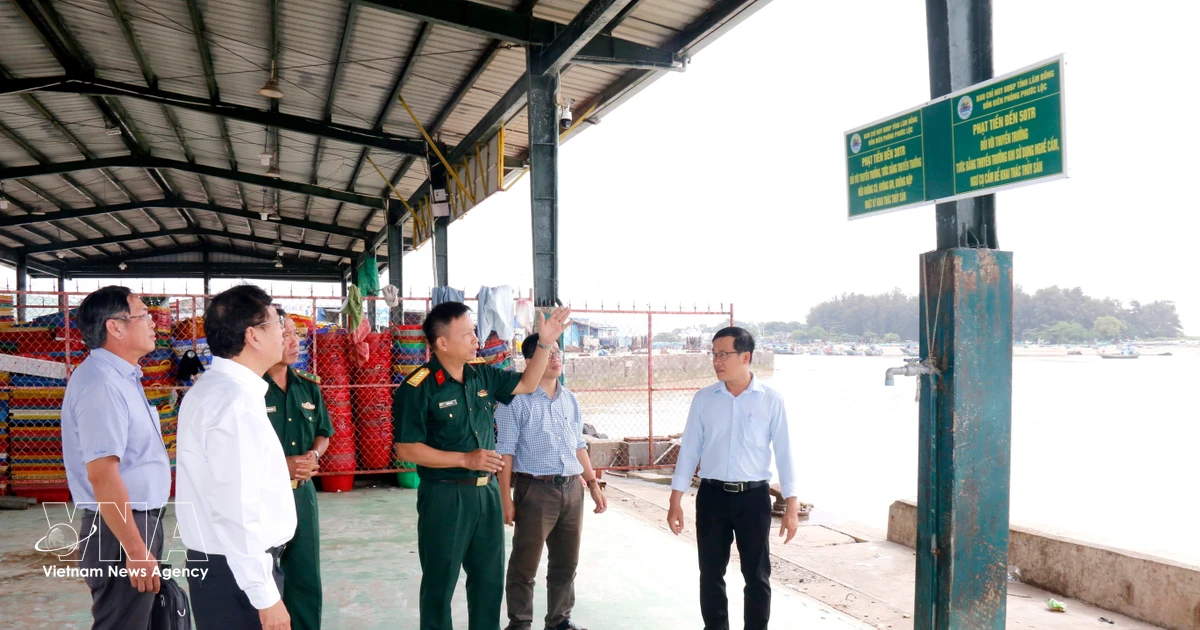
Measures are being implemented to address key gaps, including ineligible fishing vessels, port controls, electronic fishing-trip data, seafood traceability, and vessel monitoring system (VMS) violations. Authorities will also take action against vessels detained by foreign authorities, submit weekly progress reports, and develop specific action plans. The outreach focused on maritime and island laws, particularly regulations on combating IUU fishing. Through dialogues, leaflets, consultations, and question-and-answer sessions, coast guard officers helped fishermen better understand fishing-zone boundaries, requirements for installing vessel monitoring systems, and necessary legal procedures for offshore fishing. Vice Chairman of the My Tho People's Committee Dinh Tu Khoa stated that lists of ineligible vessels are publicly posted at the ward People's Committee office and residential areas. Heads of residential groups are assigned to supervise vessel owners and ensure that fishing gear and equipment are not kept on ineligible vessels. The Ministry of Agriculture and Environment will promote links between cooperatives, enterprises, science and technology organisations and other economic entities along with carrying out programmes to develop concentrated agricultural, forestry and fisheries raw material areas and enhance value chain production. The night-time economy has moved beyond being merely an add-on service to become a new growth driver for tourism. Night-time activities can “awaken” familiar heritage spaces and breathe new life into them. Art, light and music experiences after dark can create distinctive attractions while meeting the desire of middle- and high-end visitors to explore cultural depth. Once fixed fees, payment fees, infrastructure charges and service packages are included, sellers may have to spend around 24.5-27.6% of their revenue on platforms. The figure shows that the era of easy selling and low costs in e-commerce has officially come to an end. The projects mark an important step in completing Phu Quoc’s power transmission network, supporting its socio-economic development and ensuring a safe, stable and reliable power supply for APEC 2027. There is virtually no room for further consumer price index (CPI) increases in the remaining months of the year, and ministries, sectors and localities must focus on effective price management, said Deputy PM Nguyen Van Thang. The projects comprise Tu Lien, Ngoc Hoi, Tran Hung Dao, Thuong Cat, Van Phuc, Hong Ha and Me So bridges. They are among the city’s key transport projects being constructed simultaneously. In response to market changes, many Vietnamese garment and textile companies have proactively shifted their strategies, treating green transition and innovation as integral to business development rather than merely export requirements. Ho Chi Minh City will continue to implement drastic measures to achieve double-digit growth, targeting GRDP growth of at least 11.07% in the third quarter of 2026, 9.43% in the first nine months and 12.3% in the fourth quarter, with a view to completing the full-year goal of 10% or more. The total retail sales of goods and consumer service revenues in August were estimated at 679.8 trillion VND (26 billion USD), up 1.6% from the previous month and 14.9% year-on-year. In the January-August period, the figure reached 5.24 quadrillion VND, representing a 13.3% increase year-on-year. In the first eight months of 2026, the capital city attracted more than 3.7 billion USD in FDI, equivalent to 83% of the plan set for the year. Newly registered FDI exceeded 572 million USD across 450 projects, up 175.78% in project numbers and 209.46% in capital compared to the same period last year. Additional registered capital topped 492 million USD, while capital contributions and share purchases exceeded 2.6 billion USD. Previously regarded as the primary material force of the state sector, with a leading role across a broad range of areas, SOEs are now defined as an important material force, with their activities focused on a number of key and strategic industries and sectors, ensuring a pioneering, enabling and leading role in development. Turning the VIFC into an effective channel for international capital will require clear rules, quality projects and strong connections between investors and domestic businesses. Meeting these requirements will be key to transforming investor interest into concrete capital flows and investment projects in Vietnam. International organisations broadly agree that shifting the growth model from reliance on traditional factors toward technology and innovation is no longer an option for Vietnam, but an imperative of the times. An online agricultural wholesale market aimed at expanding trade links between Vietnamese agricultural producers and buyers in Singapore is expected to become operational by the end of September 2026, offering flexible wholesale purchasing options. With the current trading band of +/- 5%, the ceiling rate applicable for commercial banks during the day is 26,885 VND/USD, and the floor rate 24,325 VND/USD. Resolution No. 258/NQ-CP, dated August 31, 2026, calls for substantive and comprehensive reform, with a focus on maximum cuts and simplification of administrative procedures and business conditions. It also seeks to shift management from pre-licence inspection to post-licence inspection based on risk management, while strengthening real-time, data-driven oversight and putting people and businesses at the centre of public services. A clear, transparent and stable legal framework would not only enable Petrovietnam to play a leading role in new energy development but also strengthen investor confidence, encouraging both domestic and foreign enterprises to invest, transfer technology and cooperate in developing large-scale CCS projects. The stable presence of the Vietnamese agricultural products on the chain’s online shelves therefore demonstrates Vietnamese suppliers’ ability to meet Russia’s stringent requirements on industrial packaging and plant quarantine. Amid intensifying competition, businesses can no longer rely solely on traditional advantages but must venture into higher value-added sectors, invest in technology, enhance governance capacity and develop markets, an expert has said. In the first eight months, Vietnam's durian export revenue was estimated at 1.95 billion USD, of which exports to China alone fetched 1.85 billion USD or 95%. The country is working very hard to earn 4 billion USD from durian exports this year. Source: VietnamPlus English
Original source
VietnamPlus English