Groups to Demand Reversal of Talaingod 13 Conviction on Second Anniversary
A gathering will be held at UP Diliman on July 15 to demand the reversal of the conviction of the 'Talaingod 13,' who were found guilty in 2024. Human rights advocates decry the ruling as a weaponization of justice and a crackdown on those who support vulnerable communities.
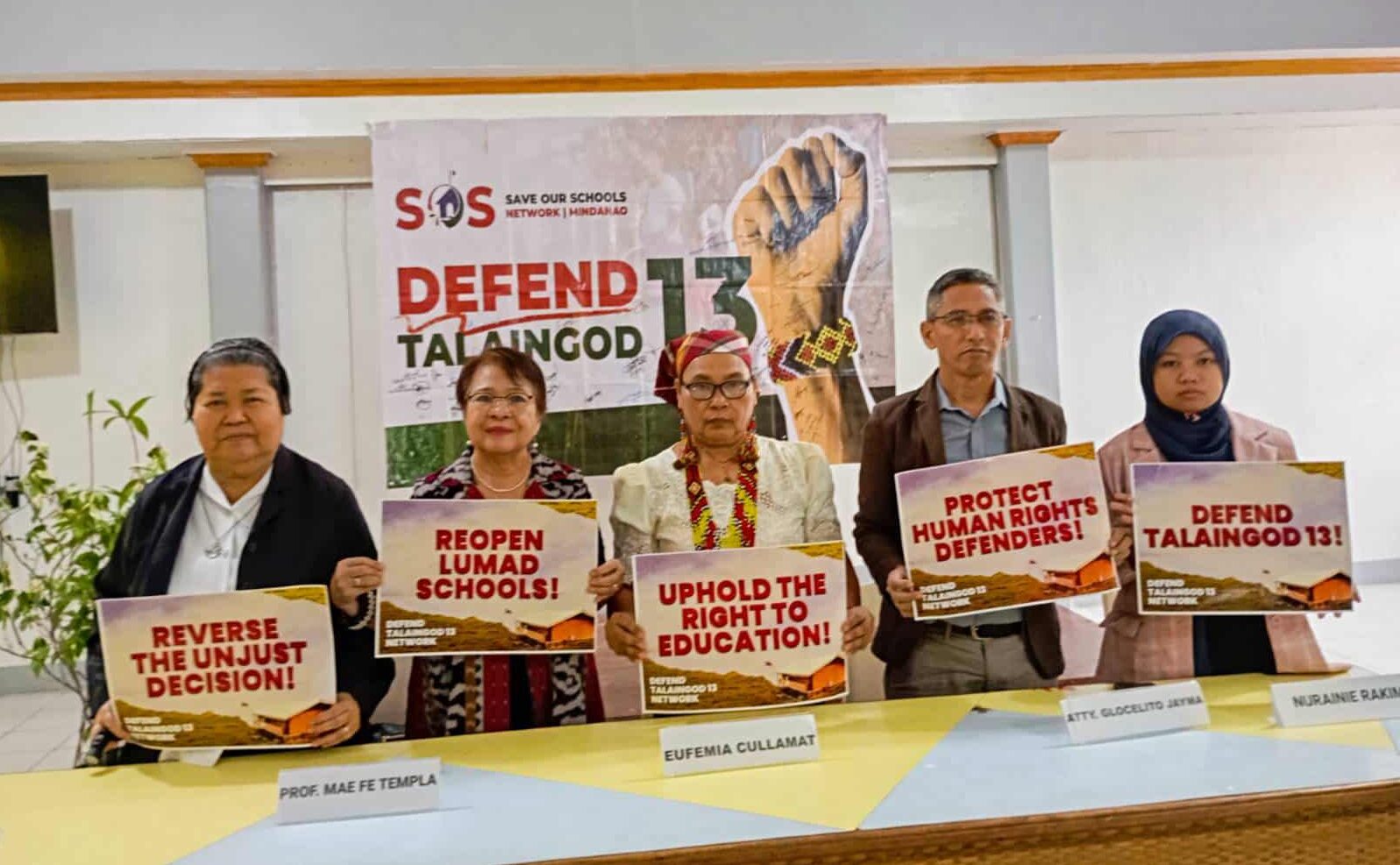
Indigenous advocates and legal professionals, including (from left) Atty. Glocelito Jayma of the Union of Peoples’ Lawyers in Mindanao, Sr. Concepcion Gasang of Save Our Schools Network–Mindanao, former DSWD Undersecretary Mae Fe Templa-Ancheta, Moro youth leader Nurainie Rakim, and former Rep. Eufemia Cullamat, vow to press for the reversal of the Talaingod 13’s conviction. Photo courtesy of Save Our Schools Network. QUEZON CITY — A group of clergy, Indigenous Peoples (IPs), Moro leaders, church workers, educators, and human rights advocates is set to gather at the University of the Philippines (UP) Diliman on Wednesday, July 15, to demand the reversal of the “Talaingod 13” conviction. Marking the second anniversary of the court decision, the “Katungod Conference 2026: Justice for the Talaingod 13 and the State of Mindanao” will be held at the Malcolm Theater of the UP College of Law. The host, the UP Institute of Human Rights-College of Law (UP-IHR), maintains that the 13 individuals did not commit a crime, noting they were part of a humanitarian and solidarity mission intended to protect Lumad children and families displaced by conflict and militarization. The charges, which advocates describe as a Strategic Lawsuit Against Public Participation (SLAPP), were filed during the Duterte administration and culminated in a conviction under the Marcos Jr. administration. READ: Lumad leader defends Talaingod 13: Not a crime to protect children READ: ‘Talaingod 13’ files notice of conviction appeal “This case is not merely a miscarriage of justice against 13 individuals—it is a symbol of how the justice system can be weaponized against those who accompany, organize, educate, and defend vulnerable communities,” Fr. Raymund Ambray, a Catholic priest from the Diocese of Tandag and convenor of the Save Our Schools Network, told the Inquirer. The Talaingod 13 includes former Bayan Muna Rep. Satur Ocampo, former ACT Teachers Rep. France Castro, and Lumad school teachers who were convicted by a Tagum court of child abuse in 2024 for efforts to rescue victims of an alleged forced evacuation after the closure of a Lumad school in Barangay Palma Gil, Talaingod, Davao del Norte, in 2018. During the conference, groups will present the “People’s State of Mindanao” assessment. The report will highlight that the conditions that led to the case, including the closure of more than 200 Lumad schools, alleged development aggression in ancestral domains, and the red-tagging of tribal communities, remain deeply entrenched. “The struggle of the Talaingod 13 is not separate from the struggles of the marginalized peoples of Mindanao. Patrimony should benefit the majority, not the few elitist corporations and oligarchs,” Carlos Zarate, National Union of Peoples’ Lawyers vice president for Mindanao, told the Inquirer on Tuesday. The gathering aims to call on the courts and government institutions to uphold the Indigenous Peoples’ Rights Act of 1997 and end the judicial harassment of humanitarian workers and environmental defenders. “Justice for the Talaingod 13 is inseparable from the struggle for Indigenous Peoples’ rights, Indigenous education, democratic freedoms, and human rights,” Bayang Barrios of the Mindanao Climate Justice Resource Facility Inc. told the Inquirer. /mcm
多角的分析
タラインゴッド13事件は、フィリピンにおける先住民族の土地利用権や経済開発のあり方と深く関連している。ルマッド学校の閉鎖や祖先の土地での開発侵略疑惑は、地域経済への影響や、先住民族コミュニティの経済的自立を妨げる要因となりうる。この事件の背景には、天然資源開発や大規模農業プロジェクトなどが絡み、先住民族の権利と経済的利益との間の緊張関係が存在すると考えられる。
タラインゴッド13事件は、フィリピンにおける投資環境、特に先住民族コミュニティが居住する地域での事業展開におけるリスク要因を示唆している。人権擁護活動家や地域コミュニティとの対立は、プロジェクトの遅延や中止、さらには評判リスクにつながる可能性がある。投資家は、土地利用権、環境規制、地域社会との関係性といった、ESG(環境・社会・ガバナンス)要因を慎重に評価する必要がある。
タラインゴッド13事件は、フィリピン社会における先住民族の権利、教育へのアクセス、そして表現の自由といった根本的な問題に光を当てている。ルマッド学校の閉鎖や、人道支援活動家への「赤化」レッテル貼りは、政府や開発業者による先住民族コミュニティへの圧力の兆候と見なされている。この事件は、社会的に脆弱な立場にある人々が、自らの権利を守るために直面する困難を浮き彫りにし、司法制度の公平性に対する懸念を提起している。
タラインゴッド13事件は、フィリピン国民、特に地方や先住民族コミュニティに住む人々に、土地、資源、そして教育へのアクセスに関する深刻な懸念を抱かせている。ルマッド学校の閉鎖は、子どもたちの教育機会を奪い、将来への不安を増大させる。また、人道支援活動家や擁護者への弾圧は、市民社会の活動に対する萎縮効果をもたらし、政府の政策や開発プロジェクトに対する異議申し立てを困難にする可能性がある。この事件は、司法の公平性や、政府が国民、特に少数派コミュニティの権利をどれだけ尊重するのかという、市民の信頼に関わる問題でもある。
背景・歴史的文脈
タラインゴッド13事件の根源は、フィリピンにおける先住民族の土地権と、開発プロジェクト、特に鉱物資源や大規模農業開発との間の長年の対立にある。1997年の先住民族権利法(IPRA)は、先住民族の土地権を保障するが、その実施はしばしば開発業者や政府の介入によって妨げられてきた。2018年のルマッド学校閉鎖は、紛争や開発による避難民を生み出し、その保護活動が今回の事件につながった。ドゥテルテ政権下で激化した「赤化」キャンペーンは、人権擁護者や社会運動家を標的とし、司法制度がこれらの活動を抑圧するために利用される懸念を高めた。
原文ソース
Inquirer NewsInfo